UK retail sales showed a surprise fall last month, driven by a slump in petrol sales, adding to concerns that economic growth slowed at the start of the year.
The first-quarter GDP numbers will be released on Tuesday, just over a week before the general election.
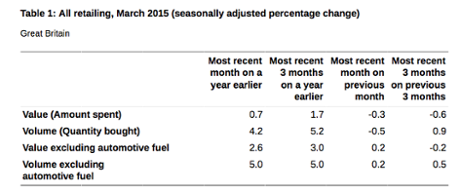
The volume of retail sales dropped 0.5% in March from February, with petrol stations reporting a 6.2% decline, the biggest in almost three years, the Office for National Statistics said. The fall wrongfooted City economists, who had been expecting a 0.4% increase. Excluding fuel, retail sales rose 0.2% – still below City forecasts.
The pound took a hit after the figures were released, falling below $1.50.
Some economists said the surprise reverse in retail sales was further evidence that economic growth was slowing, following weak industrial production and construction data. Alan Clarke, at Scotiabank, said: “It may well be that consumers maxed out before Christmas in a discount fuelled frenzy and the post-Christmas period is experiencing a pause for breath.
“The monthly data all point towards sluggish first-quarter GDP … not the sort of reading that the coalition government will be hoping for. Prior to these numbers my gut feel was 0.5% quarter-on-quarter [for GDP], but I’m now toying with 0.4%.”
Howard Archer, at IHS Global Insight, is predicting 0.5% GDP growth in the first quarter following 0.6% rises in each of the previous two. He said: “Concern that GDP growth could have slowed appreciably in the first quarter of 2015 has been fuelled by disappointing industrial production and (especially) construction output data for February as well as weaker trade data.”
Many economists were sanguine about the March fall in retail sales, noting that it came after a period of very strong sales growth. They believe that shop discounts – along with strong employment growth, high consumer confidence and inflation at zero – will keep households spending in coming months.
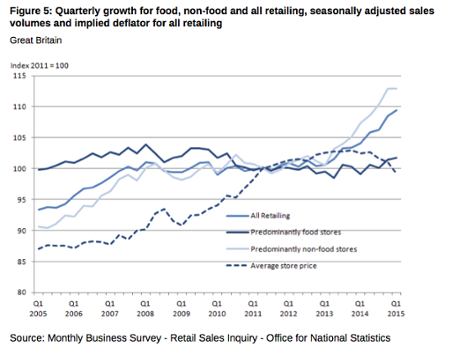
The ONS figures showed retail sales climbed 0.9% in the three months to March, marking the longest period of continued growth since November 2007.
JP Morgan economist Allan Monks said: “Heavy discounting in the retail sector is helping to underpin real spending gains, with scope for further increases to come.”
Philip Shaw, chief economist at Investec, agreed. “The latest figures seem to represent a modest break from the relentless surge in sales since last autumn and are not likely to represent a turning point ... Our suspicion is that household spending will probably play a more significant role in economic growth further ahead than in the earlier phases of the recovery, although this again might be subject to political developments after 7 May.”
The ONS said March was the first month since June 2014 in which the value of retail sales rose more than the volume, implying an increase in prices, although retail prices are still down significantly on the same month a year ago.