A warning over a steep rise in prisoner suicides formed the heart of a critical report from the chief inspector of prisons on Tuesday as he said that jails were gripped by rising violence, worsening safety and overcrowding.
Nick Hardwick, giving his annual report, said the rate of self inflicted deaths was at its highest for a decade amongst inmates in England and Wales and had risen by 69% during 2013-14.
The chief inspector described the number of suicides as “the most unacceptable feature” of a prison system facing a “rapid deterioration” in safety.
“It is important that the bald statistics do not disguise the dreadful nature of each incident and the distress caused to the prisoner’s family, other prisoners and staff,” he said. “It is a terrible toll.”
The findings follow a Guardian investigation into the rise in suicides which for the first time identified all 134 who died from January 2013 to 2 October 2014, an average of more than six a month. The investigation exposed repeated failings which were contributory factors in the deaths and told the stories of some of those who died.
Lynda and Jeff Davison, whose son Steven suffered serious mental health problems and killed himself at HMP Glen Parva in September 2013 after being locked up “for his own safety”, called on ministers to take action. “I think the government need to address this urgently – it has gone too far. Our family is still experiencing the ‘terrible toll’ this report talks about. We don’t want other families going through what we are.”
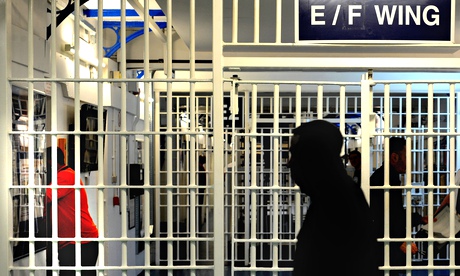
Hardwick’s report painted a graphic picture of life inside prison, where violence between men is at its highest recorded rate, bullying is rife and legal highs are widely available.
“At its worst, overcrowding meant two prisoners sharing a six foot by 10 foot cell designed for one, with bunks along one wall, a table and chair for one, some shelves, a small TV, an unscreened toilet at the foot of the bunks, little ventilation and a sheet as a makeshift curtain.
“A few prisoners might spend 23 hours a day in such a cell. Twenty hours was relatively common in a local prison. Prisoners would eat most of their meals in their cell. The food budget was reduced from £2.20 per prisoner per day in 2012 to £1.96 a day in 2013.”
Hardwick said a shortage of experienced staff and resources combined with a growing prison population – from 84,083 in April 2013 to 85,252 in March 2014 – was also contributing to the rise in self-inflicted deaths. “Increases in self-inflicted deaths, self-harm and violence cannot be attributed to a single cause,” he said. “They reflect some deep-seated trends and affect prisons in both the public and private sector.
“Nevertheless, in my view, it is impossible to avoid the conclusion that the conjunction of resource, population and policy pressures … was a very significant factor for the rapid deterioration in safety.”Asked whether the service had been fortunate to avoid riots, Hardwick said: “Managers nationally and locally have been very effective at spinning a lot of plates ... One of the reasons why things have not been as bad as we might expect has been down to the work on the ground.” The prison system was running at 99% operating capacity, he added.
Responding, the Ministry of Justice said it was not the case that staffing cuts or overcrowding were responsible for the rise in suicides. “There is no evidence to link staffing levels, or crowding levels, to the number of self-inflicted deaths across the estate. We always closely monitor any possible trends,” said a spokesperson.
Andrew Selous, the prisons minister, added that past year had “seen the prison service manage major organisational change” to save the taxpayer money.
He said ministers were committed to reducing violence and understanding the reasons for the recent rise in self-inflicted deaths. “But this is a complex issue and the chief inspector has failed to provide any evidence to support his assertion that this is linked to the reforms made under this government.”
Deborah Coles from Inquest, which works with families of those have died in custody, said: “This is a national scandal presided over by a justice secretary and ministers refusing to accept their responsibility.”