
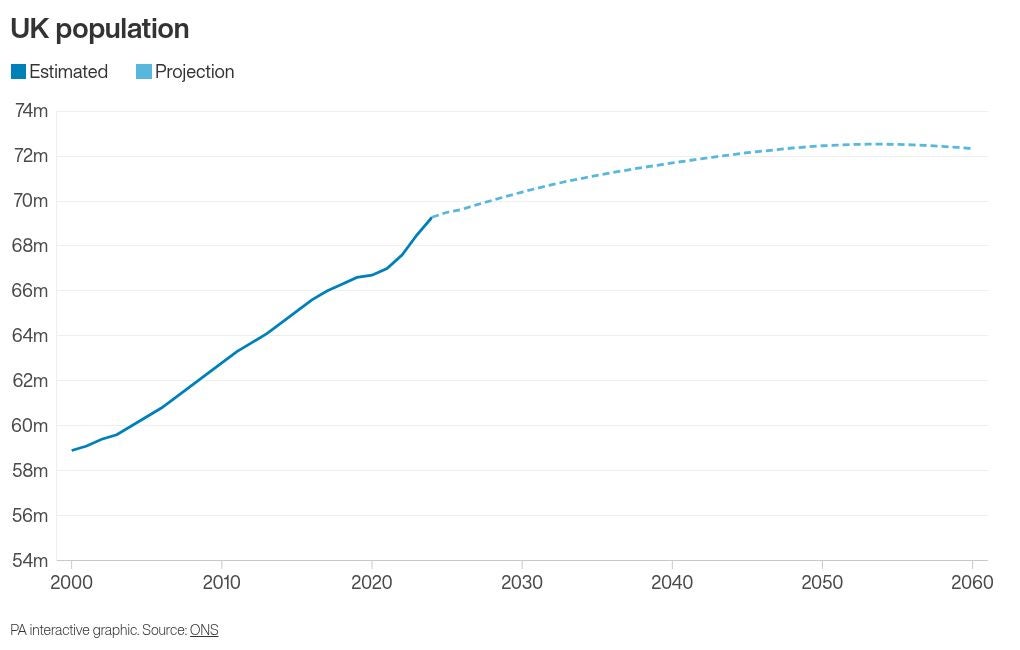
The UK population is now projected to grow at a significantly slower pace over the coming decades, with a decline expected from the mid-2050s, primarily driven by reduced migration and lower fertility rates, according to new figures.
This marks a notable revision from previous estimates, which had anticipated sustained growth for much longer.
The Office for National Statistics (ONS) forecasts an increase of 1.7 million people between 2024 and 2034, pushing the total population from 69.3 million to 71.0 million – a 2.5 per cent rise.
This is considerably less than the 3.0 million increase projected last year, which would have seen the population reach 72.2 million by 2034, representing a 4.3 per cent jump.
The downward adjustment reflects a recent sharp fall in net migration, alongside revised assumptions for future fertility rates.
James Robards, ONS head of household and population projections, stated: "Our latest projections indicate slower population growth than previously projected. This is mainly due to lower migration assumptions – reflective of the recent steep fall in net migration – and lower fertility assumptions. At the UK level, the population is projected to peak in the 2050s before decreasing."
Population growth is expected to decelerate further through the 2030s and 2040s, peaking at 72.5 million in 2054 before entering a period of decline.
Previous projections had suggested continuous growth until 2096. Net migration is anticipated to be the sole driver of population increase in the coming decades, as natural change is set to turn negative, with deaths outnumbering births annually from 2026 onwards.
The ONS data indicates that net migration to the UK stood at an estimated 204,000 in the year to June 2025, a 69 per cent reduction from 649,000 in the preceding 12 months. Over the decade to 2034, net migration is projected to add 2.2 million people, while a deficit of 450,000 from natural change will result in the overall 1.7 million growth.
Population peaks are expected to vary across the UK’s four nations. England is projected to reach its peak of 62.1 million people in 2056. However, peaks are anticipated much sooner elsewhere: Wales in 2035 (3.2 million), Scotland in 2033 (5.6 million), and Northern Ireland in 2031 (1.9 million).
These figures also highlight an ongoing shift in the UK’s age structure. The number of people of pensionable age is set to rise from 12.4 million to 14.2 million by 2034, at which point they will constitute one in five (20.0 per cent) of the total population.
Conversely, children under 16 will form a smaller proportion, decreasing from 12.6 million (18.2 per cent) to 11.0 million (15.5 per cent). By the projected peak in 2054, pensioners will account for 22.0 per cent of the total, while under-16s will make up 14.5 per cent.
Beyond 2054, the population is projected to fall from its peak of 72.5 million to 72.1 million by 2064, and further to 71.4 million by 2074. The ONS stresses that these projections are based on current and past trends and are not forecasts or predictions of future events.
UK population projected to grow at slower rate before falling in mid-2050s
High visibility operation launched to combat dissident threat, police say
RAF Poseidon plane boosts Northern Ireland search and rescue capabilities
Starmer’s ‘due process’ claim over Mandelson job not backed by ex-official
King Charles US visit live: Monarch under pressure from Epstein victims before speech
UK schools in ‘desperate situation’ as headteachers report mould and asbestos