Not since the second world war has the affinity between Britain and France been more obvious than in the coverage of the Paris attacks in Monday’s UK national press.
The London-based newspapers reflected both the nation’s sympathy for the French and its horror at the premeditated massacre of citizens by terrorists. The totality of the coverage symbolised a genuine sense of cross-Channel solidarity.
Consider first the sheer scale: most papers devoted more than a dozen pages to the story, plus leading articles, columns, commentaries and many readers’ letters. The Daily Mail stood out by carrying 23 pages. The Sun ran a full-page editorial.
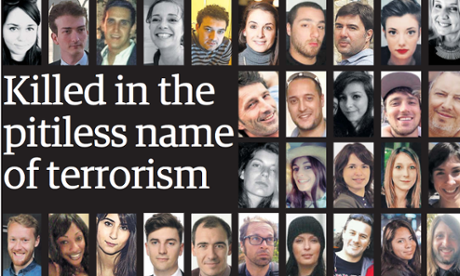
The Guardian’s front page, with its thumbnail pictures of victims, utilised a tabloid technique to convey the magnitude of the human tragedy.
Every paper expressed outrage in editorials that, having asked what should be done, provided a range of answers, notably action on European borders and on confronting Isis more efficiently in Syria and Iraq.
“The sheer extent of the carnage can overwhelm and numb the sensibilities,” said the Times in a leading article headlined Nous sommes tous Français.
“Theocratic fanatics who commit such acts... do not have negotiable demands,” it said before highlighting what it called “two serious tactical mistakes” in the face of “murderous nihilism.”
It accused the US administration of a “fitful” response to the rise of Isis and bewailed “prolonged inaction against President Assad in Syria.” As for Britain, it “imprudently” voted in 2013 against airstrikes on Isis in Syria.
The Times urged the continuance of airstrikes and called for special forces “to be embedded in the Iraqi security forces, with the Kurds and with the Free Syrian Army when they go into battle.”
Meanwhile, said the Times, “the proper and valiant ally of the US and Britain is not Russia but France, which has valiantly countered Islamic State in Syria as well as Iraq.” And it concluded: “In the broadest as well as the literal sense, France’s allies must stand and declare: Aux armes, citoyens.”
For the Telegraph, the major concern is “the borderless Schengen area in Europe” which has allowed “brutalised” men to infiltrate refugees from Syria.
The rise of militant Islamism, it said, has “made the idealism which underpinned Schengen look particularly naïve... after Paris, who is still arguing for free movement within Europe?”
The Telegraph thought it necessary “to strengthen the external frontier of the EU” but the major aim should be to defeat “the death cult” that is Isis.
“There is no appetite, even after Paris, for another major military incursion into the Middle East by countries seared by the experience in Iraq,” said the paper. “Yet only by being confronted on the ground can Isil be beaten, as the Kurds and the Russians have shown.”
The Financial Times argued that it was “time for engagement, not fearful retreat” in order to confront “civilisation’s worst nightmare”: terrorists “intent on killing ideals as well as individuals.. targeting the values of open societies, of individual liberties and collective rights.” It said:
“The immediate reaction of the civilised world must be: collective courage in the face of such outrage; heightened vigilance and intelligence sharing; a targeted military response; and international solidarity with the French people.”
But the FT argued against “populist politicians offering simplistic — and often counter-productive — solutions”. Instead “tighter border controls, albeit short of formally suspending the Schengen agreement providing for free movement, should be on the table.”
As for Isis, the paper contended that it was time to “discuss co-ordinated action to destroy this totalitarian menace on the ground” and push for a political transition that attempts to distinguish between the interests of the Syrian state and those of the Assad regime.”
Beware falling into Isis’s trap, said the Guardian. Even if the terrorists did mean their slaughter to be a declaration of war, “to declare war against Isis is to flatter it, to grant it the dignity it craves. It accords it the status of a state, which Isis claims for itself but does not deserve.”
It counselled against the “natural and human” call “to seal the borders, to halt the tide of refugees”:
“If we feel European values are in danger, then the last way to defend those values is by dismantling them. The moral case for Europe to remain a place of refuge is unaltered by what happened on Friday.
The allegation that one of the killers came to Europe disguised as a refugee is deeply suspect, the supposed evidence of a found Syrian passport highly questionable. Many of those who fled Syria did so to escape Isis. If anything, those refugees have the potential to be a great asset in the fight against that murderous group.”
As with other papers, the Guardian believed “the defeat of Isis in Syria... is a necessary step” that will “entail military action”. But “the core of the answer must be diplomatic.”
The Independent also thought “the horror in Paris should spur a fresh united assault” against Isis:
“If Paris’s 129 dead spur the diplomats at Vienna’s conference on the Syrian civil war into bringing Isis’s enemies together in a coordinated response, their deaths will not have been vain.”
But the newspaper believed that Isis’s rise is the result of mistakes going back to the Iraq invasion in 2003. So “it’s our fault, in the same way that the Versailles conference was the fault of the first world war allies. But recognising the inequities of Versailles did not make the Nazis any less of a mortal threat.”
The Indy argued that Europe must get its act together on migrant flows by finding “the political will to defend its external borders from the easy and continuous predations of the people traffickers.”
The Mail, convinced that some of “the nihilistic butchers of Islamic State” posed as refugees from Syria, demanded that “uncontrolled migration from the Middle East must be stopped and border controls within Europe imposed immediately.” It said:
“German Chancellor Angela Merkel’s reckless open-door invitation must be reversed and proper checks made on who is coming in. And crucially, Brussels must work harder with Turkey to restrict the waves of migrants flooding into Europe.”
The Sun, in a lengthy editorial saying “we must get real”, warned that “if the slaughter in Paris is not to be repeated here... action has to be taken now by our politicians... and the nation needs to get behind them as we did when we repelled the Nazis.”
Conceding that “there’s no easy solution”, the paper lamented parliament’s vote against military action in Syria and President Obama’s “incredible complacency” and “catastrophic failure to lead the western world.” So what should happen? The Sun said:
“We believe noses must be held and a deal struck with Russia’s Vladimir Putin for a multinational force of ground troops and aircraft to eradicate IS in Syria and Iraq...
Doubtless Jeremy Corbyn’s Labour will try to block our involvement... Yet perhaps the murder of 129-plus innocent people will inspire sensible Labour MPs to vote for action, as well as Tories previously opposed to it.
Next, Britain must win back full and permanent control of our borders. The EU ‘freedom of movement’ principle is already in tatters...
Our prime minister no longer has any excuse not to insist on us controlling, in perpetuity, who comes in and goes out. If he doesn’t, we can see Britain voting to leave the EU.”
Finally, said the Sun, the Muslim community in Britain “must rise up against it [Isis]... moderate Muslims and the politically correct left must condemn more and excuse less.”
Daily Express, which said it had “consistently warned Europe that its lack of border controls was asking for trouble” accused Labour politicians, archbishops and “showbusiness luvvies” of being “utterly and hopelessly wrong all along.”
The Daily Mirror, despite running a front page story stating that British intelligence agencies will hire 2,000 more spies in order to avoid a Paris-style attack by Isis, attacked David Cameron in its editorial.
It asked: “Why has the prime minister waited so long when he was repeatedly warned Islamists posed a deadly threat?”
The paper went on to accuse the government of stupidity in cutting the numbers of police and concluded: “Hiring spooks while shedding far more police officers will fool nobody, including jihadists. The PM must stop the high-risk cuts now.”
It is fair to say that this left-field (or should that be right-field?) reaction by the Mirror was somewhat surprising. In a sense, it was indicative of the wider confusion symbolised by a press raging against the nation’s inability to deal effectively with terrorists willing to sacrifice themselves in pursuit of their “cause.”