The UK will seek an even deeper partnership with the EU because of the instability wreaked by Donald Trump’s war with Iran, Keir Starmer has said, adding that the moment called for a more ambitious deal with Brussels to strengthen trade and defence.
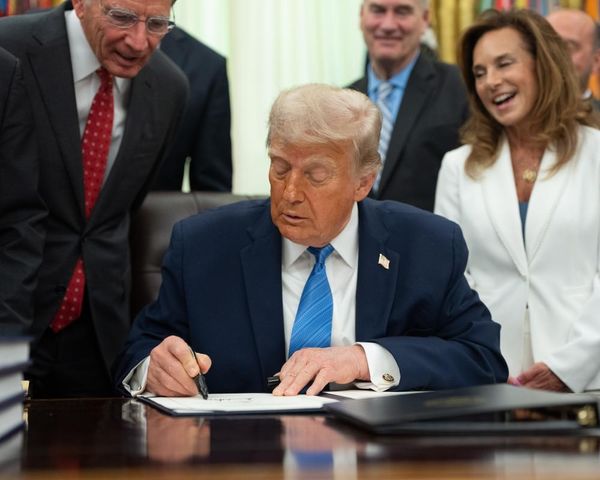
His comments came as the US president again said he was considering pulling the US out of Nato, which he described as a “paper tiger”. Trump has frequently lambasted the UK and European nations for failing to support the US-Israeli strikes on Iran, and criticised their militaries.
In another barb at the prime minister, Trump told the Daily Telegraph he believed King Charles would have backed his strikes on Iran. The king is scheduled to visit the US later this month, and will address Congress on 28 April.
At a press conference on Wednesday, Starmer said renewing closer relations with Europe would mean a “partnership for a dangerous world we must navigate together” – his strongest signal yet that he intends to reorient towards Europe and away from the US.
He said Brexit had done “deep damage” to the UK economy and he would seize the opportunity to repair that harm at a new summit in early summer, saying Britain’s long-term national interest required a closer relationship.
“The opportunities to strengthen our security and cut the cost of living are simply too big to ignore,” the prime minister said. No date has yet been named for the summit but Starmer said he wanted explicitly to explore closer ties beyond what was agreed at the Lancaster House summit last May.
“We want to be more ambitious. Closer economic cooperation, closer security cooperation, a partnership that recognises our shared values, our shared interest and our shared future. A partnership for the dangerous world that we must navigate together.”
Starmer said he would not be put under pressure by Trump’s Nato comments, and that he wanted to reassure British people that they would not get “dragged in” to the wider conflict..
“Whatever the pressure on me and others, whatever the noise, I’m going to act in the British national interest in the decisions that I make,” he said.
Starmer said Britain should strengthen cooperation with the EU on defence, security, energy and the economy. “I’m ambitious that we could do more in relation to the single market, because I think that’s hugely in our economic interests,” he said.
“Obviously, this is a matter of negotiation and discussion with the EU but the summit we have this year will not be just a stocktake summit. It will be a deliberate ambition on our part to go further than that and to cooperate more deeply, including in the economic sphere.”
The summit is expected to take place in Brussels in June or July, though talks have stalled on areas that the UK had already agreed in principle with Brussels last year.
The EU’s insistence that its citizens get home fees if they attend university in the UK has meant talks on youth mobility are at a standstill, and there have been clashes over a brake clause or cap on numbers for the visa. A sanitary and phytosanitary (SPS) deal agreed last May has also made slow progress, though there is a hoped-for announcement to come on emissions trading.
One option would be for the UK to pursue something akin to what Switzerland agreed with the EU in early March: a dynamic alignment framework for major sectors including food, energy, health and science.
“We want to remove the Tory Brexit barriers that killed growth and hiked prices, replacing the paperwork tax at the border and their ideological fantasy with commonsense economic reality that benefits the continent’s economic resilience,” a government source said.
“We won’t let the dogmatic approach favoured by Kemi Badenoch or Nigel Farage ignore the benefits of a pragmatic, ambitious partnership with Europe.”
The Cabinet Office has been looking at what more could be done with sectoral regulatory alignment, which could reboot exports for both sides in everything from medical devices to chemicals.
Some areas, such as financial services, were off the table, but sources said there were more areas where British businesses were, in practice, already closely aligned and where a formal agreement would cause minimal disruption and boost economic growth. “Everything is up for contention and we are taking a look at the entire playing field,” the government source said.
It is defence where ministers are the most keen to have deeper discussions for the longer term. Specifically about how to bolster collective European defence in a continent where just one nation, France, has an independent nuclear deterrent and the UK’s own nuclear capabilities are deeply dependent on the US.
The European Union defence commissioner, Andrius Kubilius, said in January the bloc should consider establishing a standing military force of 100,000 troops and a European security council which would include the UK. A Cabinet Office source said any discussions on this were limited because there were no defined programmes in play that the UK could seek to join in the short term.
While some EU states are frustrated with the British government’s use of rhetorical language, which is seen as lacking specifics, the speech was well received by some. A diplomat at one EU embassy said: “This is the second speech after Rachel Reeves’s a few days ago with very positive tones when it comes to economic cooperation.”
The same source said the failure to progress UK involvement in the Safe European defence initiative was regrettable, adding: “When it comes to the economy, we are open to something ambitious.”
However, Anand Menon, of Britain in a Changing Europe, said that beyond the ongoing talks, there was a problem over what substantive agreements could be achieved at the end of the “reset agenda”.
“Starmer wasn’t just talking about the EU,” Menon said. “He was referring to Europe, so there is some leeway for closer cooperation on defence. But on the EU side more generally, there is a degree of frustration that the UK government keeps saying they want a closer relationship, without spelling out specifics and what might be acceptable to the EU.”
Starmer’s speech was criticised by the Conservatives and Reform UK, though the Conservatives stopped short of criticising Starmer’s ambitions to forge a closer European deal.