Britain must be prepared for the Ebola outbreak to worsen, the health secretary, Jeremy Hunt, has said as he prepares to outline the next steps he intends to take to prevent an outbreak in the UK.
Hunt said he would give the latest estimate of the number of cases likely to emerge in the UK in the next three months, when he made a statement in the Commons later on Monday.
He told BBC Radio 4’s Today programme: “It is a question of being prepared; at present the number of [global] cases is doubling every three to four weeks. At present the numbers are very low, but we have to be prepared for it getting a lot worse.”
Hunt praised the 650 NHS staff who had “volunteered to put themselves in harm’s way to go out to west Africa – one of the most dangerous places in the world healthwise”.
He said the advice from Public Health England was that the risk of Ebola to people living in the UK remained low.
“I think there are a lot of misunderstandings and that’s why it’s very important that we get the right training in place and put in place the right procedures.”
He said the main purpose of passenger screening at airports was to identify people who were at higher risk of carrying the disease. “Because the virus incubates for 21 days we need to make sure that anyone that is higher risk – we know their contact details, we are able to stay in touch with them, monitor their temperature on a daily basis so that if they do develop the symptoms we can get to them quickly.
“You pick up on those people by making sure that you have proper interviews of people who may be higher risk when they arrive in the UK so that you have those details.”
Hunt said he hoped doctors worried about being exposed to Ebola would be reassured by measures he would announce on Monday.
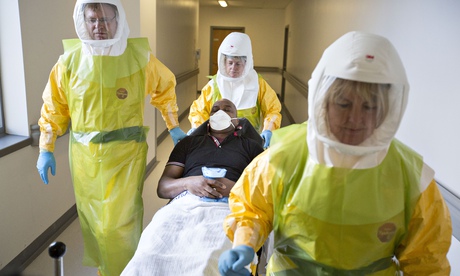
“This is not an airborne virus, you need an exchange of bodily fluids to catch it. But we need to make sure that everyone gets the training, everyone is reassured about what they need to do to stay safe.”
As part of the country’s strategy to deal with the virus, calls to the NHS’s non-emergency 111 phoneline were to be screened for possible Ebola sufferers.
Call handlers on the service would question anyone ringing up with possible symptoms of the disease about their recent travel history, to see if they had been to west Africa, where the death toll has passed 4,000 people, Hunt announced on Sunday.
The news came as the US announced its second case of the disease, in a Texas hospital worker who was in contact with Thomas Eric Duncan, who died from the virus on Wednesday.
Hunt said the UK had “robust and well-tested systems” for dealing with Ebola cases entering the country. “However, we keep the need for further measures under review and will never be complacent – and so I asked for additional steps to be taken by NHS 111.
“Now all call handlers on the NHS 111 service are asking anyone reporting potential symptoms of Ebola, such as respiratory problems, high temperatures, or diarrhoea and vomiting, about their recent travel history, so appropriate help can be given to people who might be at higher risk of having come into contact with the virus.
“If the person with symptoms has recently been to west Africa and is at high risk of having been in contact with Ebola, 111 will immediately refer them to local emergency services for assessment by ambulance personnel with appropriate protective equipment.”
The UK’s chief medical officer, Sally Davies, said the country should expect a handful of Ebola cases in the coming months and that a major exercise to test the country’s readiness for such cases proved plans were robust.
Enhanced screening for the virus at major airports and terminals are part of the government’s contingency plan against Ebola.