While Andrew Parker, the head of MI5, warns that the threat to Britain from terrorists is unprecedented, government ministers describe Jeremy Corbyn’s Labour party a threat to national security, and an army general threatens a mutiny.
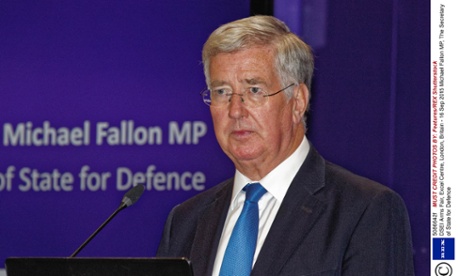
Parker expressed his concerns in an exclusive interview with the BBC last week. On Tuesday, Michael Fallon, the defence secretary, said: “Labour is a risk to national security rather than Mr Corbyn himself ”.
He made his comment to a questioner after addressing the RUSI thinktank in London. The previous day, referring to Sir Nicholas Houghton, chief of the defence staff, Fallon had insisted: “We are absolutely clear that senior members of the military must of course always remain politically neutral.”
The put-down was in response to a Sunday Times report that a senior serving general warned of direct action in the event of Corbyn becoming prime minister.
“There would be mass resignations at all levels and you would face the very real prospect of an event which would effectively be mutiny”, the general was quoted as saying.
Playing party politics with security is a dangerous game. It trivialises and distorts what should be the most serious issue confronting governments and the public.
Moreover, the Tories, Labour - and Liberal Democrat - parties are all split on most important items on the national security agenda: MI5 and GCHQ powers to intercept and store personal communications; bombing Syria; Trident; and EU membership.
In a blistering critique of the government’s policy towards Syria, Richard Barrett, a former senior MI6 officer, chastised it for appearing more interested in symbolism than substance. “Set against the much larger US effort to counter Isis”, he wrote in the Financial Times, “a few manned and unmanned RAF aircraft are neither here nor there. To the rest of the world, the British contribution has more to do with domestic politics and the transatlantic alliance than effective counter terrorism”.
British ministers and officials are indoctrinated in the belief that the US is a vital ally which must never be upset. Fallon emphasised on Tuesday how much the US wanted Britain to keep Trident.
Commenting before last year’s referendum on the prospect of an independent Scotland getting rid of Britain’s Trident base at Faslane, senior British military officials said (anonymously) their main concern was the reaction of the US.
Yet despite the convention that military chiefs should avoid political controversy, the first sea lord, Admiral Sir George Zambellas, has had a free run to state publicly how much Trident is vital to Britain’s security.
Interestingly, in his RUSI speech, Fallon referred more tha once to the EU and Britain’s leading role in the organisation. A clue, presumably, on what line he will be taking in the forthcoming EU referendum.


.png?w=600)