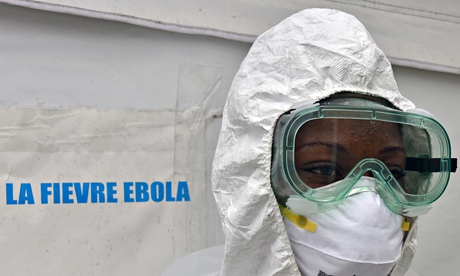
British military experts were asked to draw up guidance at the height of the Ebola outbreak in West Africa late last year on the feasibility and potential impact of terrorists ‘weaponising’ the virus.
The Ministry of Defence has released a heavily redacted report, prepared in October, that identified three different scenarios regarding the exploitation of Ebola for bioterrorism.
Details of the first scenario are entirely blacked out, as are most of those of the second, which is described as “logistically and technically challenging for a non-state group to undertake”.
It adds: “Clearly there are practical issues involved with such a scenario that of themselves are often not insurmountable but taken together add to the complexity of successfully undertaking this attack.”
The third scenario – details of which were also heavily redacted – was described as the “most technically challenging”.
The advice was drawn up by the MoD’s defence science and technology laboratory (DSTL) in early October at a time when concern was increasing about the spread of Ebola in West Africa and plans were being put in place to carry out testing of travellers at UK airports.
It’s not clear who sought the guidance – and whether it was senior civil servant or a minister – but the report states that it was sought following a phone conversation on “the feasibility of a non-state actor (NSA) exploiting the Ebola outbreak in West Africa for bioterrorism”.
The document was released by the MOD on Friday following a Freedom of Information request. The MOD cited a number of exemptions which allowed for the information to be redacted, including on the grounds that disclosure would prejudice the capability and effectiveness of the armed forces and public safety.
Jennifer Cole, a senior research fellow at the Royal United Services Institute for Defence and Security Studies (RUSI), said she wasn’t surprised the report had been drawn up. “The US and UK military have been carrying out research for some time into infectious diseases,” she said. “The fact that vaccines are so far along in development is because of concerns that the US has had about the virus being weaponised.”