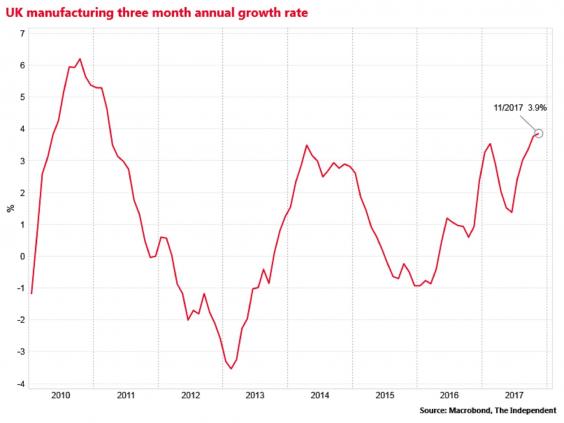
Manufacturing continued to perform strongly in November, signalling that the sector will make a decent contribution to overall UK growth in the final quarter of 2017.
The Office for National Statistics reported that manufacturing output grew by 0.4 per cent in the month and October’s growth was also revised up from 0.1 per cent to 0.3 per cent.
The annual rate of expansion for the sector, which accounts for 10 per cent of the economy. in the three months to November was 3.9 per cent, the most rapid since March 2011.
The ONS said that there were “notable increases” from renewable energy manufacturing projects, boats, planes and cars for export over the period.
Manufacturing has been boosted by a weaker pound since the Brexit vote in 2016, which has boosted exports, and also by an upturn in the global economy.
Strongest since March 2011
However, the latest trade figures from the ONS, also released on Wednesday, were less encouraging.
Goods export values rose 1 per cent in the month, while imports were up 2.1 per cent, pushing the overall goods trade deficit to £12.2bn for November, ahead of City expectations of a £10.7bn gap.
Including the services surplus, the overall trade gap was £2.8bn, up from £2.3bn in October.
“Net trade likely subtracted 0.3 percentage points from quarter-on-quarter GDP growth in Q4 having had a neutral effect in the first three quarters of 2017 provided that the level of goods exports and imports held steady in December,” said Samuel Tombs of Pantheon.
The ONS also estimated that the construction sector, which accounts for around 6 per cent of GDP, eked out 0.4 per cent growth in November, following a 1.1 per cent drop in October.
Overall UK GDP is estimated to have expanded by 0.4 per cent in the third quarter, over which period manufacturing grew by 1.3 per cent.
The National Institute of Economic and Social Research (NIESR) forecast on Wednesday that the UK economic growth rate would pick up to 0.6 per cent in the final quarter of 2017, taking total GDP growth for the calendar year to 1.8 per cent.
However, this would still be the weakest UK annual growth performance since 2012, at a time when global economy growth is rising.
And the average independent forecast for UK GDP growth in 2018 is also for a further slowdown to 1.5 per cent.
Separately, Niesr predicted that the Bank of England would raise interest rates again in May 2018, in order to dampen inflationary pressures, and then tighten monetary policy further every six months until rates plateau at 2 per cent in mid 2021.