Markets on both sides of the Atlantic have bounced back as Federal Reserve policymakers prepared to raise US interest rates for the first time since 2006.
Oil prices and shares jumped on Tuesday, making up some of the ground lost in recent days, as investors tried to judge the likely impact of higher borrowing costs.
In London, the FTSE 100 index of leading shares finished 143.73 points or 2.45% higher at 6017.79, while French and German stock markets were both up by more than 3%.
Oil prices rose with a barrel of Brent crude reaching $38.47 (£25.56) by mid-morning in New York, up 1.4%.
Global oil markets have been extremely volatile in recent days, with the Opec oil-producers’ cartel in disarray and plunging trade volumes underlining fears of a continued weakness in demand. Analysts at Goldman Sachs have even predicted that the oil price could slump to $20.
Janet Yellen, the chair of the Federal Reserve, has clearly signalled that the US central bank is preparing to “normalise” policy, at its final meeting before the end of the year, and analysts said the latest inflation data, published on Tuesday, which was in line with expectations at 0%, removed any final obstacles to a hike.
But when the two-day meeting ends on Wednesday, Fed-watchers will study the details of its announcement closely for clues as to whether any increase is a one-off, or the first of many.
If Yellen and her colleagues emphasise the risks that still remain in the US economy, it will be viewed as a “dovish hike”, suggesting policymakers are more worried about growth than inflation, and reassuring markets that have become dependent on central bank support.
Melanie Debono, of consultancy Capital Economics, said: “Any negative reaction should be tempered by the statement accompanying the decision, which is likely to signal that the Fed expects future rate rises to be gradual and the end-point still low by past standards.”
As investors braced themselves for higher rates in the US, news that UK inflation had nudged back above zero – though only just – underlined the fact that the Bank of England is unlikely to be in a rush to follow the Fed’s lead.
Mark Carney, the governor of the Bank of England, told the Financial Times on Tuesday that one of the conditions for considering raising UK rates for the first time since the depths of the financial crisis was increasing costs. But Britain had experienced overall growth without rising prices, he said.
He added a speech in the summer suggesting the decision about when to increase rates would “come into sharper relief around the turn of this year” had not been a promise that rates would rise.
Meanwhile Jon Cunliffe, the Bank’s deputy governor, told the Yorkshire Post that an increase in US rates would be a sign of resilience in the world economy but insisted that the Bank would remain focused on the health of the domestic economy.
“When the Fed are able to raise, and I don’t know if they’ll do it at their meeting … when they are able to raise that’s a good sign because it means there’s strength in the US economy. We need strength in the world economy but our decision is pretty much based on what happens here.”
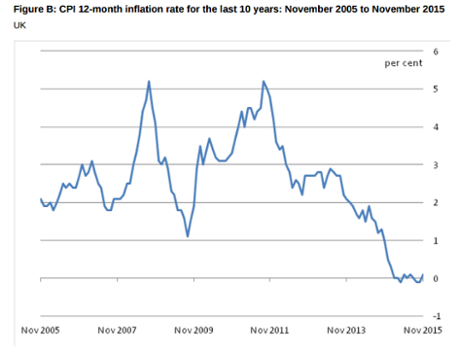
The Office for National Statistics (ONS) said that inflation was 0.1% in November, as measured on the Consumer Prices Index (CPI), up from -0.1% in October.
Plunging global commodity prices have meant that inflation has been unusually weak in historic terms through much of 2015, and despite November’s 0.1% increase, the CPI shows that the price level across the economy stood barely higher than at the end of last year.
The ONS said that smaller falls in transport costs, including petrol, than for the same month in 2014 had contributed to making inflation positive.
Clothing and footwear prices fell, partly offsetting the upward pressure from transport costs and other items such as wine and spirits.
Measured on the retail prices index (RPI), which is still used to set some train ticket prices and pension payments, and is calculated to include housing costs, inflation appeared stronger, at 1.1%.
Analysts warned that with global oil prices falling sharply in recent weeks, inflation is likely to remain well below the Bank of England’s 2% target in the coming months.
Chris Williamson, of financial data provider Markit, said: “This is clearly good news for consumers in two respects: low prices boost spending power and the dovish outlook for inflation takes pressure off the Bank of England from hiking interest rates any time soon.”
Just one of the nine members of the Bank’s rate-setting monetary policy committee, Ian McCafferty, has backed an immediate rate rise in recent months; but others, including US economist Kristin Forbes, have warned that the strong labour market could start to push up wage costs.
As markets have geared up for the Fed decision, the spotlight has increasingly shone on emerging economies, which have come under pressure from the strengthening of the dollar which has accompanied the anticipated shift in policy.