Britain’s brief flirtation with negative inflation came to an abrupt end last month, according to a Reuters poll of economists, with official figures expected to show prices started rising again in May.
April saw prices fall on a year ago for the first time in more than 50 years. The Office for National Statistics said its consumer price index measure of inflation was down 0.1% in April. But economists believe May’s figures, due at 9.30am on Tuesday, will show inflation rebounded as fuel prices rose. The consensus forecast is for inflation of 0.1% last month, according to Reuters.
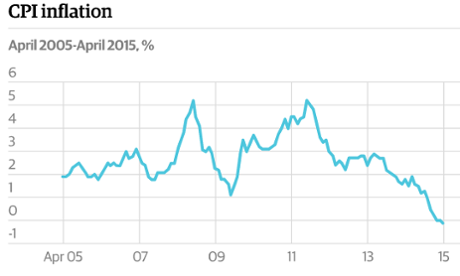
Analysts pointed out the earlier timing of Easter played a role in April’s dip into negative inflation. That meant air fares and ferry tickets rose by much less this April compared with a year ago and so dragged inflation lower.
“That influence aside, pretty much nothing else happened last month. This effect is likely to unwind this month, helping to pull the inflation reading back upward,” said Alan Clarke, head of European fixed-income strategy at Scotiabank in London.
Pushing in the other direction and acting as a downward pressure on inflation, alcohol prices, particularly wine, saw unusually big increases in May 2014, which were unlikely to have been repeated this year, added Clarke.
Forecasts in the Reuters poll for May inflation ranged from zero to 0.3%. Even at that upper boundary, inflation would still be way below the Bank of England’s government-set target for inflation at 2% and so policymakers will remain under little pressure to raise interest rates from their record low of 0.5%, where they have been for more than six years. Markets are not pricing in a rise until well into next year.
The dip into negative inflation had been widely predicted, including by the Bank of England’s governor, Mark Carney, after a sharp drop in oil prices since last summer. Writing in the BoE’s annual report on Monday, Carney reiterated that inflation would soon rebound.
“The UK, like many countries, has experienced weak inflation in large part because of falls in global commodity prices. But with the UK economy expanding steadily, inflation is likely to pick up once these falls drop out of the annual comparison,” he wrote.
Low inflation has boosted household finances for British workers, after years of wages falling in real terms. The latest pay figures due on Wednesday are expected to show average earnings rose 2.1% on a year ago in the three months to April.
The Resolution Foundation thinktank expects this week’s figures to show the fastest real wage growth since October 2007.
Matthew Whittaker, its chief economist, said: “The good news is that real wages are now, finally, growing at a respectable rate by historical standards. The bad news is that this only appears to be happening because of inflation falling to unprecedented levels.
“Normally, we’d have expected wages to grow at this rate far earlier on in a recovery, so there is an enormous amount of ground to make up. We need to see real wage growth sustained at this rate year on year.”