European markets end higher
The comments from European Central Bank policymaker Benoit Coeure suggesting an accelerated bond buying programme in May and June to avoid the summer lull sent the euro lower but stock markets higher. Investors were also hoping a deal to save Greece could be worked out, with some positive signs amid the usual confused commentary. So the final scores showed:
- The FTSE 100 finished 26.23 points or 0.38% higher at 6995.10
- Germany’s Dax is up 2.23% at 11,853.33
- France’s Cac closed up 2.09% at 5117.30
- Italy’s FTSE MIB added 2.22% to 23,713.26
- Spain’s Ibex ended up 1.35% at 11,497.7
- The Athens market rose 2.59% to 846.43
On Wall Street the Dow Jones Industrial Average is currently 22 points or 0.125 higher.
On that note, it’s time to close up for the evening. Thanks for all your comments, and we’ll be back tomorrow.
More on Christine Lagarde’s comment that progress was being made in the Greek negotiations. Reuters reports:
The International Monetary Fund is making “some” progress in discussions with Greece over an aid agreement, but it must also consider the views of the broader international community, the head of the institution said on Tuesday.
“We have constant discussions, and are making some progress in those negotiations with the Greek authorities,” IMF Managing Director Christine Lagarde said at a conference.
Greece and its international creditors are trying to reach a deal that would keep Athens from running out of money in exchange for commitments on economic reforms.
“But it’s clearly a difficult situation, and one where we all have to be mindful of the economic success, the financial stability, but also the accountability for the commitments that have been made with the international community,” Lagarde added.
Faced with criticism that the institution is biased towards its richer members, Lagarde has sought to show the Washington-based IMF will be tough with all of its 188 member countries, she said.
But Lagarde added that talks with Greece also have to account for the political reality in the country, where a new leftist government was elected earlier this year on a strong anti-bailout program.
“If one set of measures is not adjustable to a new political paradigm, fine,” Lagarde said. “But something else has to be substituted for it.”
The remarks by senior ECB policymaker Benoit Coeure made last night but released this morning have caused some controversy.
Coeure said the ECB was planning to speed up the pace of its bond-buying stimulus programme before the summer lull, comments which sent the euro tumbling. However investors are upset he made them to a select audience of bankers and hedge fund managers rather than making them generally available.
Bloomberg has the story here, including the central bank’s response:
The ECB said in a statement that the intention had been to release the remarks on Monday as Coeure spoke, and that a procedural error prevented that happening until Tuesday morning. It also said the speech was covered by Chatham House Rules, meaning it wouldn’t normally be published.
On a more positive note, the IMF’s Christine Lagarde has said that some progress is being made in the Greek negotiations.
Greek 2yr yields drop as #IMF’s Lagarde says some progress on talks with #Greece. pic.twitter.com/J0wshMkZrk
— Holger Zschaepitz (@Schuldensuehner) May 19, 2015
Back with Greece:
For the first time since SYRIZA came to power, Macedonia Uni poll finds the negotiating strategy is wrong http://t.co/1npoA1QYVC #Greece
— Yiannis Mouzakis (@YiannisMouzakis) May 19, 2015
(subscription required)
Updated
France expected to see 1.2% GDP growth this year - IMF
France’s economy is recovering but its growth potential is still much weaker than before the crisis.
This is the view of International Monetary Fund staff after the end of an official visit to the country. The IMF is forecasting real GDP growth to rise to 1.2% this year after almost four years of near stagnation, above the government’s prediction. It added:
The recovery is supported by a highly accommodative external environment, in particular sharply lower oil prices, a depreciated euro, and interest rates at historic lows. The initial rebound has been driven by household consumption and exports are set to pick up as well. However, investment has not yet responded, unemployment remains stubbornly high, and public debt continues to rise.
Overall the mission concluded:
We see a solid short-term recovery, but structural rigidities continue to weigh on medium-term prospects. Important progress has recently been made to address them, notably by reducing the tax wedge on labor and advancing supply-side reforms. However, continued efforts are needed to tackle France’s fundamental economic problems: high structural unemployment, low potential growth, and record-high public spending. Our main recommendations are to:
- Adopt structural reforms, at all levels of government, to improve the efficiency of public spending and limit its growth to inflation.
- Enhance flexibility for social partners at the firm level and facilitate the employment of the young and low skilled.
- Maintain the momentum on supply-side reforms to restore competitiveness and encourage investment, including by removing obstacles to enterprise growth.
The full statement is here:
France: 2015 Article IV Consultation—Concluding Statement
Updated
Whatever happens it seems unlikely that any deal between Greece and its creditors will be reached at this week’s EU summit in Riga. The summit is mainly concerned with Eastern Europe but Greek prime minister Alexis Tsipras is expected to talk to fellow leaders on the sidelines of the meeting. But, Reuters reports:

Eurogroup head Jeroen Dijsselbloem said on Tuesday it was unlikely Greece would reach a deal with its lenders when European leaders meet for a summit in Riga, Latvia, this week.
Dijsselbloem, who is also Dutch finance minister, said a decision on Greece’s debt and reform negotiations would be made during talks with the European Commission, European Central Bank and International Monetary Fund.
“It’s not on the agenda for Friday,” he told Dutch broadcaster RTL in a televised weekly interview. “I think it is unlikely.”
An uncertain opening on Wall Street has taken some of the shine off European shares, with the FTSE 100 now back below the 7000 level although it is still up around 0.35%.
French and German shares have also come off their best levels, but are still holding on to reasonable gains after an ECB member suggested an acceleration in its bond buying programme.
The Dow Jones Industrial Average is currently down 9 points or 0.05%, with poor figures from Wal-Mart upsetting investors.
Meanwhile US housing starts rose to their highest level in nearly seven and a half years in April, a positive sign for the US economy after recent disappointing data.
Another call for the Greece talks to speed up, this time from European Commission vice president Valdis Dombrovskis:
EU’s Dombrovskis: Progress On Greece Depends On Technical Talks - #BBG -Time Is ‘Really Running Out’ For Greece Talks
— Live Squawk (@livesquawk) May 19, 2015
There’s a very good reason why Greece needs a deal by June 5th, as Labour minister Panos Skourletis warned today -- it owes €305m to the IMF that day. But that’s just the start....
Greece has €1.5bn in IMF payments coming in June. 'Endgame' here according to Yves Mersch. http://t.co/D0fYOcszDc pic.twitter.com/5zMa8su1G0
— Mike Bird (@Birdyword) May 18, 2015
Updated
Merkel and Hollande push for accelerated Greek talks

The leaders of the eurozone’s two largest countries have both called for the negotiations between Greece and her creditors to speed up.
Speaking at a press conference in Berlin today, Angela Merkel and Francois Hollande both warned that there is no time to waste.
Chancellor Merkel told reporters:
“I’d say the talks need to speed up, rather than that they are going too fast, and we hope the relevant forum - the Brussels Group - can make clear progress because the agreement in February was that a programme should be set up by the end of May.”
Officials from Greece and her lenders have been talking in Brussels for some weeks, and are still divided over pensions, labour market reforms and the minimum wage.
Hollande insisted that European leaders does not want to lose Greece:
“We all have the same stance which is that Greece must stay in the eurozone.”
(quotes via Reuters)
These comments come hours after Greek labour minister warned the country must have a deal by 5 June (see here), before facing further repayments to the IMF.

Updated
German chancellor Angela Merkel is trying to prevent a potential rebellion among her own party against approving more aid for Greece, reports Bloomberg.
Here’s a flavour:
Caucus leaders of Merkel’s party are working on the objectors, telling them they may be asked to approve further aid to ward off a default even if Greece refuses to implement all changes demanded by creditors, according to three officials.
Merkel has been calling small groups of dissenters to the chancellery to tell them that Greece leaving the euro area would risk causing geopolitical instability in the region, one of the people said.
All the officials asked not to be identified because the discussions are private.
In for a penny, in for a pound? - Merkel Seeks to Head Off Party Revolt Against Greek Deal http://t.co/WsqWrI08xE via @business
— Michael Hewson (@mhewson_CMC) May 19, 2015
Greek minister: We need a deal by June 5th

Over in Athens word is coming through that June 5th is now being seen as the absolute deadline for a deal to be done.
Helena Smith reports
It’s final and it’s official, says Greece’s Labour minister Panos Skourletis. The deadline date for an agreement to be sealed between Athens and its creditors is June 5th – and not a day later. “If a solution is not found financially by then, things will be difficult,” the politician, a close ally of prime minister Alexis Tsipras told the Greek television station Ant 1 this morning.
June 5th would fit in with the government’s assessment that an emergency euro group meeting could be called at the end of May to rubber-stamp a deal.
Skourletis, who has taken a step back from promises to augment the minimum wage, denied that Tsipras’ far left Syriza party was becoming increasingly divided between radicals and reform-minded pragmatists.
“There is no rupture with the Left Platform,” he said referring to Syriza’s militant wing that represents about a third of the party and is lead by the marxist Energy minister Panagiotis Lafazanis.
Any deal drawn up with foreign lenders at the EU and IMF would be endorsed by the entire party and approved by parliamentary vote, he insisted.
Far left dissidents will be meeting in urgent session this evening to discuss whether they can stomach yet more austerity in the form of further reforms, taxes and cutbacks.
Skourletis, often seen as a hardliner himself, suggested that foreign lenders appeared bent on “humiliating Greece.” A new law, outlining labour legislation that his ministry had drawn up, would not require the endorsement of technical teams representing creditors.
He told Ant 1:
“Personally and collectively we will not accept this humiliation. Any rejection [of the plan] is aimed at humiliating the government.”
Updated
Video: George Osborne has reiterated that today’s inflation data is not bad news..... and also ducked the question about falling prices will mean for benefit payments (which are pegged to the CPI rate)

News is coming through from Berlin that Greek prime minister Alexis Tsipras is likely to meet Angela Merkel on the sidelines of the Riga summit, which starts on Thursday.
A chance to discuss Greece’s ongoing bailout talks, as pressure mounts to reach an agreement.
From Athens, Helena Smith reports:
A spokesman for the chancellor has said no decision will be taken in regards to reforms or debt by the two leaders. Insiders in Athens are saying it is likely they will reconfirm the headway made by technical teams leading negotiations.
Media reports here are suggesting that “a working agreement” has been drawn up and is now the basis of talks which would imply that the two sides are closer to an agreement.
Let’s turn back to the Greek crisis.....
The European Commission continues to deny that it has drawn up a secret plan to bridge the rift between Athens and its lenders.
Reuters has the story:
Progress in talks between Greece and its creditors on more funding is slow, the European Commission said on Tuesday, denying the existence of a new proposal reported by the Greek press that would give Athens cash on more favourable terms.
Greek newspaper To Vima said on Monday the Commission had prepared a possible compromise, proposing that creditors should accept a lower primary surplus target from Greece in return for tax reform and a hike in sales taxes.
The report lifted the Athens stock market, but the Commission in Brussels and the Greek government both denied any knowledge of such a proposal.
“More time and effort is needed to bridge the gaps on the remaining open issues. We consider that progress is being made albeit at a slow pace,” Commission spokesman Margaritis Schinas told a daily news briefing.
“We cannot confirm any paper of the kind which has been mentioned in the Greek press. We cannot confirm the existence of any such paper and we really don’t know where that story has come from,” he said.
One last chart....
#UK inflation since the 1950s, by @ReutersFlasseur pic.twitter.com/oLQ1LhZ55I
— Yiannis Mouzakis (@YiannisMouzakis) May 19, 2015
Carney: Enjoy low inflation while it lasts....
Bank of England governor Mark Carney has vowed to get UK inflation back to its 2% target.
He told ITV News:
We expect inflation to be very low for several months. But over the course of the year, towards the end, inflation should start to pick up towards our 2% target. Our job is to ensure that inflation remains low, stable and predictable.
The British people should enjoy this period of very low energy prices, very low food prices....enjoy it while it lasts. We’re going to bring inflation back to that 2% target to keep this economy well functioning, to keep the jobs market growing and to bring income growth up.
Bank of England Governor says Brits should 'enjoy low inflation and low prices while it lasts' http://t.co/dLUjU4D8DT pic.twitter.com/joULR6GbTX
— ITV News (@itvnews) May 19, 2015
Updated
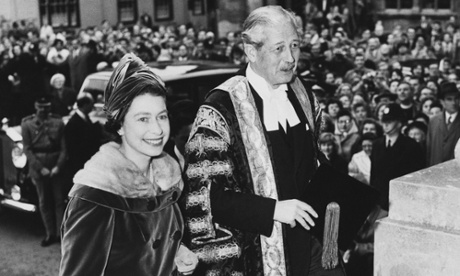
Summary: First negative UK inflation since Macmillan
Time for a recap.
Economists and government ministers have urged Britons not to panic after inflation turned negative for the first time since March 1960.
Cheaper oil and food prices, and a drop in transport costs due to the early Easter, has pushed prices down across the UK. This caused the Consumer Prices Index to drop by 0.1% year-on-year in April.
The Office for National Statistics reported that food prices have fallen by 3.0% over the last year, as supermarket continue to compete hard. The prices of motor fuels fell by 12.3%, as the fall in crude oil prices since last autumn feeds through to consumers.
My colleague Katie Allen has the full story:
Chancellor George Osborne argued that families should welcome the drop in the cost of living (according to the CPI, anyway). This is not damaging deflation, he insisted.
Instead we should welcome the positive effects that lower food and energy prices bring for households at a time when wages are rising strongly, unemployment is falling and the economy is growing. Of course, we have to remain vigilant to deflationary risks and our system is well equipped to deal with them should they arise.
A raft of City experts have predicted that inflation will soon turn positive again, and squashed talk of a damaging deflationary spiral. Reaction starts here
But union leader Frances O’Grady fears that the data could show trouble ahead; she urged Osborne to resist making new painful cuts to government spending.
Click here for more charts
Updated
Deflation, like cholesterol, can apparently come in good and bad flavours.
Ben Southwood, Head of Research at the Adam Smith Institute argues that Britain is enjoying a dose of the good stuff:
“We have deflation—albeit extremely mild deflation of 0.1%—for the first time since the 1960s. But this seems to be ‘good deflation’, coming mainly from cheaper goods – especially from cheaper oil— rather than from a drop in consumer demand.
“Economists worry about deflation, but only the ‘bad’ kind, when prices are sliding at the same time as wages and output. Bad deflation makes debts harder to bear, puts people out of jobs, and can lead to a downward spiral. Good deflation, when wages and output are rising steadily, makes everyone better off.

And here’s Chris Leslie MP, Labour’s Shadow Chancellor, on today’s inflation figures:
“Any relief for households is welcome, but this month’s figures reflect global trends and doesn’t change the reality that many are still struggling to pay the bills.
“The Government must clearly guard against the risk that business investment might be deferred. We need stronger action now to raise productivity to deliver sustainable growth and rising living standards.”
Britain isn’t the only country experiencing disinflationary pressures.
America’s annual inflation rate fell by 0.1% in March (we get April’s data on Friday).
And data this morning showed prices across the eurozone were flat in April, having fallen earlier this year.
Alastair Winter, chief economist at investment bank Daniel Stewart, fears that global growth is slowing, pushing prices down:
There is no doubt the US economy is no longer the world’s locomotive while China is struggling to replace it and Japan and Germany have long since given up.
Central banks seem to be running out of ideas and there is an increasing disconnect between economic fundamentals and asset prices. There are potentially very dark clouds gathering that could prolong this deflation and make it malign.
Britain’s inflation rate will soon spring back into positive territory, predicts Martin Beck, senior economic advisor to the EY ITEM Club:
“CPI inflation in April recorded its first negative reading since 1960, but this looks likely to be a one-off.
Overall today’s reading may be an interesting piece of trivia, but it will have no tangible impact on the economic outlook beyond offering further evidence that UK consumers are enjoying a substantial boost to their spending power.”

TUC General Secretary Frances O’Grady does not share George Osborne’s optimism - she urges the chancellor to hold back from fierce cuts in his Budget in July:
“The first period of negative inflation in over half a century could turn out to be the canary in the mine, signalling that there’s something very wrong with the recovery. And with the threat of deflation set to continue, the Chancellor’s plans for extreme cuts risk putting the economy into more serious trouble.
“We need a better plan for growth if we are going to have a recovery built to last with a firm foundation for improving living standards. Stagnating prices are not a sound foundation for the strong and sustained pay rises that workers have been waiting years for.”
Andrew Sentance, senior economic adviser at the accountancy firm PwC, reckons that inflation could be pushed up as British workers gets a long-awaited pay rise.
“Though prices are slightly down on a year ago according to the CPI, sustained deflation is not on the cards. Once the impact of the big drop in oil prices drops out of the annual inflation rate, it will move back up to 1-2% over the next year or so. With wage inflation picking up we may soon be considering the prospect of above target inflation.
“In the meantime, flat or slightly falling consumer prices are good for growth, boosting real consumer spending power. So a temporary period of slightly negative inflation can be good for the UK economy.”

Falling prices means there’s no reason for the Bank of England to raise interest rates soon.
Rain Newton-Smith, CBI Director of Economics, reckons borrowing costs will remain at their current record low until 2016:
“With inflation set to remain below 1 per cent this year, a rise in interest rates anytime soon seems off the cards. Rates are likely to remain low into next year and beyond, continuing to help the domestic recovery.”
James Sproule, Chief Economist at the Institute of Directors, agrees with George Osborne that Britain hasn’t lurched into a harmful period of deflation:
Falling prices in necessities, such as food and transport, along with a period of sustained job creation and wage growth mean demand and consumption will remain buoyant.
“Deflation can be a chronic problem where it represents a lack of consumer confidence and an unwillingness to spend. This danger is very real in some parts of southern Europe, but is not even a distant threat in the UK. While deflation does cause the cost of debt to rise in real terms, the benefits to the wider economy of a period of falling prices far outweigh any downsides.”
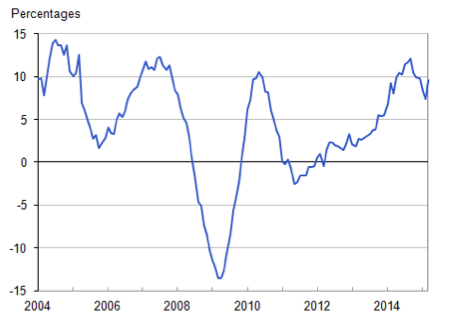
For the worst housing inflation, look at Scotland -- where prices are up almost 15% since March 2014.
Annual house price inflation rises for first time in 7 months. 9.6% across UK. But no longer just driven by London: pic.twitter.com/qs2P7EfIgm
— Ed Conway (@EdConwaySky) May 19, 2015
There’s not much sign of negative inflation in the UK housing market.
New data this morning shows that UK house prices increased by 9.6% in the year to March 2015, up from 7.4% a month earlier.
In England, the market was driven by an 11.4% surge in house prices in the East, and 11.2% in London and in the South East.
Updated
The recent strength of the pound has also driven prices down over the last year, by making imports cheaper
Jeremy Cook, chief economist at the international payments company, World First, explains:
Sterling is around 5.8% stronger than this time last year and the past 12 months have obviously been a significant decline in oil and food prices. The subsequent effect on imports into the UK means that disinflation is piggybacking on every product that we bring in from abroad.”
“As oil prices recover and last year’s declines fall out of the inflationary basket then this will become less of an issue.
Another sign that Britain isn’t in “damaging deflation” - the Retail Prices Index, a broader measure of inflation that also includes housing costs, rose by 0.9% over the last year.
Updated
Kevin Doran, Chief Investment Officer at Brown Shipley, a private bank, says we shouldn’t read too much into the CPI index:
“Despite today’s inflation numbers showing a fall into negative territory, investors shouldn’t be fooled into thinking this is an accurate representation of the state of inflation in the UK.
You don’t have to look far to see that there is an abundance of inflation in asset prices, largely in bond and equity markets, with people rightly talking about bubbles in each of these respective asset classes, particularly tech stocks.
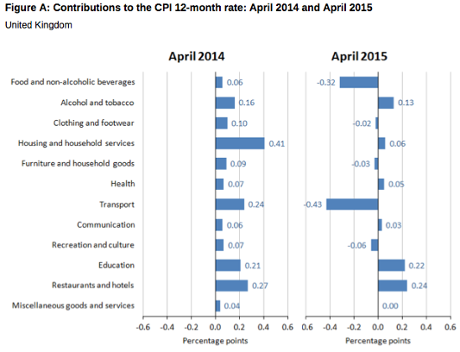
Over the last year, food prices have fallen by 3.0% and prices of motor fuels fell by 12.3%, according to today’s inflation report.
This chart gives a better picture of price changes over the last 12 months and their impact on the inflation date:
Updated
What to call -0.1% CPI: negative inflation or deflation? My take: if you’re calling it deflation make sure you emphasise it’s not ‘30s style
— Ed Conway (@EdConwaySky) May 19, 2015
Here’s another chart, showing how UK prices have risen (or very occasionally fallen) since the end of WW2 rationing:
CPI inflation since 1950. Last time it was in negative territory was 55 years ago pic.twitter.com/o6atO2fOZV
— Ed Conway (@EdConwaySky) May 19, 2015
There is a caveat, though -- CPI didn’t exist until 1996, so this is based on historical data....
George Osborne: It's good news (and it's not damaging deflation)

A brief bout of negative inflation is NOT the same as full-blown deflation (defined as a protracted period of falling prices, where consumers expect things to keep getting cheaper).
As Chancellor of the Exchequer, George Osborne explains:
“Today we see good news for family budgets with prices lower than they were a year ago. As the Governor of the Bank of England said only last week, we should not mistake this for damaging deflation.
Instead we should welcome the positive effects that lower food and energy prices bring for households at a time when wages are rising strongly, unemployment is falling and the economy is growing. Of course, we have to remain vigilant to deflationary risks and our system is well equipped to deal with them should they arise.”
We should enjoy falling prices while we can, says Tom Stevenson of Fidelity.
Speaking on Sky News, he explains that Britain isn’t turning into Japan [which suffered actual deflation for many years], and this isn’t a return to the depression of the 1930.
Updated
CPI at -0.1% year on year, first dip into deflation since 1960. Timing of Easter this year an issue slightly depressing prices.
— Duncan Weldon (@DuncanWeldon) May 19, 2015
The key charts: UK in negative inflation
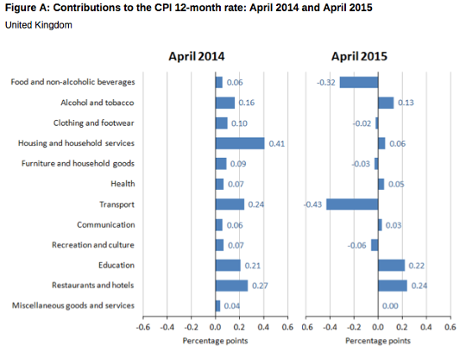
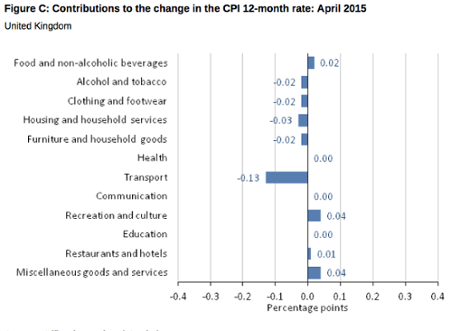
This chart confirms that transport costs were the biggest drag on inflation last month.
That’s because Easter fell in March in 2015, but in April in 2014 -- so transport firms didn’t put their prices up this year.
Updated
This is the first time the CPI has fallen over the year since official records began in 1996 and the first time since 1960 based on comparable historic estimates. The largest downward contribution came from transport services - notably air and sea fares, with the timing of Easter this year a likely factor.
UK inflation falls by 0.1%
Breaking: Britain is experiencing negative inflation for the first time in over half a century.
The Office for National Statistics just reported that the consumer prices index fell by 0.1% in April. That’s the first negative reading since March 1960.
More to follow!
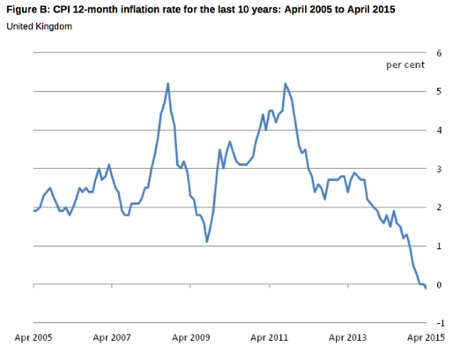
This chart, from ING, shows how inflation, as measured by the Consumer Prices Index, hit a record low of zero this year.
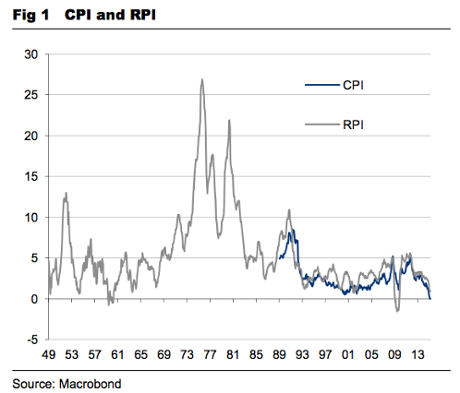
Incidentally, CPI was created in the mid-1990s, but has been calculated back to 1989 using historical data.
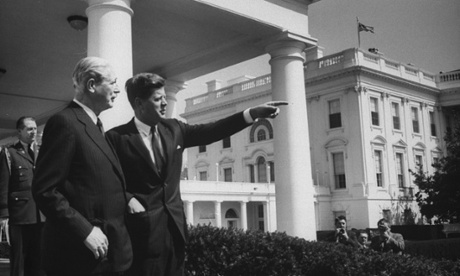
More experimental data shows that it briefly turned negative in 1960, when Harold Macmillan was prime minister.
Just 20 minute to go until we get the UK inflation data for April.
Jeremy Cook, chief economist at World First, predicts that the consumer prices index will have turned negative, after being unchanged in February and March.
Expecting UK CPI to see a YoY decline in April. Nothing catastrophic, but strong GBP, lower oil and food should see a print of -0.1%
— World First (@World_First) May 19, 2015
ING’s economics team reckon inflation will soon start rising again:
UK consumer price inflation could fall into negative territory for the first time in the series’ history. This won’t last long though with the BoE expecting inflation to be at 2% in 2 years’ time.....
Motor fuel prices are starting to move higher given the pick-up in oil prices. Furthermore, we are doubtful that much more food price deflation can be squeezed out of the supermarket fight for market share.
And a small dose of negative inflation is no reason to panic, argues Newsnight’s Duncan Weldon:
Preemptive tweet: if CPI goes negative today that is not "bad deflation" & no reason to panic. As long as wages are growing, it's benign.
— Duncan Weldon (@DuncanWeldon) May 19, 2015
Updated
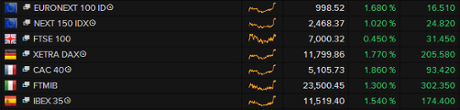
European stock markets have jumped, following the news that the ECB will accelerate its bond-buying programme in May and June (before heading to the beaches for the summer).
Traders are deducing that a weaker euro and an extra dose of stimulus is good news for European firms, pushing up shares in Paris, Frankfurt, Milan and Madrid:
Updated
Juncker denies drawing up Greek compromise plan

Newsflashes are coming in that Jean-Claude Juncker, EC president, has denied that he’s drawn up a compromise plan to break the Greek deadlock.
He’s also ruled out a breakthrough at this week’s meeting of EU leaders in Latvia, but still hopes for a deal by early June.
*JUNCKER DISMISSES REPORTS OF GREECE COMPROMISE PLAN BY HIM
— Michael Hewson (@mhewson_CMC) May 19, 2015
[As we covered in Monday’s liveblog, the To Vima newspaper had reported that Juncker had proposed more achievable Greek budget surplus targets and a cut-down list of economic reforms.]
*JUNCKER RULES OUT POSSIBILITY OF GREECE AID DEAL IN RIGA
— Michael Hewson (@mhewson_CMC) May 19, 2015
*JUNCKER FORESEES AID DEAL ON GREECE AT END-MAY OR IN EARLY JUNE
— lemasabachthani (@lemasabachthani) May 19, 2015
EU Commission Pres Jean-Claude Juncker tells Bloomberg he expects end-of-May/early-June Greek deal & that he's personally involved in talks.
— Ian Wishart (@IanWishart) May 19, 2015
Greek car sales may be up 43% this year, but they’re still way, way below their pre-crisis peak:
About that 43.3% y/y rise in Greek car regs. Impressive, but also about base effects, trend still below 1990 levels! pic.twitter.com/vtymqhi8UX
— Claus Vistesen (@ClausVistesen) May 19, 2015
Euro tumbles as ECB vows to speed up QE
The European Central Bank is planning to speed up the pace of its bond-buying stimulus programme before the summer lull, according to senior policymaker Benoit Coeure.
In remarks that just send the euro tumbling, Coeure explained that the ECB wants to buy more bonds than average over the next six weeks, to avoid the “notably lower market liquidity” in late July and August.
The Eurosystem is taking this into account in the implementation of its expanded asset purchase programme by moderately frontloading its purchase activity in May and June, which will allow us to maintain our monthly average of €60 billion, while having to buy less in the holiday period. If need be, the frontloading may be complemented by some backloading in September when market liquidity is expected to improve again.
Coeure denied that the ECB is putting its foot on the accelerator to calm the bond markets, after seeing wild swings in the price of bunds in recent weeks.
The slightly higher purchase volume that market analysts may observe in the coming weeks is therefore unrelated to the recent episode of market volatility.
The speech was given in London yesterday, but appears to have just been made public. The ECB is even tweeting the key points now, to make sure everyone gets the message:
Cœuré: we frontload purchases in May and June to maintain monthly average of 60bn while buying less in holiday season http://t.co/do7tWq3fln
— ECB (@ecb) May 19, 2015
Cœuré: slightly higher purchases in coming weeks are therefore unrelated to the recent episode of market volatility http://t.co/do7tWq3fln
— ECB (@ecb) May 19, 2015
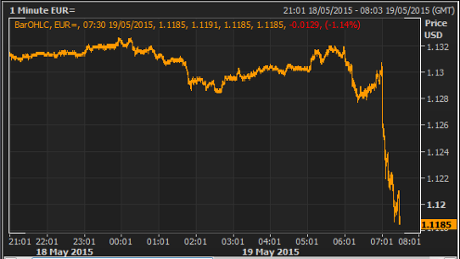
The prospect of the ECB buying even more government bonds in May and June has sent the euro tumbling by more than one cent against the US dollar, to $1.1195:
Car sales numbers from Greece suggest Greeks are storing cash in cars. Whether that is in the boot or not remains to be seen
— World First (@World_First) May 19, 2015
European car sales rise again
Car sales across Europe have risen for the 20th month running, helped by a remarkable boom in demand in Greece.
Industry body ACEA has reported that new passenger registrations in the EU rose by 6.9% year-on-year in April, as the pick-up in consumer spending continues.
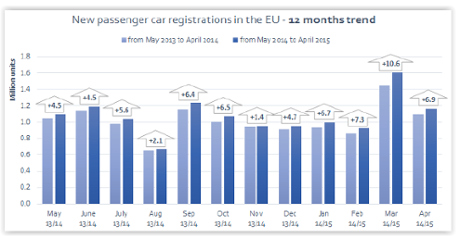
The recovery looks broad-based. ACEA says:
All major markets contributed positively to the overall expansion, especially Italy (+24.2%), which posted double‐digit growth, followed by Germany (+6.3%), the UK (+5.1%), Spain (+3.2%) and France (+2.3%) that also performed better than in April 2014.
European car sales rose a 20th consecutive month in April, bolstered by reviving economy and new models from Renault, BMW and Fiat Chrysler
— Francine Lacqua (@flacqua) May 19, 2015
The data also shows that 7,801 new cars were bought in Greece last month, a 43% jump on the 5,444 sold in April 2014.
Analysts have suggested some nervous Greeks are taking money out of the banks, and buying cars, in case the country should plunge out of the eurozone or implement capital controls.
As Mehreen Khan wrote in the Telegraph last week:
Despite depreciating in value quite quickly, cars are still a handy asset to own because they can be put to productive use - especially if the alternative is just stashing your money under a mattress.
In a strange irony of Greece’s woes, German industry is perversely one of the main beneficiaries of the country’s banking collapse. Greek consumers, like many of their fellow Europeans, buy German cars more than any other brand.
Cars sales: decent proxy for Greek capital flight http://t.co/zILnpZQVM3
— Mehreen (@MehreenKhn) May 12, 2015
Germany’s Deutsche Bank has made a dramatic intervention into the debate over Britain’s membership of the European Union, revealing it might quit the City if the UK left the EU.
This makes Deutsche, which employs 8,000 people in the UK, the first financial company to formally say it could shift its operations overseas in the event of Brexit.
Varoufakis: Deal could come in a week
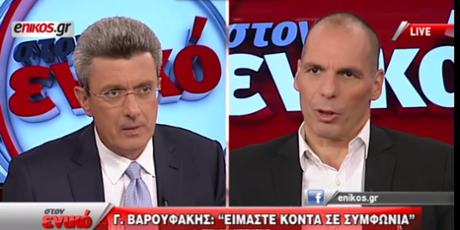
Last night, Greek finance minister Yanis Varoufakis was grilled about the country’s bailout negotiations in a live TV interview on Star TV.
Here are the key points, in case you missed it:
On the timing of any deal with creditors:
“I think we are very close....Let’s say (it’s a matter) of about a week.”
What would happen if Greece couldn’t repay both the IMF and its pensions?
“I assure you that if we face a dilemma between paying a creditor who refuses to sign an agreement with us and a pensioner, we will pay the pensioner.....I hope we will be able to pay both.”
Who is to blame for Greece’s liquidity squeeze?
“The lack of liquidity is neither the choice nor the responsibility of the Greek government.
It is a tough negotiating tactic of our partners, and I do not know whether everybody in Europe feels proud of it.”
Should Greece hold a referendum?
“It would be unfair for Greek citizens to have to take a position on such a matter, answering with either a yes or a no.”
Enikos, which broadcast a live translation, tweeted some key points:
Varoufakis: I am a soldier, never considered resigning - http://t.co/pj2NGKwYfW pic.twitter.com/zy6fvUBFId
— enikos_en (@enikos_en) May 18, 2015
Varoufakis: We are NOT considering a different currency -http://t.co/ggxdwIAyEK
— enikos_en (@enikos_en) May 18, 2015
Updated
The Agenda: UK inflation and Greek developments
Good morning, and welcome to our rolling coverage of the world economy, the financial markets, the eurozone and business.
Britain’s headline inflation rate may turn negative for the first time in half a century. The cost of living has been unchanged for the last two months, but economists reckon it could actually have fallen in April, thanks to the cheaper oil and fuel.
We find out at 9.30am BST, when the Office for National Statistics publishes the latest Consumer Prices Index data.
Here’s our preview:
Greece is also dominating the attention again, on hopes that it could yet find a compromise with its lenders before running out of cash reserves.
Last night, prime minister Alexis Tsipras claimed that a breakthrough was close, sentiments echoed by his finance minister in a late night TV interview (more on that shortly):
And although reports that EC president Jean-Claude Juncker was working on a compromise deal were denied (although not very robustly) yesterday, they did raise hopes that the two sides could make enough progress to unlock some bailout funds.
But tensions are rising in Athens. Later today, a group of prominent left-wing politicians from Tsipras’s Syriza party will hold a meeting to argue that Greece must ‘rupture’ with its lenders, and possibly leave the euro.
In a statement released yesterday, they declare said:
With a suspension of repayments [of the debt], measures that restrict the “freedom” of capital flight, governmental control over the banks, taxation of capital and of the rich for the financing of pro-people measures, support of this policy with any and all possible means, and with the possible break from the EMU.
Call for "rupture now" by the Political Secretariat & Central Committee of #Syriza http://t.co/cGcxZlGExD #Greece
— The Greek Analyst (@GreekAnalyst) May 18, 2015
We also find out if the Greek crisis is hitting German economic sentiment, when the ZEW index is released at 11am.
Europe’s stock markets are expected to inch higher. Here’s IG’s opening calls:
- FTSE 6982, up 13 points
- DAX 11653, up 59 points
- CAC 5030, up 18 points
- IBEX 11384, up 39 points
- MIB 23280, up 82 points
We’ll be tracking all the main developments through the day....