Increasing shortages of bricklayers and bricks threaten to undermine ambitious housebuilding plans laid out by politicians ahead of the election, a leading construction industry group has warned.
All the main parties have sought to assure voters they will tackle Britain’s chronic housing shortage but the Federation of Master Builders (FMB) says its members are already struggling to get the skills and materials they need to meet demand.
After its savage recession, the construction sector is still scrambling to get brick plants back to full capacity and to train more tradespeople. Half of small- and medium-sized (SME) builders are finding it difficult to recruit bricklayers, according to the FMB. Two in five say they are struggling to source certain types of bricks, with some being asked to wait up to six months for new stocks from suppliers.
FMB chief executive Brian Berry says the latest poll of SME construction companies exposes politicians’ pledges on housebuilding.
“The brick manufacturers are working hard to reignite their kilns, which were mothballed during the recession. However, in the meantime, let’s make sure small local housebuilders are not overlooked in favour of large housebuilders when it comes to manufacturers meeting requests for new bricks,” he said.
“In terms of skills, the ever-growing lack of bricklayers is causing concern. Compared to this time one year ago, more than twice the firms are reporting difficulties recruiting these tradespeople. In the short term, many SME housebuilders may have to rely on migrant labour.”
Bricklayer shortage
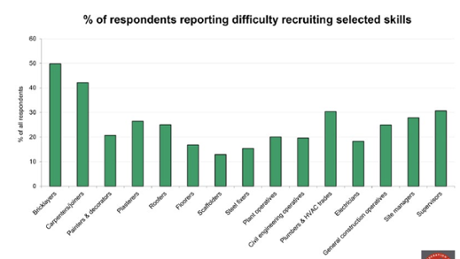
Businesses said bricklayers were hardest to recruit but it was also difficult to find carpenters and joiners, supervisors and plumbers, according to the survey’s 400 responses.
That echoes warnings of a skills timebomb in the industry after it lost almost 400,000 people during the recession, and with another 400,000 due to retire over the next five years, according to the Construction Industry Training Board (CITB).
Berry said the next government must focus on appenticeships to fill the skills gap.
“To ensure we have an ample supply of skilled workers in the future, the next government must ensure it sets the right framework in terms of apprenticeship funding and apprenticeship standards. Also, more construction firms – large and small – need to willingly engage with training. After all, there’s strong evidence to suggest that training apprentices is good for business,” he said.
The group’s trade survey asked guest questions this quarter on brick supplies, following growing reports of long waiting times and rising prices.
The poll found 43% of companies were having difficulty sourcing certain types of bricks. Of those, 62% were being asked to wait for up to two months for bricks by suppliers. A fifth, or 22%, were waiting up to four months and 14% were waiting up to six months.
Brickmakers say they have been investing to raise capacity but that it takes time to get a mothballed plant up and running.
Martin Warner, chief executive of Michelmersh Brick Holdings, said the latest report of shortages underlined changes in the industry in recent years.
“For many years, people used to be able to get bricks for tomorrow because there was effectively more capacity than demand. Over the last couple of years, things have changed. So we are now importing – about 20% of bricks are imported,” he says.
“People are getting used to a new system. People are realising there is more planning required.”
Warner says his company, made up of centuries-old brickworks acquired since the late 1990s, invested last year and is now making 6m more bricks than a year earlier, an 10% increase in production. But to invest further, the whole industry needs more long-term certainty about housebuilding in the UK rather than plans that fluctuate as governments change every five years.
“What we need is almost to depoliticise it and have long-term planning … There has to be a national plan, five years is too short a time to do something. Everyone says they are going to do something, but nothing really happens,” said Warner.
Industry sceptical on politician plans
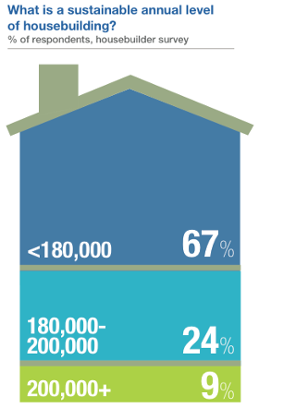
In a separate survey, builders also raised planning and access to land as obstacles to increasing housing supply.
More than two-thirds of UK housebuilders believe delivering more than 180,000 new homes a year is unachievable under current market conditions, according to a report by property company Knight Frank. Just 9% said it was possible to build more than 200,000 homes a year, a number pledged by Labour.
The survey of 160 housebuilders and developers found that four out of five said improving resources at local planning departments was the most important step policymakers could take to raise housing supply in the UK.
Gráinne Gilmore, head of Knight Frank UK residential research, said: “Policymakers, especially those in power after the election, may want to heed the calls from housebuilders to beef up planning departments in local authorities, plough more investment into skills and training in the construction sector and provide better access to public sector land, moves which the housebuilding industry is signalling could move the country closer to building enough homes for all.”