After a sluggish first quarter, the UK economy got going again in the second quarter, with signs even that the long-awaited recovery in living standards is taking root. Chancellor George Osborne says Britain is “motoring ahead”, which is an interesting choice of words given manufacturing shrank.
However, he is right that the headlines from Tuesday’s growth figures tell a generally happy tale.
The Office for National Statistics estimates that, powered by the services sector, GDP grew 0.7% in the second quarter after just 0.4% in the first. It means the UK economy has now been expanding for 10 consecutive quarters. That is the third-longest spell of growth since 1955 and economists at Royal Bank of Scotland say “we’ve rarely had it so good”.
We’ve rarely had it so good. Today’s GDP data will confirm UK is enjoying its 3rd-longest spell of growth since 1955. pic.twitter.com/TSlRedG47Z
— RBS Economics (@RBS_Economics) July 28, 2015
The ONS says GDP per head, generally taken as a better guide to prosperity than mere GDP, is “broadly equal” to the pre-crisis peak reached in early 2008.
Does it feel like it? Well, it depends, of course, very much on who you are and what you do. And here we come back to what is powering the growth and what is not.
If you are enjoying the happy combination of virtually no inflation alongside a post-crisis pay rise, you might be feeling quite flush.
If you are a young person struggling to get a job or someone stuck in one of Britain’s many low-paid service sector jobs, chances are the claims from Osborne that his “economic plan is working” will ring hollow.
GDP tells only part of the story on the economy and that is even more true for this first stab at estimating growth in the second quarter, when the ONS has less than half the data it needs. Similarly, average pay figures provide only a rough guide to how workers are doing.
Behind the headlines there are worrying signs that the spoils of Britain’s seemingly booming jobs market are not being shared equally.
The Bank of England’s chief economist, Andy Haldane, has warned about this as he makes the case for holding off a potentially damaging early interest rate rise.
“There are still people without a job who would like a job; there are still people with jobs who would like to work more hours. And, even for those that have got jobs, their pay – in most cases – isn’t racing away,” he told BBC2’s Newsnight last week.
The latest analysis of what jobs are available gives yet more reasons for caution. Advertised salaries have fallen to an 11-month low, as growth in the workforce is driven by lower-paid roles and part-time positions, according to jobs search engine Adzuna.co.uk which aims to list every vacancy advertised.
These latest GDP figures underline the very British addiction to low-paid labour rather than more innovative and productive economic activity. For all the government’s pledges to rebalance the economy, the dominant services sector is the only part of Britain’s economy to be back to its pre-crisis peak.
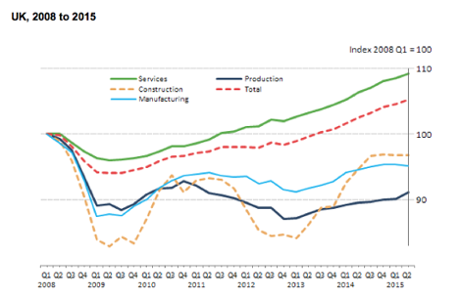
So while the chancellor talks about “motoring ahead”, manufacturing has some way to go to recover ground lost in the downturn. The latest news is gloomy, Britain’s factories recorded a 0.3% drop in the latest three months, the ONS says. Construction, meanwhile, stagnated.
So yes, there are undoubtedly signs of the overall economy strengthening in these latest numbers. But for anyone looking to the long-term, the figures show this recovery is anything but broad-based.