European shares edge higher
Despite mixed economic news - including a downturn in UK exports, job cuts at Standard Chartered and Micheline - leading shares managed to end the day (mostly) in positive territory. Support came from Wall Street, where poor US factory order figures came into the “bad news is good” category, suggesting the Federal Reserve might think again about raising interest rates this year. More crucial data follows later in the week, with the non-farm payroll numbers due on Friday. Meanwhile the day’s closing scores showed:
- The FTSE 100 finished up 21.81 points or 0.34% at 6383.61, with energy companies lifted by a 2% rise in the Brent crude price to $49.87 a barrel
- Germany’s Dax was virtually unchanged, up just 0.48 points at 10,951.15
- France’s Cac closed 0.41% higher at 4936.18
- Italy’s FTSE MIB dipped 0.1% to 22,419.45
- Spain’s Ibex ended up 0.45% at 10,465.2
On Wall Street, the Dow Jones Industrial Average is currently up 76 points or 0.43%.
On that note, we’ll close up for the evening. Thanks for your comments, and we’ll be back tomorrow.
Elsewhere there has been a meeting between EU commissioner Pierre Moscovici and Greek president Alexis Tsipras, and the mood from the EU side seems positive:
Very constructive meeting between @tsipras_eu and @pierremoscovici on #greece, growth and reforms @EU_Commission pic.twitter.com/0RlRlWRDBm
— Olivier Bailly (@OlivierBaillyEU) November 3, 2015
With @tsipras_eu @atsipras: positive momentum needs to be maintained, @EU_Commission supports reform process #Greece pic.twitter.com/Hf1SDaump0
— Pierre Moscovici (@pierremoscovici) November 3, 2015
Meanwhile Secretary of State for Northern Ireland Theresa Villiers said the Michelin news was “a tragic blow” for the company’s employees, writes Henry McDonald. She said:

The announcement represents the closure of a long-standing and valued employer in Northern Ireland.
I welcome the support being offered by the company, Invest NI and the Department of Employment and Learning to assist staff in searching for alternative employment.
I will be engaging with the NI Executive and colleagues in government on this issue.
Our economics correspondent Phillip Inman has pointed out that Michelin, in blaming a glut of tyres from the far east, fails to mention that it has a huge plant in India, four in Thailand and two in China. The Chinese factories employ more than 6,000 workers out of Michelin’s 112,000 global workforce.
@Michelin to close #NorthernIreland factory. Blames far east dumping, though it has 7 sites making tyres in far east https://t.co/JwSRfza75o
— Phillip Inman (@phillipinman) November 3, 2015
He also says that blaming outdated machinery harks back to a similar incident in 1979 when Dunlop closed its Liverpool factory. There was a House of Commons debate at the time with angry Liverpool MPs to the fore. Dunlop owner Goodyear closed its last UK tyre factory in Birmingham last year
@Michelin to close #NorthernIreland factory. Blames far east dumping.brings back memories of Dunlop circa 1979 https://t.co/jYcf9D2v1P
— Phillip Inman (@phillipinman) November 3, 2015
Back to Ireland. South of the border, away from the doom and gloom over Northern Ireland’s shrinking manufacturing base, the emphasis today in Dublin is all on hi-tech.
More than 30,000 tech entrepreneurs from all over the planet have descended on the city’s RDS conference centre for the annual Web Summit. But even amid all of the start ups and the hyper-optimistic tech speak there is discord from the lips of a Game of Thrones star.

Liam Cunningham who plays Davos Seaworth in the cult TV series used a live question and answer session at the summit today to denounce Dublin’s loss of the annual hi-tech global gathering to Lisbon for the next three years.
Criticising the Irish government for its alleged lack of support for the summit and its founder Paddy Cosgrave, the Game of Thrones actor told a packed audience: “I think it’s a disgrace that something this clever and wonderful has been lost by people who probably don’t know how to turn on a mobile phone.”
Cunningham said the government should get “on its hands and knees” to help Cosgrave bring the international conference back to the Irish capital.

Earlier there was better news for the US economy, with New York business activity bouncing back in October.
The Institute of Supply Management’s index surged from 44.5 to 65.8. This is the best performance for 12 years and follows the lowest reading in September since 2009.
HUGE BEAT: ISM New York explodes to 65.8 from 44.5 (45.7 expected) https://t.co/avjpLWlCFX
— BI Markets (@themoneygame) November 3, 2015
Did they just go to 24/7 working in NY area or what? https://t.co/ec9XWSL3ZI
— George Magnus (@georgemagnus1) November 3, 2015
After disappointing UK export figures, come weaker than expected US factory orders.
According to the Commerce Department, new orders for factory goods fell for the second month in a row in September, hit by a strong dollar and cutbacks by energy companies.
Orders dropped by 1%, compared to a 2.1% decline in August - itself revised down from the initial 1.7% fall.
Analysts had been expecting a decline of 0.9% in September.
Updated
Wall Street edges higher
Ahead of the latest US factory order figures, markets are treading cautiously, with the Dow Jones Industrial Average currently up around 10 points after an initial dip.
The factory orders are expected to recover a little from August’s 1.7% decline, but most observers will be concentrating on Friday’s non-farm payroll numbers for further guidance as to when the Federal Reserve might raise interest rates.
Michelin move a "body blow" to local economy
Northern Ireland’s First Minister Peter Robinson and Deputy First Minister Martin McGuinness said they would do everything they could for the Michelin workers, the Belfast Telegraph reports. They said:
The Executive will make every effort to alleviate the impact of the job losses and ensure the necessary support is available to those affected directly and indirectly.
Just over a year ago the workers of JTI Gallaher in Ballymena received similar news and so this combined with today’s announcement is a real body blow to the local economy.
The Executive is willing to meet with management, workers, trade unions and all local representatives to see if there is anything further we as an Executive can do.
The Belfast Telegraph has also spoken with Ballymena factory manager John Milsted, who has worked at the factory for two years and had been a Michelin employee for the past 36 years.
“The decision was not made easily, but is due to the dramatic transformation of the truck tyre market since 2007.
“Sales have slumped and we are competing with cheap imports.”
Updated

Davy Thompson of Unite said that in terms of per head of population the loss of 860 jobs for a country town like Ballymena would be the equivalent of the city of Belfast losing 14,000 jobs.
Meanwhile the Michelin management are trying to soften the blow by holding out the chances of some workers relocating to other plants.
Jim Milsted, Michelin’s manager at the North Antrim town, said the company now had “two and a half years to find out how to get 860 people into alternative employment” before its final closure in 2018.
Updated
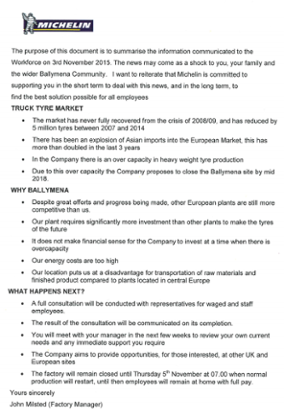
Here's Michelin's statement to staff
We’ve got hold of the document which Michelin handed to staff in Ballymena today, explaining why the plant is to shut by 2018.
It blames “Asian imports”, general over-capacity and high energy costs, which mean it doesn’t make financial sense to upgrade the plant:
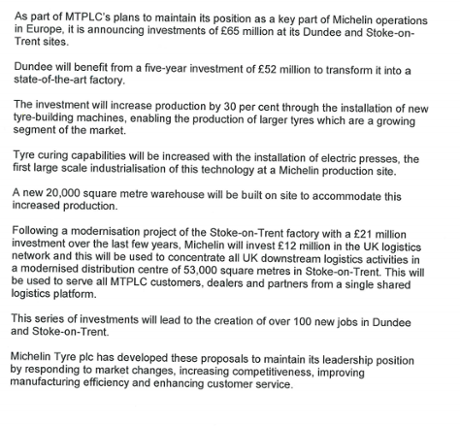
The document then outlines how Michelin will invest in its plants in Stoke and Dundee
Updated
The Ballymena job losses are a particularly bitter blow, as the pneumatic tire was (re)invented in Northern Ireland by John Boyd Dunlop back in the 1880s.
860 jobs lost as Michelin closes its tyre factory in Ballymena, Northern Ireland - the country which gave the world the pneumatic tyre
— Alan Strange (@AlanStrangeSky) November 3, 2015
Michelin is actually cutting around 1,6000 jobs across Europe.
The French tire maker has announced it will also restructure its operations in Italy and Germany, and is taking a £280m impairment charge to cover the cost.
As well as 860 jobs going in Ballymena, Michelin is axing around 750 posts in Italy and Germany
— Jamie Delargy (@Jamie_utv) November 3, 2015
Pneu Laurent
According to workers who attended the briefing from management today some staff will be offered relocation to other Michelin factories in Britain and Europe, reports our correspondent Henry McDonald.
Commercial television station UTV’s business editor, Jamie Delargy, is tweeting more details of the closure:
Michelin factory manager John Milsted says jobs will begin to be phased out in six months time
— Jamie Delargy (@Jamie_utv) November 3, 2015
Michelin offering jobs to any worker willing to up sticks and take up a position at another plant.
— Jamie Delargy (@Jamie_utv) November 3, 2015
Michelin: Northern Ireland plant wasn't ready for the future
Michelin has blamed outdated machinery at the Ballymena factory for the decision to close the site by 2018.
In a statement, it says:
“The tyre building machines at Ballymena are not capable of making the high tech tyres of the future, and the amount of investment required to upgrade the plant is prohibitive, particularly at a time when that capacity is not required.
Michelin will “immediately” start a consultation process with employees over its proposal to close the site:
“The Ballymena factory currently employs 860 people and the MTPLC is committed to supporting those employees during consultation and in the forthcoming months.
“Michelin appreciates the impact these proposals may have on the employees and local community and commits to support every employee throughout the process.
“In the coming weeks we will meet every employee individually to discuss the proposal and the assistance the employee may need.”
Ballymena’s local MP, Ian Paisley, says he will table an urgent question at the House of Commons tomorrow, about the Michelin factory closure.
Ballymena MP Ian Paisley describes loss of 860 jobs at Michelin as "apocalyptic news"
— Tracey Magee (@Tracey_utv) November 3, 2015
Jim Allister, who represents North Antrim in the Northern Ireland Assembly, is also very concerned by the news:
TUV leader @JimAllister statement on Michelin says it's "impossible to exaggerate the devastating blow that has fallen on North Antrim"
— Tracey Magee (@Tracey_utv) November 3, 2015
860 jobs lost as Michelin closes Northern Ireland factory
I’m afraid we have bad news from Northern Ireland, as feared.
Nearly nine hundred jobs are to go, after Michelin told its workforce at today’s meeting in Ballymena that it is closing the plant where it has operated since 1969.
The company has just told its workforce that 860 jobs will be lost when the factory closes, in 2018.
Unions representing employees at the factory said the decision was a cruel blow in the face of Christmas and the town already facing mass redundancies because JTI-Gallagher Tobacco is leaving Ballymena.
Michelin staff told plant will shut gradually from 2017 before closing completely in 2018. 1,000 jobs affected.
— Simon Cunningham (@simjcunningham) November 3, 2015
The Unite union said the Michelin decision was devastating news for Northern Ireland manufacturing.
Davy Thompson, Unite’s regional co-ordinating officer said:
“In addition to the 860 workers who are directly employed by Michelin on the site, there are approximately 500 contractors and many more in the economy who now face the threat of redundancy as a result of this announcement.”
Thompson also said regional and national government inaction played a part in Michellin’s planned departure from Ballymena after more than four decades.
He said:
“Unite has repeatedly demanded action from Ministers in relation to the high energy costs, the protracted difficulties experienced by Michelin in obtaining a connection for a proposed combined-heat power plant and the pressing need for capital support to modernise the plant.
Ministerial inaction has resulted in a situation where high energy costs have left the Ballymena plant having the second lowest operating efficiency and now facing closure.
It’s also a blow to the wirer UK export industry, as the Ballymena site made tires that were shipped overseas.
Almost 900 jobs to go with closure of Michelin plant in Ballymena. Company had previously complained of high energy costs in NI.
— Rick Faragher (@R_Faragher) November 3, 2015
Updated
BCC: Britain is 14 years behind Cameron's export target.

The British Chamber of Commerce has raised the pressure on the British government to help exporters, after warning this morning that the sector is at a six-year low.
BCC director general John Longworth an audience in London that David Cameron’s ambition of £1trillion in exports by 2020 is simply not going to happen
Longworth says:
Yes, we have to be honest with ourselves – and acknowledge that, as a country, we are not living up to the national export challenge set by the Prime Minister back in 2012.
And then he makes some serious home truths about the state of British exports -- showing how talk about creating the March Of The Makers is still that, just talk.
-
Britain has had a trade deficit since 1998 – and this became four-and-a half-times larger by the end of 2014, at £34.5 billion. Yes, it’s true that he deficit has narrowed by £8 billion since 2010 – but this has been on the back of a standout performance by services alone.
-
The UK has had a current account deficit since 1984. It’s now 57 times as large as it was then, at nearly £93 billion. Since 2010, the current account deficit has more than doubled, as income from overseas investments has reduced and it is indicative of the quality and volume of both inward and outward investment.
- Even though the value of UK exports to non-EU countries has increased by 25% over the past five years, compared to just 6% for exports to the EU, we have not moved quickly enough to seize opportunities in the new markets.
- By British Chambers calculations, we’re 14 years behind meeting the target of £1 trillion in annual exports, despite standout performances by so many individual companies.
The solution, Longworth told the BCC International Trade Conference 2015, is to restructure the UK economy:
Will we continue, our unsustainable binge of consumer and Government spending – or will we make the tough choices and fix the fundamentals, a choice that would lead to more investment and global trade?
Over in Ballymena, Northern Ireland, workers at the Michelin tire plant have been told to assemble for a meeting at noon, and it could be bad news.
We understand they will be told about plans to halt production at the site, which could lead to job losses.
Local Stormont Assembly member Jim Allister says there is ‘alarming’ news about the plant. Michelin has been operating in Ballymena since 1969 and employs about 1,000 people.
It makes truck and bus tyres mainly for export to the US.
Updated
The Standard Chartered selloff is gathering speed.
The bank’s shares are now down 10% , as the City learns more about CEO Bill Winters’ plan for the company, funded by £3.3bn from shareholders through a cash call.
Standard Chartered $STAN.LN down 10% after posting an unexpected loss in Q3.
— RANsquawk (@RANsquawk) November 3, 2015
Winters faces a tricky task, turning around a bank that is badly exposed to slowing emerging markets and just reported its first quarterly loss since the Asian debt crisis in 1998.
He told analysts this morning that Standard Chartered would liquidate $20bn of loans that are outside its ‘risk tolerance’, suggesting some of its lending has been too ambitious.
It is also planning to restructure its Indonesian and South Korean operations, and also throw more money into operations in Africa and China.
Richard de Meo, managing director at Foenix Partners, agrees that today’s construction report suggests growth will rebound this quarter.
He says (via Reuters):
The construction data was a bit underwhelming, but overall we are still on track for 1% growth in the final quarter which is pretty good.
My money would still be on the Bank of England hiking rates sometime in the first half of 2016,” said
Britain’s housebuilders are having a bad morning on the stock market.
Shares in Barratt Development and Taylor Wimpey have both shed 3%, followed by Persimmon (down 2%).
That follows a ratings downgrade by analysts at Liberum, who recommended selling shares in the building sector:
Liberum putting the knife into UK housebuilders. Downgrades Barratt, Persimmon and Taylor Wimpey to 'sell'. Flags margin pressures.
— Daniel Coatsworth (@SharesMagDan) November 3, 2015
Today’s construction report follows an unexpectedly strong manufacturing PMI yesterday, which showed growth rebounded in October.
This may be a sign that the economy is picking up after slowing in the last quarter, reckons Newsnight’s Duncan Weldon:
Manufacturing & construction PMIs strong, consumer confidence high = forward looking indicators point to Q3 UK GDP as blip not slowdown.
— Duncan Weldon (@DuncanWeldon) November 3, 2015
Markit also disputes the official claim that the construction sector shrank in the last quarter (as the Office for National Statistics believes).
Rather than acting as a drag on the economy, as suggested by recent GDP estimates, the sector is continuing to act as an important driving force behind the ongoing UK economic upturn.
Markit’s PMI survey found solid construction growth between July and September. The ONS, though, believes the sector shrank by 2.2%.
At least one of them is wrong.....
The UK #PMI construction series is very different from the official output series and "ne'er the twain shall meet" #ukhosuing #GBP
— Shaun Richards (@notayesmansecon) November 3, 2015

Construction firms are struggling to find enough builders to keep up with demand, says Markit’s Tim Moore:
“Construction companies noted a rebound in new business flows during October and responded to rising workloads by taking on extra staff at the fastest rate for almost a year.
Shortages of skilled staff persisted as a result, with the current period of falling sub-contractor availability the longest seen in over a decade.”
This chart shows how commercial building activity jumped last month, growing nearly as fast as housebuilding.
Civil engineering growth slowed, though, continuing a recent trend:

UK construction sector keeps growing
Britain’s construction sector has posted another month of solid growth, according to data firm Markit.
Markit’s construction PMI came in at 58.8 in October, down from 59.9 in September.
That suggests growth slowed a little, but it’s still looking pretty healthy (50 points is the the cut-off point between expansion and contraction).
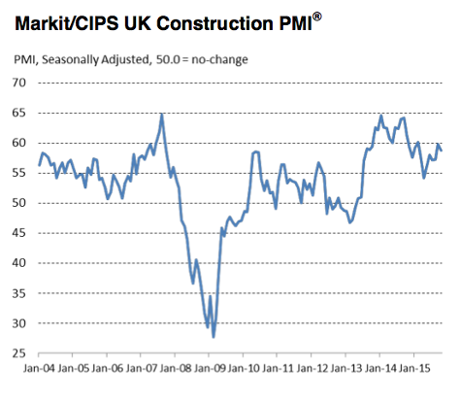
Markit reports that new orders picked up, while job creation hit a near one-year high. That suggests the sector is ending 2015 quite strongly.
Here’s the key points:
- Business activity continues to rise in all three construction sub-categories...
- ...but only commercial building sees a faster increase than in September
- Employment growth picks up to its fastest since November 2014
Builders are also quite optimistic -- 58% forecasting a rise in business activity over the next year, and only 7% expect a decline.
Reaction to follow....
Updated
Central bank news. Zambia has just hiked interest rates by three whole percentage points, in an attempt to fight inflation and prop up its currency, the Kwacha.....
Kwacha gonna do? *ZAMBIA RAISES BENCHMARK INTEREST RATE TO 15.5% FROM 12.5%
— World First (@World_First) November 3, 2015
It’s nearly time for Markit’s monthly healthcheck of Britain’s construction sector:
Updated
Reuters columnist Olaf Storbeck sees more trouble ahead for Volkswagen:
I'm a bit surprised VW shares only down 3.5 pct this morning. Investors don't seem to comprehend full dimension of additional EPA charges.
— Olaf Storbeck (@OlafStorbeck) November 3, 2015

Volkswagen shares have taken a predictable hit from the news that the emissions cheating scam may be even bigger than thought.
The company has slumped to the bottom of the Frankfurt stock market, down 3.33%, after US regulators claimed that the 2015 Porsche Cayenne contained software to evade emissions tests.
They also alleged that several Audi models are involved in the scandal.
Volkswagen has denied adding ‘defeat devices’ to these cars, but the prospect of the scandal widening is another blow to the carmaker.
Here we go again for Volkswagen... https://t.co/a89y9KXPKP
— Shaun Richards (@notayesmansecon) November 3, 2015

The biggest takeover of a UK tech company since 2011 has been announced, with US video game maker Activision Blizzard sweeping on King Digital, the British creator of Candy Crush.
Activision are paying a hefty price – $5.9bn – for a company whose addictive game once racked up a billion plays every day from smartphone fans eager to smash those sweets.
But that’s rather less than the $8bn which King was worth when it floated on the New York stock market last year.
Not the first time that someone’s paid too much for a mobile gaming experience, of course.
As blogger John Gruber jokes:
They were only going to pay $1 billion, but then they got stuck on a couple of levels, bought some gold bars, and, well, here they are.
Updated
Standard Chartered shares slide after rights issue announced
Standard Chartered’s shares have slumped to the bottom of the FTSE 100 index at the start of trading in London.
They lost almost 6% at one stage, as investors react to the decision to issue £3.3bn of new shares to raise capital.
City editor Jill Treanor explains:
Standard Chartered is asking its investors to stump up £3.3bn after reporting its first quarterly loss in at least 15 years and warning of further penalties for regulatory breaches.
Alongside the rights issue, the emerging markets-focused bank also revealed it would need to cut 15,000 jobs as it reins in costs and pulls back from riskier operations.
Standard Chartered seeks £3.3bn from investors https://t.co/pL8G9sPMbS
— Jill Treanor (@jilltreanor) November 3, 2015
Standard Chartered’s financial results, also released this morning, won’t help the share price either. It made a loss of $139m in the last quarter, due to rising bad debts in emerging markets such as India.
Stanchart Q3 numbers show why it needs to raise capital: income -18%, bad debts more than double, quarterly loss. pic.twitter.com/xzY48T50iq
— Peter Thal Larsen (@peter_tl) November 3, 2015
The company is briefing the media now, on a conference call.
Newish CEO Bill Winters says his strategic plan is “ambitions, aggressive and well-thought through”. Let’s see if the City agrees....
The Times is so worried about Britain’s current account deficit that it has published two different opinion pieces on it today.
Ed Conway, Sky’s economics editor, argues on page 27 that policymakers are deliberately ignoring the alarm bells, because they’ve been ringing for so long.
UK has biggest peacetime current account deficit since 1772. Time to panic? @thetimes col: https://t.co/LlWftow29E pic.twitter.com/IrUObYbweh
— Ed Conway (@EdConwaySky) November 3, 2015
Ed’s solution? A weaker pound, to make exports more competitive and also drive up the cost of imported goods to make us live within our means again.
Then on page 41, Oliver Kamm also warns that Britain’s balance of payments is the deficit that ‘no-one is talking about’, despite being a headache for decades:
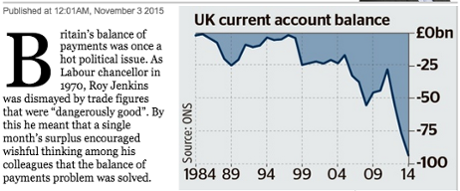
At present, Britain helps to covers its trade deficit with capital from foreign investors - who still get a decent return on their investments. In contrast, UK investments overseas aren’t yielding as much - driving the balance of payments further into the red.
So if exports deteriorate, and the global economy worsens, Britain’s prosperity could take a hit.
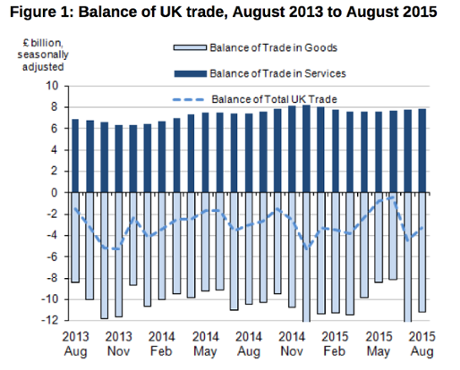
This export gloom is a worry, because Britain is already running a persistent trade gap with the rest of the world.
This chart, from last month’s trade figures, shows how the UK’s surplus in services is more than wiped out by the deficit in goods traded in and out of the country:

Phil Couchman, CEO of parcel business DHL Express UK, says British exporters are suffering from persisting worries over the eurozone (after another summer dominated by the Greek crisis)
The strong pound isn’t helping either, leading to today’s downbeat survey:
Couchman explains:
“We can mostly attribute the drop in export orders and sales to uncertainty in the Eurozone, and the instability of the Chinese and wider global economy.
He’s not sounding too alarmed, though:
Despite these factors, we must remember that UK businesses are resoundingly resilient. Whilst the overall index has fallen, over half of businesses say export orders have remained constant – and half say export sales have too.”
Updated
UK exporters hit six year low as overseas problems bite
The UK manufacturing industry has suffered a painful slump in export growth and confidence as problems in the global economy hit demand.
According to the British Chambers of Commerce this morning, exporters are at their gloomiest since the dark days of the last recession.
Growth in sales and orders is now at its weakest in six years, say businesses surveyed for the Trade Confidence Index.
The BCC warns:
While export orders have remained constant for just over half (54%) of UK businesses, and 50% report that export sales have remained the same as in the previous quarter, both have fallen to their lowest level since Q2 2009.
The report suggests that Britain is going to struggle to close its hefty trade gap with the rest of the world, given the economic problems in the eurozone and many emerging markets.
The BCC also found that:
- 50% of businesses report export sales have remained constant, 21% report a decrease (up from 15% in Q2).
- 54% of businesses report export orders have remained constant, 22% report a decrease (up from 17% in Q2).
- 13% of exporters say that they have seen a decrease in investment in plant and machinery during the previous quarter.
All quite concerning, at at time when growth is slowing in China, America and Canada, and remains lacklustre in Europe.
John Longworth, director general of the British Chambers of Commerce, fears that the sector is teetering on the brink of a serious crisis:
“Driving export growth is key to reducing the UK’s deficit and maintaining our global competitiveness. These figures make it clear that the UK’s export drive is at risk of going into reverse gear, precisely at the time when it needs to be moving forward.
“Many firms are currently operating at capacity and are in need of support to invest in machinery or staff. Those businesses considering taking the leap and breaking into new markets desperately need access to the growth funding and working capital to enable this transformation.
Updated
The agenda: UK construction data and Standard Chartered's new plan

Good morning, and welcome to our rolling coverage of the world economy, the financial markets, the eurozone and business.
Coming up today.....
After yesterday’s splurge of manufacturing data, today we find out how Britain’s builders fared in October. The Construction PMI, due at 9.30am GMT, is expected to show that growth slowed a little.
Construction was the worst-performing sector of the UK in the last quarter, helping to drag growth down to 0.5%, so any signs of fresh weakness will be worrying.
In the financial sector, Standard Chartered is centre-stage as its new CEO, Bill Winters, announces a new turnaround plan. The bank is cutting 15,000 jobs and raising £3.3bn in new capital, and will explain the moves this morning.
We’ve also launched a GBP3.3bn Rights Issue to strengthen our balance sheet and accelerate execution of our strategic plan.
— Standard Chartered (@StanChart) November 3, 2015
Group CEO Bill Winters: “These actions will result in a lean, focused & well capitalised bank, poised for growth.” pic.twitter.com/XRRZGVvKLE
— Standard Chartered (@StanChart) November 3, 2015
Volkswagen is also in the spotlight, after US regulators claimed that the emissions cheating scandal was even bigger than expected.
The Environmental Protection Agency (EPA), which uncovered the initial emissions rigging at VW, claims the carmaker installed defeat devices in VW, Audi and Porsche vehicles with three-litre engines in models with dates ranging from 2014 to 2016.
That could pull VW’s shares down again today.
Europe’s stock markets are tipped to rally a little, after Wall Street closed almost 1% higher.
Bit of a lift expected for the FTSE this morning after a strong finish in the US. FTSE100 forecast to start +25 at 6387.
— David Jones (@JonesTheMarkets) November 3, 2015
And over in Australia, the central bank has left interest rates unchanged - and suggested that economic conditions have ‘firmed’ a little.
Here’s how the action unfolded (with bonus horse racing coverage):
We’ll be tracking all the main events through the day....
Updated