Summary
Here the latest key developments at a glance:
- A government-backed study is being launched to determine whether people can be safely given different coronavirus vaccines for their first and second doses, with results expected “probably after the summe”, according to vaccines minister Nadhim Zahawi.
- The UK reported 915 further deaths on Thursday, as well as 20,634 new infections, slightly up from Wednesday’s 19,202 new cases. Over the past seven days, infections in the UK have declined by 25,7%.
- Zahawi declined to give a date for when the first nine groups in the priority list will have received their vaccine. Previously, NHS England chief executive Sir Simon Stevens has said the aim is for all over-50s and those at risk to be vaccinated by the end of April.
- Rob Paterson, chief executive of Best Western hotels, has criticised a lack of communication from the government over its plan to quarantine certain international arrivals in hotels, and said hotel bosses “to this day simply haven’t heard anything despite multiple offers”. The health secretary, Matt Hancock, will lay out the “operational plan” for hotel quarantines next week.
- “A significant return to normality” is on the cards once the most vulnerable groups have been vaccinated, Scientific Advisory Group for Emergencies (Sage) member professor Andrew Hayward said on Thursday, but Nadhim Zahawi told the Commons that the economny would only be reopened “very gradually”.
-
Nadhim Zahawi told the Commons the UK government, despite having pre-purchased 300m coronavirus vaccine doses, was “nowhere near having enough supply” to send vaccines to poorer countries.
- The Welsh health minister, Vaughan Gething, said that there cannot be a “huge splurge of reopening” in the country despite Covid-19 rates falling since before Christmas.
- England’s infections fell by 29% in week to 27 January, as a total of 196,257 people tested positive for Covid-19 in England at least once in that week.
- Case rates in England have decreased in all age groups and are currently highest in those aged 30-39 years old, according to Public Health England.
- Around one in 10 major hospital trusts in England had no spare adult critical care beds last week, according to NHS England figures.
- A mutation of coronavirus initially detected in Liverpool has been found in Preston and West Lancashire, local health officials said on Thursday.
That’s everything from me, this blog will close shortly. Thanks for following along and writing in.
Labour’s Yvette Cooper has written an article for PoliticsHome on why she believes the government’s border policy isn’t working in its current form.
She writes:
For a start, we cannot afford more delays. Pre-travel tests are finally in place but that didn’t happen until four weeks after the South Africa variant was discovered and many months after other countries did the same.
There is still no timetable for quarantine hotels, and major hotel chains say they haven’t yet been contacted. That means that months after risky new variants were identified, people can still travel home on indirect flights from South Africa or Brazil, not be tested on arrival at Heathrow and head straight onto the tube.
[...]
Even once quarantine hotels are in place, they won’t cover the vast majority of passengers and the system for everyone else is still too weak. No one is tested on arrival even though passengers could have been on long, crowded journeys to the airport or in busy departure halls since their last test was done. And everyone can go straight onto public transport home - getting onto the tube, bus or train with key workers.
Last week, Cooper questioned Priti Patel in the Commons over the government’s plans to tighten the borders to curb cases, and pressed the home secretary on “crowded scenes at Heathrow on Friday at the UK border—the very opposite of quarantine”.
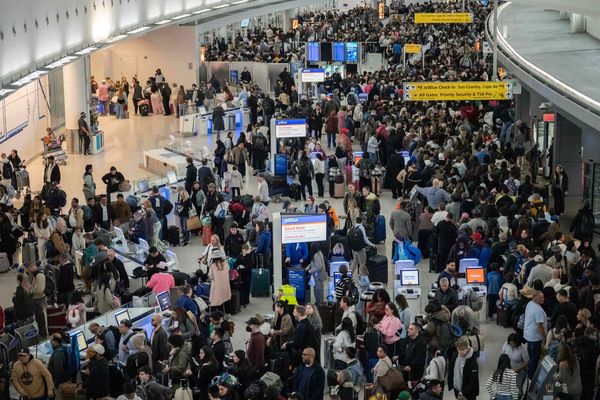
Patel responded: “[Cooper] asked, rightly, about the scenes at Heathrow airport at the weekend, and the fact is that those queues materialised because of the compliance checks that Border Force had put in place.”
Updated
Government data up to 3 February shows that of the 10,992,444 jabs given in the UK so far, 10,490,487 were first doses - a rise of 469,016 on the previous day’s figures.
Some 501,957 were second doses, an increase of 2,995 on figures released the previous day, PA Media reports.
The seven-day rolling average of first doses given in the UK is now 430,532.
Based on the latest figures, an average of 409,956 first doses of vaccine would be needed each day in order to meet the government’s target of 15 million first doses by 15 February.
Updated
Liverpool virus mutation found in Preston and West Lancashire
A mutation of coronavirus initially detected in Liverpool has been found in Preston and West Lancashire, say local health officials.
People living in those areas are being urged to take a Covid-19 test if they are feeling unwell, with symptoms including a cold, mild flu and headaches.
Dr Sakthi Karunanithi, director of public health and wellbeing at Lancashire county council, said:
If you live in Preston or West Lancashire and you’re feeling under the weather, please get a Covid test.
It doesn’t matter if you don’t have the three classic symptoms of a fever, loss of taste or smell, or a cough - even a headache could be an indication you may have this mutation.
Understandably, some residents may be concerned but all viruses mutate over time so this should not cause any further alarm. Alongside our partners, please rest assured that we are monitoring the situation closely.
It is important to stress that there is currently no evidence that this mutation alone causes more severe illness or is more transmissible.
On Tuesday, health secretary Matt Hancock had said there had been 11 cases of “mutations of concern” in Bristol and 32 in Liverpool, and that both cities had been added to areas that will see large amounts of community testing.
Updated
A further 10 people with Covid-19 have died in Northern Ireland. Another 412 positive cases of the virus were also notified by the Department of Health on Wednesday.
There are 671 Covid-positive inpatients in hospital, 68 of whom are in intensive care.
First minister Arlene Foster said the current lockdown had made a “major difference” in efforts to suppress the virus.
“In real terms, this means that many thousands of people have been protected from this deadly virus, some of whom would have not survived contact,” she said.
Updated
UK reports 915 further deaths and 20,634 new infections
The UK reported 915 further deaths on Thursday, as well as 20,634 new infections, slightly up from Wednesday’s 19,202 new cases.
Over the past seven days, infections in the UK have declined by 25,7%.
On Wednesday, 1,322 deaths had been reported. The official death toll now stands at 110,250.
The government said on Thursday a further 2,365 people had been admitted to hospital, compared with yesterday’s 2,651.
Updated
The UK’s vaccination programme will help the economy bounce back sharply later this year towards levels seen before the crisis, the Bank of England boss, Andrew Bailey, said on Thursday.
The Bank’s governor said the rapid rollout of the programme would help the economy recover from the start of the summer as it allows restrictions to be lifted and gives Britons more confidence to spend.
But the Bank also warned the third national lockdown in England would send the gross domestic product (GDP) tumbling by more than 4% at the start of this year.
Bailey said:
The MPC’s central forecast assumes that Covid-related restrictions and people’s health concerns weigh on activity in the near term, but that the vaccination programme leads to those easing, such that GDP is projected to recover strongly from the second quarter of 2021, towards pre-Covid levels.
Updated
London is the region with the highest proportion of people aged 70 to 74 to have had their first dose of the Covid-19 vaccine, according to additional figures from NHS England.
An estimated 61.1% of people in the capital in that age group had received their first jab by 31 January, compared with 24.6% in south-west England and 25.6% in south-east England.
Figures for the other regions are: north-west England 46.0%, eastern England 36.8%, Midlands 33.9%, north-east England/Yorkshire 29.2%.
For the 75-79 age group, the estimates are: north-west England 87.9%, south-west England 84.5%, eastern England 84.3%, north-east England/Yorkshire 83.4%, Midlands 81.6%, south-east England 79.8%, London 76.2%, PA Media reports.
This just in from Channel 4 News’ Alex Thomson:
Got it finally for you: Scotland had vaccinated 98% (on Monday) of people in elderly care homes. NHS just released the figure for England and it is 90.1%
— alex thomson (@alextomo) February 4, 2021
On Monday, NHS England said it had offered vaccines to every eligible care home with older residents, except a “small remainder”, to be confirmed by official figures later that day, PA reports.
Downing Street also said all eligible care home staff had been offered a coronavirus vaccine and that figures expected on Monday would confirm this.
According to NHS England figures, 99% of all care homes have been visited by vaccination teams, but only 90.0% of eligible care home residents have had the vaccine.
This from the ipaper’s Hugo Gye:
Some of those will have been medically unable to receive a vaccine and homes will be revisited to give these people a second chance.
— Hugo Gye (@HugoGye) February 4, 2021
In Scotland around 98% of older care home residents had got a jab by this morning. In Wales, the figure was 75.1% on Tuesday.
Here's the proportion of those aged 80% who'd had the vaccine in each English region by Sunday:
— Hugo Gye (@HugoGye) February 4, 2021
East Of England 88.1%
London 74.9%
Midlands 88.7%
North East And Yorkshire 90.5%
North West 88.9%
South East 88.8%
South West 92.8%
Earlier on Thursday, on Good Morning Scotland, the vaccines minister, Nadhim Zahawi, said 91% of eligible residents had been given the vaccine.
Asked in the Commons what percentage of all care home residents and all staff in England had received a jab, Zahawi did not give an answer.
Updated
More than 100 Public Health England workers have been given a Covid jab despite not falling into any of the priority categories.
The decision to vaccinate staff at PHE’s site in Porton Down, Wiltshire, has raised questions internally at the agency about how those involved were allowed to jump the queue for their first doses of the vaccine.
The move has also sparked fears that it will undermine the public health message about the importance of vaccinating priority groups first – a strategy that PHE helped to draw up and promote.
My colleague Matthew Weaver reports.
Health secretary Matt Hancock said the UK remained on track to complete the vaccination of the top four priority groups by 15 February, with one in five of all adults now having received the jab.
He told reporters on Thursday:
We are on track to deliver the commitment we have made of offering the jab to all of the top four priority groups by 15 February.
I’m just so proud of the team who are delivering this, it’s going really, really well.
You saw yesterday 10 million jabs done. Today we passed the threshold of one in five of the population who have been jabbed already.
Hancock would not confirm whether details of the government’s hotel quarantine plan would be set out next week.
Asked if there would be an announcement next week, he told reporters: “Of course we’re working at pace to further strengthen the measures at the border but we’ve already put in place for isolation for everybody who arrives, wherever they come from in the world.”
Hancock said he discussed the issue with Australian ministers earlier on Thursday because they already have “quarantine hotels”.
“We have been working to make sure that we get this right,” he said.
Hancock insisted “there isn’t a delay, what there is is work to make sure that the border is always as secure as it needs to be.”
Updated
A seven-year-old with known underlying health conditions is among the latest reported deaths of people who have tested positive for coronavirus in England.
The child is thought to be among the youngest to have died with the virus, PA Media reports.
England’s chief medical officer, Prof Chris Whitty, has previously said the chances of children dying from Covid are “incredibly small” and they are less likely to get severe illness and end up in hospital due to the virus.
Last year the parents of 10-year-old Fehzan Jamil, from Bradford, spoke of their “indescribable” pain following his death.
The young boy, who had a number of underlying health issues, including epilepsy, died in hospital after contracting the disease and was laid to rest in November.
Other young victims of the pandemic in the UK include Ismail Mohamed Abdulwahab, who died in March aged just 13, with no known underlying conditions.
A 13-day-old baby, thought to have no underlying health conditions, was reported to have died with Covid-19 by NHS England in June.
Updated
Around nine in 10 eligible residents of older adult care homes in England have had their first dose of the Covid-19 vaccine, NHS England said.
As of the end of 31 January, 236,499 residents had received their first jab, out of 260,060 who were eligible for the vaccine - a total of 90.9%.
NHS England said the number of eligible residents included a small number of residents at care homes currently undergoing an outbreak and which cannot yet be visited for vaccination, along with residents who did not receive the vaccine for valid medical reasons, and those for whom consent had not been provided.
When pressed earlier in the Commons why some care homes hadn’t been visited and offered vaccines yet, the vaccines minister Nadhim Zahawi didn’t give a reason.
Updated
The vaccines minister Nadhim Zahawi has declined to say whether the government is recording data on who has refused a coronavirus vaccine.
Zahawi said uptake was “incredibly high” in the UK, with 85% of adults accepting the vaccine, according to the Office for National Statistics, and the 15% skewing heavily towards black, Asian and minority ethnic (BAME) communities.
PA Media reports:
He acknowledged that recent research from the London School of Hygiene & Tropical Medicine, which found that white people were twice as likely to have been vaccinated than black people, was “worrying”.
The minister was asked three times on BBC Radio 4’s Today programme if refusal rates were being tracked.
He confirmed that everybody who had had the vaccine went into the national immunisation vaccination system.
But he did not say this was true of those who had declined a jab, instead referring to the “high” uptake among the first four priority groups.
Asked if the government should be recording this, he said: “So we absolutely will look at how we are addressing the issue of refusal rates. At the moment, this is the highest uptake of any vaccination programme, including all the flu vaccination programmes, that NHS has run.
“So currently the good news is the UK is the standout country in terms of people actually wanting to keep themselves safe by being vaccinated and of course keep their families and communities safe as well.”
Updated
A total of 9,508,006 Covid-19 vaccinations had taken place in England between 8 December and 3 February, according to provisional NHS England data, including first and second doses, which is a rise of 381,076 on the previous day’s figures.
Of this number, 9,041,835 were the first dose of the vaccine, a rise of 378,794 on the previous day’s figures, while 466,171 were the second dose, an increase of 2,282.
On Saturday, almost 540,000 people received their first jab in England, a daily record since the inoculation programme began.
A breakdown of NHS England data by region shows that a total of 1,081,307 jabs have been given to people in the south-west between 8 December and 3 February, including 1,025,480 first doses and 55,827 second doses.
This compares with 1,723,042 first doses and 70,404 second doses given to people in the Midlands, a total of 1,793,446.
The breakdown for the other regions is as follows:
East of England - 1,096,607 first doses and 56,377 second doses, making 1,152,984 in total
London - 1,051,735 first doses and 60,907 second doses, making 1,112,642 in total
North-east and Yorkshire - 1,400,503 first doses and 75,095 second doses, making 1,475,598 in total
North-west - 1,249,300 first doses and 66,894 second doses, making 1,316,194 in total
South-east - 1,443,444 first doses and 80,330 second doses, making 1,523,774 in total.
Updated
MPs will at the end of this month debate proposals for getting students back into schools, Jacob Rees-Mogg announced on Thursday.
PA Media reports:
Speaking during the business statement in the Commons, Jacob Rees-Mogg said proceedings on Thursday 25 February will include “a general debate on the proposal for a national education route map for schools and colleges in response to the Covid-19 outbreak”.
It comes as the government faces mounting pressure from some Conservative MPs to get children back to physical learning as soon as possible.
Education secretary Gavin Williamson has maintained that schools and colleges will get at least two weeks’ notice before pupils return to the classroom in order to give pupils, parents and teachers time to prepare.
Prime minister Boris Johnson has said he hopes it will be safe to commence the reopening of schools from Monday 8 March.
Updated
The UK government is “bailing out” Scotland to help speed up its vaccine rollout, Jacob Rees-Mogg, the leader of the House of Commons and lord president of the council, has claimed.
During business questions in the Commons, the minister said there had been a “really important unionist level of support”.
Raising the issue, the SNP MP Owen Thompson challenged the government over what he described as “unfair and unreasonable limits” placed on borrowing powers.
Thompson said:
[On Wednesday], I tried to seek some assurance from [Welsh secretary Simon Hart] on the financial powers for devolved nations around their tackling of the pandemic and looking forward to how we tackle climate change.
As part of that, I was looking to see why it is that the Treasury continue to impose unfair and unreasonable limits on the devolved nations’ borrowing powers.
I’d be very grateful if we could have a debate in government time to further consider what steps we could take to consider these implications and the impact it has on the devolved nations and to untie the hands of devolved nations so that we can tackle all the challenges that face us.
Rees-Mogg responded:
On the fiscal arrangements, it is worth reminding [Thompson] that 8.6 billion of UK taxpayers’ money has gone to help Scotland during the pandemic and it is the strength of the United Kingdom that throughout this pandemic has provided the support that has been needed.
He may chunter behind his elegant mask but that means 779,500 jobs in the furlough scheme, it means 1.13 billion in the self-employed scheme. It is a really important unionist level of support.
And we know now that the unionist government is helping the devolved Scottish government roll out its vaccine programme, that more people will be going from the British Army to help set up more vaccine centres.
This is our UK government bailing out a devolved government. That is what we do and we should be really proud of the United Kingdom which has such strength as one country.
Updated
Oxford University has announced record admissions for students of British black, Asian and minority ethnic heritage.
Figures released by the university show the proportion of offers of a place rose from 22% last year to 23.6% this year, though offers to state school pupils dipped slightly, down from last year’s record of 69.1% to 68.7%.
The university said 684 black, Asian and minority ethnic undergraduates had been accepted for a place to start studying in the autumn, up from 558 last year. The number of places offered to black students, a group which has previously been significantly underrepresented at Oxford, went up from 80 (3.2%) to 106 (3.7%) out of a total of 3541 offers.
Dr Samina Khan, the director of undergraduate admissions and outreach at Oxford, said:
Last year’s record figures for offers to students from underrepresented groups was a significant step towards diversifying our student body.
But to be able to make further advances for a second year during the Covid-19 pandemic is an achievement and testament to the hard work by many students in these difficult circumstances.
Updated
The SNP’s Kirsty Blackman, the MP for Aberdeen North, asked vaccines minister Nadhim Zahawi to explain how the UK government, having pre-purchased 300m coronavirus vaccine doses, would “step up” and ensure, as a “global Britain”, that poorer countries around the world would get doses as well, since the Covax programme will only provide vaccines to about 20% of the population in low- and middle-income countries.
Blackman said Guinea for instance had only received 55 doses for its entire population.
Zahawi responded: “Once we have enough vaccine supply to be able to offer the vaccine to every eligible adult in the United Kingdom, every adult in the United Kingdom, I should say [...] then we will look at our vaccine supply strategy. At the moment we are nowhere near having enough supply to be able to make that offer. That has to be our priority.”
Updated
Nadra Ahmed, the chair of the National Care Association, said she thought more care workers would take up the offer of having the vaccine as “time goes on”.
She told BBC Radio 4’s World at One that quite a “high average was emerging, around the 20% mark” of employees in the sector who were refusing to have a jab to protect them against Covid-19.
Admitting the scenario was “quite a challenge”, Ahmed said it was important to educate care workers on why they should get vaccinated.
She said:
We can’t compel anybody to have it but I do feel very optimistic about this because I think, as time goes on, some of the people who are refusing at this stage will feel more comfortable.
This is more about building confidence and education and making sure we answer every single question that anyone asks about it to empower them to understand the value of the vaccine and then make an informed decision.
Updated
The mayor of the West Midlands, Andy Street, has announced his mum has died after contracting Covid-19.
Street announced on Twitter: “Painfully, yesterday, I joined so many others in our region who have lost a loved one to Covid - my Mum.
“All I want to say is to offer my sincere thanks, appreciation, and respect to the staff at Heartlands for all they did for her, and for everything they do day in and day out.”
Painfully, yesterday, I joined so many others in our region who have lost a loved one to Covid - my Mum. All I want to say is to offer my sincere thanks, appreciation, and respect to the staff at Heartlands for all they did for her, and for everything they do day in and day out.
— Andy Street (@andy4wm) February 4, 2021
Street is the Conservative mayor of the West Midlands region, which includes Birmingham and Coventry, and is running for re-election in May.
In the West Midlands, 11,427 have died after contracting Covid since the start of the pandemic, a rate of 192.6 per 100,000 of the population – overall the third highest rate in England.
Updated
England's infections now highest among 30-39-year-olds
Case rates have decreased in all age groups and are currently highest in those aged 30-39 years old, this week’s Covid-19 surveillance report by Public Health England shows.
The data, covering the last week of January and for some indicators daily data for the days up until 2 February, also shows that case rates have fallen in all regions and are now highest in the West Midlands.
In the West Midlands, the rate of new cases stood at 319.9 per 100,000 people in the seven days to 31 January – the highest rate of any region, but down from 427.5 in the previous week.
North-west England recorded the second highest rate: 281.1, down from 379.9.
South-west England recorded the lowest rate: 172.9, down from 237.4.
Hospital admissions for Covid-19 remain highest in those aged 85 and over, the report said.
This week's #COVID19 surveillance report shows that case rates have decreased in all age groups and are currently highest in those aged 30-39 years old.
— Public Health England (@PHE_uk) February 4, 2021
See the data for yourself: https://t.co/8dYt9zEVk9 pic.twitter.com/dqWOVJoJGx
Case rates in England are also continuing to fall among all age groups, Public Health England said.
The highest rate is among 30 to 39-year-olds, which stood at 358.6 cases per 100,000 people in the seven days to January 31, down week-on-week from 499.5.
Among 20- to 29-year-olds, the rate dropped from 478.7 to 333.5, and for 40 to 49-year-olds, it fell from 442.5 to 316.0.
For people aged 80 and over, the rate fell from 412.0 to 284.5.
Updated
A further 630 people who tested positive for coronavirus have died in hospital in England, bringing the total number of confirmed deaths reported in hospitals to 74,249, NHS England said on Thursday.
Patients were aged between seven and 102. All except 30, aged between 40 and 99, had known underlying health conditions.
The deaths were between 4 January and 3 February, with the majority being on or after 29 January.
A further 42 other Covid-related deaths were reported with no positive Covid-19 test result.
The Conservative MP Mark Harper, MP for Forest of Dean and chairman of the Covid Recovery Group (CRG), which is made up of lockdown-sceptic Conservative MPs, asked the vaccines minister, Nadhim Zahawi, in the Commons whether all lockdown restrictions would be relaxed once the first nine priority groups, accounting for 99% of deaths and about 80% of hospitalisations, have been vaccinated.
Zahawi responded that “no one more than he and the prime minister wants to get the economy back open [...] as soon as possible”, but said the impact of the vaccines would kick in about four weeks from mid-February.
It was important to wait for evidence on transmissions and the impact of vaccinations, Zahawi said. “Robust evidence” was needed before the economy was going to be reopened “very gradually”, he added.
Updated
The rate of the fall in Covid-19 cases made him optimistic that restrictions on households mixing could be lifted as soon as next month, Paul Hunter, professor of medicine at the University of East Anglia, said on Thursday.
Hunter added that pupils could be back to school before the prime minister’s 8 March target date.
He told BBC Radio 4’s World At One:
I think there could well be a case for opening schools sooner - I particularly think schools for children under 11 years of age, where the evidence that they contribute to the spread of the epidemic in the wider population is a lot lower.
I would certainly hope to see schools, and particularly junior schools, opening relatively soon.”
Asked about when people could start to see friends and family, Prof Hunter replied:
Personally I believe we should be able to start doing that probably not long after [schools reopen] - if I had to bet on a time, I’d say some time in March certainly.
Updated
Students in Northern Ireland are to receive a £500 payment to reflect the disruption to studies caused by the pandemic.
All students from the UK or EU currently enrolled on a full-time higher education course in the region will receive the one-off discretionary payment, PA reports.
The Covid disruption payments will be issued to students by the end of March.
An estimated 39,900 students will be eligible, and the scheme will cost £22m.
The initiative is part of a wider financial support package of almost £38m for higher education signed off by the Stormont executive on Thursday.
The economy minister, Diane Dodds, who has responsibility for higher education, said:
I am acutely aware that students in local higher education institutions have experienced significant disruption since the onset of the pandemic and that this continues to have an impact.
I am pleased to confirm that I have secured £22m from the executive to fund a one-off discretionary payment of £500 to all students from the UK and EU who are in full-time higher education in Northern Ireland, whether that is in a university or further education college setting.
Updated
Conservative MP Richard Drax, the MP for South Dorset, asked vaccine minister Nadhim Zahawi in the Commons to give more information about the planned 12-week gap between Pfizer vaccines following “concerns from the medical world”.
Zahawi replied:
Pfizer themselves say that it is up to the national regulatory authority to essentially advise on the dosing interval and so not only the MHRA regulator but the JCVI and the four chief medical officers of England, Scotland, Wales and Northern Ireland all agreed that the up to 12-week interval for Pfizer/Biontech is exactly the right thing to do to make sure we protect as many people as possible.
Labour’s Kerry McCarthy, MP for Bristol East, asked Zahawi, in light of the more infectious Kent variant having been found in Bristol, where the development of new vaccine variants against new mutations would leave people who have already been vaccinated or who will be vaccinated with existing vaccines.
Zahawi replied:
The current vaccines that we are deploying will work on the variants that are in the United Kingdom.
So we continue to vaccinate at speed, at the same time, of course, being vigilant by sequencing the new variants and of course being able to react with the manufacturers to any future need in terms of the vaccination programme.
Updated
Boris Johnson made a “genuine error” by stating that an announcement on quarantine hotels for international arrivals would be made on Thursday.
PA Media reports:
The prime minister told a Downing Street press conference on Wednesday evening that the health secretary would set out the plans the following day.
But Mr Johnson’s official spokesman told a Westminster briefing on Thursday: “It was a genuine error ... there is a statement by the vaccines minister in the House later today, but that is on vaccine deployment.
“The health secretary will set out the operational elements of the policy next week.”
The spokesman added: “We are continuing to work on the operational side and we will set out more detail next week.”
Downing Street said the government was continuing to work on how to introduce the quarantine policy successfully.
“The government continues to work on how we will ensure that we introduce this policy successfully.
“There are operational aspects of the policy that need to be completed and once they are we will set out the full details next week.”
The spokesman said a number of departments were working on the policy, but could not confirm who was ultimately in control.
Updated
Nicola Sturgeon confirmed there were 1149 new positive tests in Scotland overnight, with a 4.9% test positivity rate, which she described as a “small ray of sunshine” – a rate under 5% is one WHO indicator of having the virus under control. This is the first time the rate has been below 5% in over a month.
Sturgeon also confirmed that 694, 347 people have now received the first dose of a Covid vaccine, an increase of 45 085 and the highest daily total so far.
She said that the Scottish government’s current policy was “children first”, saying that getting young people back into schools would mean “the rest of us can’t go for a pint in the pub or a meal in a restaurant for a bit longer”.
She said that there would be a similar trade-off regarding overseas travel and quarantine for visitors in the medium term, while saying she was unable to say how long that managed quarantine requirement would last for: “If we want greater normality at home, we’re going to have to accept for a period the tradeoff is no overseas travel”.
Neale Hanvey, the SNP health spokesman, asked Zahawi to confirm the number of all care home residents and care home staff who have had the jab, and to justify why some hadn’t received it.
Zahawi responded that it was the government’s target last weekend to make sure over 10,000 eligible care homes had been visited and offered the vaccine, and said that “only a handful of care homes who were deemed to have an outbreak weren’t visited”.
“I’m slightly saddened in a way that there is this sort of politicking between ourselves here around this issue,” Zahawi added.
Staff in care homes were also offered the vaccine on those visits, Zahawi said.
Updated
The chair of the health and social care committee, Jeremy Hunt, asked Zahawi about the timescale of the development, approval and manufacturing of vaccines that would protect against mutations of the virus.
Hunt also asked about the prospect of a “worst-case scenario” in which a Covid-19 variant is immune to vaccines.
“I wonder, now that we know that mutations and variants are really the name of the game, if I could ask [Nadhim Zahawi] about a worst-case scenario which is that we see a variant that is wholly immune to the vaccines that we are currently distributing? How possible is it that we could see that in the next few months in the UK? Has the Manaus variant from Brazil, which I know people are particularly worried about, arrived here?”
Zahawi said manufacturers were already working on tweaking their vaccines to have efficacy against variants, repeating comments he made earlier this morning and pointing to the UK’s world-leading genome sequencing industry and catalogue of virus mutations that would aide the developments of new vaccine variants.
The government is looking at making the most of new messenger RNA technology to develop effective vaccines for virus mutations, Zahawi said, adding that a new vaccine variant could theoretically be developed in “30 to 40 days”, but he didn’t provide a concrete timescale.
Updated
Zahawi said “no one is really safe until the whole world is safe”, and told MPs:
We will not rest on our laurels - no one is really safe until the whole world is safe.
Our scientific pioneers will keep innovating so we can help the whole world in our collective fight against this virus.
Data from a study by the University of Oxford released this week suggested a single dose of the Oxford/AstraZeneca vaccine offers protection of 76% for up to three months and may reduce transmission by 67% - with efficacy rising to 82.4% after the second dose 12 weeks later, PA reports.
Alex Norris, shadow health and social care minister, welcomed the announcement of the new clinical trial and the news of the Oxford/AstraZeneca jabs efficacy, and asked Zahawi when colleagues would receive “hard” council ward-level data on the lagging uptake of the vaccine in the UK’s BAME population.
Regarding second doses, Norris asked what assurances Zahawi could give about when people would get their second doses.
Zahawi said the government was doing an “enormous amount of work” to share data with local governments on BAME uptake, and that he wanted local clinical commissioning groups sharing data on this with the government.
In terms of second doses, people would get their second doses of the same manufacturer within 12 weeks, Zahawi said.
Norris further pleaded for the inclusion of key workers in the priority list, and asked whether the government was looking at this suggestion Labour has raised over a week ago.
Zahawi responded that the Joint Committee on Vaccination and Immunisation (JCVI) looked very closely at both BAME uptake and other factors and decided that age was the most deciding factor in determining who should be prioritised in getting the jab, adding that he believes it would be wrong to change the JCVI recommendation.
The JCVI would advise on the vaccinations of teachers, shop workers and police officers and other frontline staff in phase two of the vaccination programme, once groups 1-9 had received the jab.
Zahawi said:
I certainly think it would be wrong to change the JCVI recommendation because 1-9 is 99% of mortality.
I think when we get into phase two then we would welcome a debate and of course ask the question of the JCVI as to whether professions like teachers, like shop workers, like police officers, who though their work will come into contact with much greater volumes of the virus than others do, and they will then advise us accordingly.
Earlier today Zahawi had told a London Assembly session that his “big fear” is that Covid-19 will infect unvaccinated groups and “once it gets into particular communities it will go through them like wildfire”.
He said:
Vaccine acceptance in the UK is the highest in the world and I’m very proud of that. The ONS (Office for National Statistics) survey suggests 85% of adults will take a vaccine.
That’s great on its own but the 15% skew heavily toward BAME communities, and especially the black and afro-Caribbean community, which I am concerned about.
Updated
Even though we appear to be past the peak, Zahawi said, and the accelerating vaccination programme being the way out of the pandemic, it would take time for vaccinations to show big effects, “so we must all stand firm”, he said.
The vaccines minister said the Oxford/AstraZeneca vaccine gives 76% protection during the 12-week interval between the first and second dose, and “seems likely” to reduce transmission to others by two-thirds.
A world-first year-long study would look at the potential use of two different vaccines in a person, he said, adding that there are no current plans on changing the current use of the vaccines, he said.
Updated
Zahawi thanked volunteers, doctors, GPs, nurses, local authorities, manufacturers, and the army, among others, for playing a part in the vaccine rollout.
The level of infection was still “alarmingly high”, he said, with over 32,000 patients still in hospital.
“Our portfolio now stands at over 400m doses,” he said.
There are now 89 large vaccination centres and 194 sites in UK high street pharmacies, he said, along with 1,000 GP-run services, and over 250 hospital hubs.
Updated
Nadhim Zahawi’s Covid-19 vaccine statement in the Commons has just begun.
Almost one in five adults in the UK have now received one dose of coronavirus vaccine, he said.
“I am pleased to inform the House that we have now vaccinated almost nine in 10 over-80s in the UK, almost nine in 10 over-75s, and over half of people in their 70s,” he said.
“We’ve also visited every eligible care home possible with older residents in England and have offered vaccinations to all their residents and staff.
“This means we are currently on track to meet our target of offering a vaccine to the four most vulnerable groups by mid-February.”
Updated
Wales reported a further 544 cases of coronavirus on Thursday, taking the total number of confirmed cases to 194,525.
Public Health Wales reported another 35 deaths, taking the total in Wales since the start of the pandemic to 4,867.
Public Health Wales said a total of 490,570 first doses of the Covid-19 vaccine had now been given, an increase of 28,073 from the previous day.
The agency said 1,216 second doses were also given, an increase of 56.
Updated
Mass testing is starting in parts of Birmingham today after two cases of the South African coronavirus variant were detected in the country’s second-largest city.
All adults aged 18 and over who live or work in the Frankley Great Park ward and part of the south Northfield area are being asked to take a Covid test, even if they do not show symptoms.
Door-to-door testing also started in the nearby market town of Walsall yesterday after the new strain was detected there.
Dr Justin Varney, director of public health in Birmingham, said: “This new variant from South Africa presents a new risk so it is essential that all adults in the affected areas take up this offer of testing to help us contain the spread quickly.”
Varney said the new variant was detected in two people, part of an extended family living in neighbouring homes, who tested positive for Covid-19 in early January, but it was not until Friday that random tests picked up the South African strain.
The two cases are not linked to international travel, he confirmed.
“There is no cause for panic. We simply ask people to not take risks. We are being over cautious to an extent,” said Varney.
Drive-through testing is available without an appointment, while a further mobile testing centre will be opened on Friday and the council has opened sites for people to collect home testing kits.
Updated
The vaccines minister, Nadhim Zahawi, is going to give an update in the Commons at 12.30 today.
As we reported earlier, Zahawi appeared to suggest this morning that the government is considering making the vaccination of the top nine risk categories, which are around 32 million people, a requirement before a substantial easing of restrictions can occur.
Updated
Starmer said ministers should stick to their 8 March target date for reopening schools, despite classrooms in Scotland possibly opening to pupils later this month.
He said:
All of us want schools to be open just as quickly as possible, there is huge damage done to children by being out of school.
The prime minister said 8 March but the biggest threat is that, if we reopen on 8 March, there will be disruption because, unless we vaccinate teachers and school staff, we know that they will have to self-isolate, as they did in September through to December, with disruption - we need testing in schools, we need ‘Nightingale classrooms’.
I’d actually rather the prime minister sticks to the date he has got and makes sure we open fully without disruption, because I think we can all work to that date.
Starmer repeated that he wanted to see hotel quarantine measures applied to every international arrival, with exemptions only for people supplying medicines or food.
He said:
We’re calling for quarantine for everybody who arrives in the UK from any country.
There will have to be exceptions for medicines and foods - there always is - but for everybody else that is not within those exceptions, a full quarantine.
And the reason for that is because, in the first wave, 0.1% of cases came from China where we had restrictions, 62% came from France and from Spain, where we didn’t have restrictions.
There is every reason to think the variant will behave in the same way and that’s why we’re saying to [the] government: ‘We’re in race now, virus against vaccination, let’s secure our borders while we carry out the vaccination process.’
Boris Johnson on Wednesday defended attacks on his planned hotel quarantine scheme in the Commons, labelling it “not practical” to introduce mandatory quarantine in government-provided accommodation for all travellers arriving in the UK.
Nicola Sturgeon said on Monday that a mandatory hotel quarantine would be extended to all travellers arriving in Scotland “regardless of which country they have come from”.
The chief executive of Glasgow and Aberdeen airports, Derek Provan, criticised the Scottish government for not involving the industry in its discussions.
Updated
The Labour leader, Sir Keir Starmer, has said the UK will be back to “square one” if coronavirus variants that currently-approved vaccines might not be effective against enter the country and urged the government to bring in blanket quarantine measures for international arrivals.
Speaking to broadcasters at a vaccine centre at Watford’s Asda supermarket, Sir Keir said:
Of course tough quarantine measures have an (economic) impact and in a sense nobody wants that.
But if a variant gets through that isn’t subject to the vaccine, we are going to be back to square one and that will have months of impact on the economy, huge damage to the economy.
So the risk is huge if we don’t secure our borders and I think most people would say: ‘For heaven’s sake, now we’ve got the vaccine being rolled out, don’t put that at risk.’
Surely, before you announce arrangements like this, you’d have done the planning beforehand.

Updated
Some 82.7% of people who were tested for Covid-19 in England in the week ending January 27 at a regional site, local site or mobile testing unit - a so-called “in-person” test - received their result within 24 hours.
This is up from 70.7% in the previous week and is the highest figure since the week to 8 July 2020.
PA Media reports:
Prime minister Boris Johnson had pledged that, by the end of June 2020, the results of all in-person tests would be back within 24 hours.
He told the House of Commons on 3 June he would get “all tests turned around within 24 hours by the end of June, except for difficulties with postal tests or insuperable problems like that”.
Of the 198,874 people transferred to the test and trace system in the week to 27 January, 86.4% were reached and asked to provide details of recent close contacts.
This is down very slightly from 86.9% in the previous week. Some 11.9% of people transferred to test and trace in the week to 27 January were not reached, while a further 1.7% did not provide any communication details.
Updated
England's infections fell by 29% in week to 27 January
A total of 196,257 people tested positive for Covid-19 in England at least once in the week to 27 January, according to the latest test and trace figures.
This is down 29% on the previous week and the lowest number since the week to 16 December, PA reports.
Updated
Over 1 in 10 (12%) currently trading UK businesses said that turnover had decreased by more than 50% compared with what is normally expected for this time of year, according to latest findings from the Office of National Statistics (ONS) Business Impact of Coronavirus Survey.
London saw the largest fall in volume of online job adverts across all UK countries and regions between 22 and 29 January 2021, according to online job advert figures from job search engine Adzuna.
Retail footfall figures from Springboard show overall retail footfall in the UK in the week ending 31 January 2021 was at 35% of its level in the same week of 202.
There were 5,667 voluntary company dissolutions in the week to 29 January 2021, according to Companies House data, a 17% increase from the previous week, but still lower than the level observed in the same week of 2020.
The vaccines minister, Nadhim Zahawi, is answering questions from a London assembly plenary now.
Assembly member Andrew Boff asked whether the government regretted not remaining a member of the European Medicines Agency (EMA).
Zahawi replied that it was “the right decision to make”, and said that Sir Patrick Vallance should be credited with the successful set up of the UK’s vaccine taskforce, as should Kate Bingham.
“This has led to an incredible success story,” Zahawi said.
Updated
Nicola Sturgeon has labelled arguments that Brexit has given the UK an advantage in procuring more coronavirus vaccines as “over-simplistic”.
PA Media reports:
During an interview on Good Morning Britain, Scotland’s First Minister was asked about comments made by SNP MP Dr Philippa Whitford last July when she said the UK Government should be working with EU partners to find a vaccine.
Interviewer Susanna Reid suggested the UK now managing to get vaccines because it is not part of the EU vaccination programme “must be one of the most powerful arguments for Brexit”.
The SNP leader replied: “I think there’s a bigger point but I’m not going to sit here and say anything other than I think it’s really good that the UK has managed to procure as much vaccine and that the UK as a whole is getting ahead in terms of vaccine.
“We all have an interest in seeing all countries get the populations vaccinated because this is a global pandemic but I think the UK is in a very strong position.
“That the vaccination procurement and the approval of the vaccines started while the UK was still in the EU transition period, the rules around the European Medicines Agency would have allowed that to happen anyway.”
She added: “Of course you can make that argument but sometimes I think it’s a slightly over-simplistic argument, but we should all be pleased that the vaccination programme is going so well.
“The issues around Brexit are much wider and more fundamental but even on this narrow point I think if you were to apply really detailed scrutiny it wouldn’t be quite that simple.
“The UK, even if it had still been in the EU under the rules of medicines approval would still have been able to take decisions around vaccines as it has done.
“But it’s thoroughly a good thing that the UK has got such good supplies. Obviously all of us want to make sure those supplies keep flowing.”
Ms Sturgeon also maintained Scotland’s vaccination rate had sped up this week and is being done proportionately “at a higher rate than England”.When asked if she would change the date of school pupils returning in Scotland if it does not meet its target of vaccinating all over-70s by February 15, she said it was “a hypothetical question but we’re on track to meet that target”.
Around one in 10 major hospital trusts in England had no spare adult critical care beds last week, NHS England figures show.
PA Media reports:
A total of 15 out of 140 acute trusts reported 100% occupancy of all “open” beds each day from January 25 to 31.
These included University hospitals Birmingham NHS foundation trust, one of the largest trusts in England, along with Brighton & Sussex University hospitals NHS trust and Portsmouth hospitals University NHS trust.
The figure is down slightly on 18 out of 140 acute trusts that reported 100% occupancy of critical care beds each day from January 18 to 24.
Updated
The number of patients waiting longer than an hour to be handed over from ambulance teams to A&E staff at hospitals in England has fallen to its lowest level this winter.
PA Media reports:
A total of 2,339 delays of more than 60 minutes were recorded across all acute trusts in the seven days to January 31, according to figures published by NHS England.
This compares with 3,283 in the previous week, and 5,513 in the seven days to January 10 - the highest weekly figure so far this winter.
University Hospitals Birmingham NHS Foundation Trust reported the highest number last week for an individual trust (214 delays of more than 60 minutes), followed by the Royal Wolverhampton Trust (125) and University Hospitals Bristol & Weston NHS Foundation Trust (118).
A handover delay does not always mean a patient has waited in the ambulance. They may have been moved into an A&E department, but staff were not available to complete the handover.
Professor Matthew Snape, the chief investigator in the Com-Cov study into the use of a mixture of Covid-19 vaccines, said no “shine has been taken off” the Oxford/AstraZeneca vaccine over the decision of some European countries - such as Germany, France and Italy - to not use the jab for older people.
Snape, who is an associate professor in paediatrics and vaccinology at the University of Oxford, said the decision was up to those countries and AstraZeneca.
He told Times Radio:
We are interested in preventing disease as best we can with the vaccines, and we are thrilled they are being deployed here in the UK and in many other countries.
The results continue to come out from the studies that have been done here in Oxford, showing the effectiveness of this vaccine - even with a single dose.
So, I don’t think any shine has been taken off really at all.
Asked about Switzerland’s decision not to approve the Oxford/AstraZeneca vaccine, Snape said:
The [Oxford/AstraZeneca] vaccines have been licensed in many, many countries around the world now and been given to millions of people.
We have published in peer-review manuscripts the effectiveness of this vaccine.
The actual filing of the licensure is with Astra Zeneca, and that is between AstraZeneca and the Swiss authorities, so I can’t really comment on that.
But the vaccine has been licensed in many countries around the world and is being used as it is.
Updated
Reopening of primary schools priority over "huge splurge of reopening", Welsh health minister says
The Welsh health minister, Vaughan Gething, also said on Thursday that there cannot be a “huge splurge of reopening” in the country despite Covid-19 rates falling since before Christmas.
He told Times Radio that the “first priority” for the Welsh government is to start a return to face-to-face teaching in some schools.
He said:
We’re hopeful that we’ll be able to start that after half-term, so from the week beginning 22 February, and we think we’re going to be able to focus that on our youngest children in primary schools initially.
That’s because we do have limited headroom. So, despite all the good news about our case rates falling, they’re still just under 125, which is actually still quite high.
We had eye-watering levels before Christmas at nearly 700 cases per 100,000. So really good progress but still high and our NHS is still very pressured.
Critical care today is operating at 130% of its normal capacity. So we can’t have a huge splurge of reopening because we really do think that would lead to a significant bounce-back in cases and potentially overwhelm our service.
We’ve got to go in small steps and schools are the first priority and hopefully, straight after the half-term break, we’ll be able to see our youngest children return to face-to-face learning in primary schools.

Updated
Officials in Wales will meet later to discuss the South African variant after three cases with no clear link to travel were identified in the country, Vaughan Gething said on Thursday.
The health minister told Times Radio that health experts will be examining who the cases had been in contact with and where they had been “to try to pinpoint” how they became infected with the variant.
The three are quite different instances as well, so each of them will tell us something different.
We’re looking at targeted testing at this point to help us as we identify more people they’ve been in contact with.
We don’t think there’s a sensible basis to have the wider community testing that you’re seeing in England.
More than 60% of the first four priority groups in Wales have received their first dose of the Covid-19 vaccination, the health minister, Vaughan Gething said.
He told Times Radio that more than 400 sites across Wales are now delivering vaccines, with the number of mass vaccination centres in the country expected to increase to 40.
He said:
That’s happened because we work so closely between the health service and local government, and with the assistance of military planners too, so it’s been a real team Wales effort.
We’ve now done over 60% of priority groups one to four, so really rapid progress now.
He added that vaccinations at all older adult care homes in Wales, apart from a “handful” that had experienced an active Covid-19 outbreak, have been completed.
Updated
“A significant return to normality” is on the cards once the most vulnerable groups have been vaccinated, Scientific Advisory Group for Emergencies (Sage) member professor Andrew Hayward told BBC Radio 4’s Today Programme on Thursday.
He said:
Once the most vulnerable people, particularly those over 50 and those with chronic illnesses, are vaccinated then yes I think we can see a significant return to normality.
That in addition to the fact coronavirus is a seasonal disease, I think will make a big difference and allow us to open up.
I think what we’ll see is a phased opening up as the vaccination levels increase, and then we will be more or less back to normal for the summer, I would imagine.
Labour MP Yvette Cooper said it was “troubling” that the government appeared to not have communicated properly with hotels on the quarantine hotels issue.
Cooper, who is chairwoman of the home affairs select committee, told BBC Radio 4’s Today programme:
They do have to get the practicalities right, which is why it’s troubling they don’t seem to be talking to some of the major hotel chains already.
We’ve always been warned about both second waves and new variants; the work should have been done a long time ago.
The problem is, of course, as long as we’re waiting, not just for this system but for stronger measures, we know that the system isn’t working at the moment.
We can see that because the South Africa variant is spreading across the country, that’s the evidence that too many cases are getting into the country, then spreading in the country.
Updated
The health secretary, Matt Hancock, will lay out the “operational plan” for hotel quarantines next week, Nadhim Zahawi has confirmed.
The vaccines minister told ITV’s Good Morning Britain:
Next week the secretary of state for health will be setting out the operational elements of this policy. We will absolutely be setting out how the quarantine hotels will work next week.
Asked whether he had been frustrated by the delay in implementing the tighter border restrictions, Zahawi replied:
No, because it is one part of a greater piece. [There is] the passenger locator form - you will be refused by the airlines to get on a flight if you haven’t filled in a passenger locator form - so we know exactly where you are, so we can check where you are and that you are quarantined, and you get fined - and I make no apology for the 40,000 fines that we’ve issued already.
But, as I say, it is one part, and next week you will have the operational plan for how we are implementing the hotel quarantine.
Updated
Rob Paterson, chief executive of Best Western hotels, has criticised a lack of communication from the government over quarantining international arrivals in hotels.
Paterson told the Today programme:
We got the understanding that quarantine hotels was something going to be considered in the UK quite some time ago and we’re yet to understand exactly what the protocols are required of the hotels.
We’ve set out a set of protocols, suggested protocols, we’ve shared that information, and we’ve offered our support and we’re yet to hear anything.
I think in any normal company if you went out and announced a programme nationally and you hadn’t thought about how you were going to plan that and you hadn’t spoken to the people involved, I’m not sure I’d have a job if I did that in my company.
To this day we simply haven’t heard anything despite multiple offers.
Regarding quarantining international arrivals, he added:
Other than very broad information about what timings they’re thinking about and who is handling it we haven’t had any discussions at all.
[...]
We’ve got all these contacts in other countries that have already rolled this out for some time. They could offer some really valuable support and we’re just simply kept in the dark.
He added hoteliers “need some assurance what demand levels are going to be” as well as clarity over pricing and security measures, PA reports.
Zahawi declined to give a date for when the first nine groups in the priority list will have received their vaccine, but said people could “do the maths”.
Speaking to BBC Breakfast, Zahawi said:
We will set out our target (for vaccinating groups 5-9) after we have hit our February 15 target. But you can do the maths. We did 600,000 in a single day - the deployment infrastructure that we’ve built can do as much vaccines as we get supply, so the limiting factor will be vaccine supply.
You can see that in the next 10 or so days, we’ve got to do another almost touching five million and so if we keep that rate up we will very quickly go down the list of the top nine.
Pressed on whether that meant it would take another 35 days from 15 February to have jabbed all 31 million people in the first nine cohorts, Zahawi said:
That assumes the supply, so I don’t want to commit to a date without going through it with a very fine toothcomb with the whole team, because our limiting factor is the supply of vaccines ultimately.
With any manufacturing process, especially one that is new, there are challenges around that, as we’ve seen in Europe and as we saw in the early days in the UK as well.
Previously, NHS England chief executive Sir Simon Stevens has said the aim is for all over-50s and those at risk to be vaccinated by the end of April.
Updated
Vaccine tsar Nadhim Zahawi said on Thursday that infection transmission studies among vaccinated care home residents and frontline healthcare workers would provide more information on a “roadmap” for reopening the economy.
The minister told BBC Breakfast:
The phase one, the top nine [groups], is 99% of mortality so I think we should be by then having really good robust data. We’ve got two sets of data we’re waiting for.
One is in care homes, where Public Health England are testing residents in care homes because they are in category one, and one with health frontline workers, who are category two of that top nine.
Those pieces of evidence, coupled with other pieces of evidence from other countries as well, will hopefully give us a very clear road map to opening the economy where we see a huge reduction, hopefully, in deaths and hospitalisation.

Updated
Dozens of school leaders have urged the government to vaccinate all teachers as they supported plans for children to return to the classroom from March.
PA Media reports:
Some 135 headteachers, mostly from independent schools, signed a letter calling for staff from all educational settings to be vaccinated.
They said they were heartened by the progress of the vaccination programme and encouraged that the government’s target of 15 million first doses by February 15 is “likely to be reached”.
In the letter, coordinated by William Goldsmith, headmaster of St George’s School Windsor Castle, they said: “This is saving lives, bringing light to a dark period for many and giving hope that pupils will be back in their schools without any further delay.
“To support this mission, we urge the government to vaccinate all teachers and school staff, along with other priority groups of workers.
“The emotional and social wellbeing of young people is a significant concern to us, and every day we see the need for pupils to be in school; with each hour that passes the need to be back with their peers and teachers grows stronger.
“Teachers have demonstrated that they are ready for the challenge ahead; without neglecting anyone’s safety, reopening schools from 8 March should be the priority under any circumstance.”
Government study to look into effects of giving mix of vaccines
A government-backed study is being launched to determine whether different coronavirus vaccines can safely be used for the first and second doses.
The programme, which has received £7m in funding from the government’s vaccine taskforce, aims to establish whether a mixed-dose vaccine regimen is better than, or a good alternative to, using two doses of the same Covid-19 jab, PA Media reports.
The launch comes after England’s chief medical officer professor Chris Whitty warned the pace of the vaccine rollout will inevitably slow as more people get their second jab.
More than 10 million people - almost a fifth of the adult population - across the four nations have now received their first jab, but Whitty warned on Wednesday hopes that all adults in the UK could get their first dose by the end of May and the second by the end of August were “very optimistic”.
However, England’s deputy chief medical officer, Prof Jonathan Van-Tam, who is the senior responsible officer for the new study, said that being able to mix vaccines would give them greater flexibility in future.
He said:
Given the inevitable challenges of immunising large numbers of the population against Covid-19 and potential global supply constraints, there are definite advantages to having data that could support a more flexible immunisation programme, if needed and if approved by the medicines regulator.
It is also even possible that by combining vaccines, the immune response could be enhanced giving even higher antibody levels that last longer; unless this is evaluated in a clinical trial we just won’t know.”
The study, dubbed Com-Cov, will initially look at mixing doses of the Oxford University/AstraZeneca and Pfizer/BioNTech vaccines, as well as different intervals between doses.
But researchers at the National Immunisation Schedule Evaluation Consortium (NISEC), which is carrying out the study, said more vaccines will be added to the list as they get approved for use.
The vaccines minister, Nadhim Zahawi, told Sky:
It will report probably after the summer and of course it will have no impact on the deployment.
If you have currently had the Pfizer/BioNTech vaccine, you will get your Pfizer/BioNTech vaccine as your second dose, your booster dose.
And of course if you have the Oxford/AstraZeneca vaccine, you’ll get the Oxford/AstraZeneca vaccine.
Updated
Good morning.
The health secretary Matt Hancock will today make an announcement on further plans to order some travellers into hotel quarantine, the prime minister, Boris Johnson, said.
However, the vaccines minister, Nadhim Zahawi, said on BBC Radio 4’s Today programme on Thursday that Hancock would set out further details “in the next few days”.
Zahawi said quarantine hotels were “part of a much bigger plan”. “If you come to the UK, already you have to quarantine for 10 days, you have to have a test within three days before travel, you have to fill in a passenger locator form ... we already have a robust border policy.”
There are around 4,000 variants of the virus that causes Covid-19 around the world now so all vaccine manufacturers including Pfizer and AstraZeneca are trying to improve their vaccines, Zahawi also said today.
He told Sky:
It’s very unlikely that the current vaccine won’t be effective on the variants whether in Kent or other variants especially when it comes to severe illness and hospitalisation.
All manufacturers, Pfizer-BioNTech, Moderna, Oxford-AstraZeneca and others are looking at how they can improve their vaccine to make sure that we are ready for any variant - there are about 4,000 variants around the world of Covid now.
I’m Jedidajah Otte and will be at the helm of this blog for the next few hours. As ever, feel free to contact me with comments and tips, you can reach me on Twitter @JedySays or via email.
Updated