Evening summary
- Only one in four children returned to schools in England last week, wrecking Boris Johnson’s ambitions for a phased reopening of schools to allow parents back to work to boost the economy. The Department for Education released the figures as Gavin Williamson, the education secretary for England, confirmed that primary schools will not have to take any more pupils before the end of the summer term. Williamson also told MPs that it would take a year or more to repair the damage done to pupils’ education by the time spent in lockdown. (See 2.30pm.)
That’s all from us for tonight.
But the coverage continues on our global coronavirus live blog.
Updated
This is from Helen Dickinson, chief executive of the British Retail Consortium, on the announcement that non-essential shops in England can open next Monday. She said:
Retailers who are not yet open have been working hard to install perspex screens, hygiene systems and apply social distancing measures.
We hope the public will take the opportunity from next week to go out and support millions of stores up and down the country.
Nonetheless, the challenge for these stores is not over.
Many firms will continue to struggle as the 2-metre rule will limit sales while retailers continue to face the same rent and other fixed costs.
If the government is to limit retailers in this way, it must be prepared to provide an ongoing package of support to address the economic difficulties they will face.
Updated
Perhaps it’s a good thing that schools are not reopening fully before the summer holidays. According to some new research from academics at the London School of Hygiene and Tropical Medicine (LSHTM) and elsewhere, “if schools reopen fully or in phases in June or July without a large-scale and effective [test-and-trace] strategy, a second wave would be around 2.2-2.5 times larger than the first Covid-19 wave in the UK.”
The paper defines an effective test-and-trace strategy as one in which at least 50% of those with symptomatic infections are tested, and at least 40% of their contacts are traced.
The government has not published any data yet on its new test-and-trace system, and so it is impossible to know whether or not it is working well enough to meet the LSHTM benchmark for efficiency.
Updated

Updated
Q: Are local R rates being calculated? Will they be published, and could they lead to local lockdowns?
Sharma says the government will take action to address local flare-ups. That has happened in Weston-super-Mare, he says.
And that’s it. The press conference is over.
Q: Will the national security and investment bill address concerns about China’s involvement in UK infrastructure?
Sharma says the government is committed to the bill. But he won’t say any more about what may or may not be in it.
Q: Prof Chris Whitty said last week the 2-metre rule would stay for the whole of the pandemic. Was he right?
Sharma says it will be kept under review.
Q: What factors will be taken into account before a decision to change it?
Sharma says government will look at factors like the infection rate.
Albon says science clearly shows that, at 2 metres, the risk of an infection is significantly lower than at 1 metre. So the prevalence of the illness becomes relevant, she says.
Sharma says factors like being side by side, not face to face, can help.
Updated
Q: Thousands of people submitted material to the BAME coronavirus review that was not published (relating to structural racism). Why was that not published?
Sharma says the report was published. He summarises what it said.
Q: But the communities engagement bit was missing.
Sharma says the report was published.
Q: You promised a review of the 2-metre rule ahead of the reopening of shops on 15 June. Has it been reviewed and will it be reduced?
Sharma repeats the point about this being under review. He says he understands why business wants it reduced. But the government will only change it when it is safe to do so.
Q: It is estimated that sticking with 2 metres could cost 1m jobs. Are you resigned to losing those jobs?
Sharma again says this is being kept under review.
Q: The PM promised a review by 15 June. Where is it?
Like a stuck record, Sharma is back to saying this is being kept under review.
Q: So when will the review be published?
Sharma says the rule will only be changed when it is safe to do so.
Updated
Q: Are you arguing to replace the 2-metre rule with a 1-metre rule?
Sharma says the 2-metre rule remains in place. But it is kept under review. Some countries use one metre. But they are further down the recovery.
Q: When might it be changed?
Sharma says he cannot say. He says it is vital not to sacrifice the gains made so far.
Updated
Another member of the public asks if the government will submit to supporting new innovative start-ups.
Sharma says the Treasury has announced a scheme already. More measures are planned.
Alison from London asks the first question. When can people book UK holidays and stay overnight?
Sharma says he understands why people want to know the answer. But the economy is being opened in a phased manner.
He sums up what has been announced already, but does not address Alison’s question.
Sharma says that after the crisis the government wants to rebuild an economy that is greener, fairer and more dynamic.
He will chair five roundtables looking at this project. They will feed into government policy making.
Updated
Sharma says his department has provided guidance that will allow shops to open safely.
If they can follow the Covid-19 secure guidelines, shops will be allowed to open.
But they will have to complete a coronavirus risk assessment.
They should display a notice saying they have done this.
If shops open without taking these measures, they could be subject to enforcement notices.
Some places will still have to remain closed, he says, and pubs, restaurants, barbers and hairdressers will get further guidance on when they can open in due course.
Updated
Non-essential shops in England to be allowed to open from next Monday, Sharma says
Sharma says the government is opening parts of the economy in a careful manner.
He says the government is still meeting its five tests, and the reproduction number, R, is below 1.
So, he says, he can confirm that non-essential shops will be allowed to open from Monday 15 June.
(He is talking about England, although he does not say so.)
Sharma is now going through the daily slides.
Here is the slide with the death figures.

In fact, Sharma is here with an expert. I was misled. He is here with Sarah Albon, the chief executive of the Health and Safety Executive.
Alok Sharma's press conference
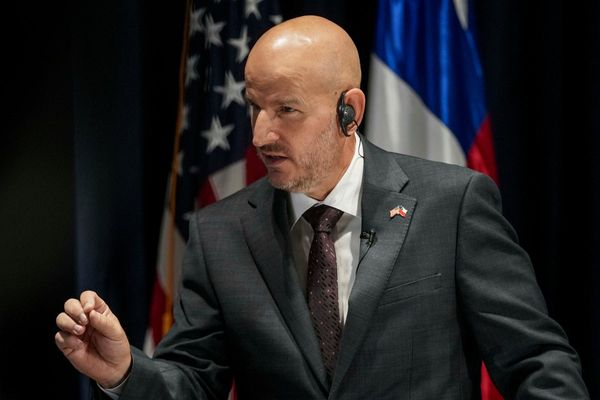
Alok Sharma, the business secretary, is taking the UK government’s daily press conference. It will be starting shortly. He will be appearing on his own.
(No 10 has in recent days stopped putting up scientists to appear alongside the ministers at this event. No 10 claims this is not because they have been banned for good. See 1.20pm. But the move has coincided with government policy increasingly diverging from the scientific advice. For example, Sir Patrick Vallance, the government’s chief scientific adviser, has refused to publicly back the quarantine policy, and Prof Chris Whitty, the chief medical adviser, has refused to agree to lower the coronavirus threat level - which was supposed to be a precondition for lockdown measures being eased. Ministers are easing them anyway.)
According to BBC News, today marks the days when pubs in the UK have been shut for more days this year than they have been open.
The UK has recorded an extra 286 coronavirus deaths today. (See 4.38pm.) For the record, here are the equivalent figures for the last two weeks for comparison.
Tuesday 26 May - 134
Wednesday 27 May - 412
Thursday 28 May - 377
Friday 29 May - 324
Saturday 30 May - 215
Sunday 31 May - 113
Monday 1 June - 111
Tuesday 2 June - 324
Wednesday 3 June - 359
Thursday 4 June - 176
Friday 5 June - 357
Saturday 6 June - 204
Sunday 7 June - 77
Monday 8 June - 55
UK records a further 286 coronavirus deaths, taking total to 40,883
Here are the latest UK coronavirus death figures. A further 286 people are recorded as having died, taking the total to 40,883.
These numbers record the deaths of people who have tested positive for coronavirus. The real number of coronavirus deaths will be higher. That’s because these figures do not include cases where there was no positive test but where coronavirus was mentioned on the death certificate (included in the ONS figures), and cases where coronavirus was to blame but doctors did not realise.
As of 9am 9 June, there have been 5,870,506 tests, with 102,930 tests on 8 June.
— Department of Health and Social Care (@DHSCgovuk) June 9, 2020
289,140 people have tested positive.
As of 5pm on 8 June, of those tested positive for coronavirus, across all settings, 40,883 have sadly died.
More info:
▶️ https://t.co/xXnL3FU15k pic.twitter.com/PK5EhiKkkj
Blair says coronavirus makes case for digital ID scheme stronger than ever
When Tony Blair was prime minister his government legislated to introduce an identity card scheme. The plan was hugely controversial, by the time the law got passed the scheme had been watered down and was to a large extent voluntary, and later it was enthusiastically repealed by David Cameron’s coalition government. But Blair has not lost interest in the concept and, at an event today, he said that coronavirus made the case for digital ID more compelling than ever.
As PA Media reports, Blair said that only if people can show easily whether they are clear of coronavirus will industries like international travel be able to restart. Speaking at the virtual CogX technology conference, Blair said that such a system would operate alongside track and trace programmes as the economy reopens. He explained:
You can create a digital ID today that is much more easily protected so you can deal with a lot of the privacy and surveillance issues that worry people.
It is a natural evolution of the way that we are going to use technology in any event to transact daily life and this Covid crisis gives an additional reason for doing that.
I think people’s disease status - have they been tested, what is the result of that test and have they had the disease, do they have the disease - unless you are able to record some of this data in a way people can use, it is going to be difficult to go back to anything like a near normal in things like transport.
If you are going to start international travel again, how can you do that unless people can be easily tested and have some record of that test?
There has always been a good case for introducing some form of digital ID but I think that case is even more powerful today.

Updated
At the press conference to launch the report on the test and trace system from the Independent Sage pressure group (see 11.25am), its chair, Sir David King, a former government chief scientific adviser, suggested there had been a “loss of moral authority” on the test and trace issue. He said:
What is really needed now is to renew the system and this means admitting that this system is not functioning. Every single day that passes with a dysfunctional system means longer before we recover from this pandemic and get back to economic stability ...
I think we actually need the leaders in the country to regain moral authority by saying ‘yes, we agree, this is not functioning and we need to go back and use the local systems that we’ve been talking about’.
The Conservative party received the highest amount of donations in the first quarter of the year compared to other major UK political parties, according to the Electoral Commission. As PA Media reports, the 17 political parties registered in Great Britain and Northern Ireland reported accepting a total of £11.79m during the year’s first quarter, up from £9.16m during the same period in 2019. The Tories reported receiving £4.04m, a mix of donations and public funds, between 1 January 1 and 31 March 2020. Labour declared that it received £3.88m, the Liberal Democrats £1.27m and the Scottish National Party £418,305.
Updated
Here is a comment from Prof Sir David Spiegelhalter, chair of the Winton Centre for Risk and Evidence Communication at the University of Cambridge, on the implications of the latest death figures from the ONS.
Conclusion: Covid-19 deaths have represented a temporary 50% increased risk of death in the over 45s, considerably less in younger age groups, and had an extremely small impact on school children.
The full statement from Spiegelhalter is here, on the Science Media Centre website.
Updated

The number of confirmed cases of Covid-19 among prisons in England and Wales continues to rise, Ministry of Justice figures shows.
As at 5pm on Monday, 486 prisoners had tested positive for the coronavirus across 80 prisons, a rise of less than 0.5% in 24 hours, while there were 956 infected staff across 105 prisons, another rise of less than 0.5% in the same period.
There are around 79,800 prisoners across 117 prisons in England and Wales, and around 33,000 staff working in public sector prisons. The population was last below 80,000 in January 2008.
At least 23 prisoners and nine staff are known to have died, as well as one prison escort driver and one NHS trust employee working in a secure training centre.
Will the coronavirus pandemic and governments’ reaction to it change society for the better? Research from the Co-operative party suggests the desire for change is there.
The report, Owning the Future, suggests 10% of people felt wealth was shared fairly before the crisis but nearly two-thirds believe it should be a priority of the recovery.
It found that 69% of people think that the coronavirus recovery should give communities more of a say in how businesses and the economy are run, rising to 73% in former “red wall” areas.
The Co-operative party, which is allied to the Labour party and effectively operates within it (many MPs stand as joint Labour and Co-operative party candidates), is calling for:
- A new law to allow the workers in companies at risk of closure to buy out the business and run it as an employee-owned co-operative
- A Co-operative recovery development fund
- A scheme to write off coronavirus business interruption scheme loan repayments for firms that come under employee ownership
- A requirement for companies getting taxpayer bailout to end the use of tax havens
- New co-operative regional banks to rebalance the economy
Labour’s Jim McMahon, who chairs of the Co-operative party parliamentary group, said:
Owning the Future builds on what we already know – that countries which embrace the co-operative model are fairer, more community-minded and more productive places to live and work.
In planning for our recovery we must not repeat the mistakes which followed the financial crash and a lost decade of austerity which deepened inequality and left us weaker to deal with Covid-19.
This report gives us a great opportunity to seize the renewed community spirit we saw emerge during lockdown, and build on its ideas to develop innovative solutions as we emerge from this crisis.
Updated
UK jobs outlook gloomiest in nearly 30 years amid coronavirus pandemic
The outlook for UK jobs is the gloomiest in almost three decades, according to the latest employment survey by recruitment firm ManpowerGroup. My colleague Joanna Partridge has the full story.
Public Health Wales said a further nine people have died after testing positive for coronavirus, taking the total number of deaths in Wales to 1,410.

The latest Guardian Science Weekly podcast is out. Nicola Davis speaks to Prof John Drury about the psychology of physical distancing and why we like to be near those we feel emotionally close to.
Updated
No new coronavirus deaths in Northern Ireland for third day
No new deaths with coronavirus have been reported in Northern Ireland for a third day. According to Department of Health figures, which refer mostly to deaths in hospital, the number who have died with coronavirus remains at 537.
Updated
Only one in four children returned to schools in England last week, wrecking Boris Johnson’s ambitions for a phased reopening of schools to allow parents back to work to boost the economy, my colleague Sally Weale reports.
England records a further 129 hospital deaths
NHS England has announced a further 129 people have died in hospital after testing positive for coronavirus, bringing the total number in England to 27,618. The full details are here.
Those who died included two people aged between 20-39, two aged 40-59, 38 aged 60-79 and 87 people aged 80 or above.
Updated
Robert Halfon, the Tory chair of the Commons education committee, has welcomed what Gavin Williamson said about the catch-up support for pupils after the lockdown lasting well beyond the summer. (See 2.30pm.)
Encouraged what @GavinWilliamson @educationgovuk says in @HouseofCommons Statement that catch-up programme for left behind pupils may be a long term programme for schools, not just over the Summer.
— Robert Halfon MP -Working Hard for Harlow- (@halfon4harlowMP) June 9, 2020
Helping pupils recover from damage done to learning by lockdown will take year or more, MPs told
In response to questions from MPs, Gavin Williamson, the education secretary for England, has repeatedly said that his department will be taking action to help compensate pupils for the lack of education that they have had this summer. He has not given many details, but he has stressed that this it will take a long time – more than a year – to repair the damage done.
This is what he said to the Conservative MP Robert Halfon on this topic.
We do need a long-term plan. That is what we are doing. We recognise that the learning loss is not something that is going to be corrected over a few weeks, but this is action that needs to be taken over a long period of time, and that is the approach we are taking.
This is what Williamson said to Labour’s Meg Hillier.
And in terms of catch-up planning, this isn’t about something that is just over a few weeks. This has got to be an approach over a full year and more. That is what we are putting in place. That is how we are going to be supporting children into the long term.
And this is what he said to the Conservative MP Tim Loughton, who (like Halfon) asked about the possibility of running catch-up schemes over the summer holidays. Williamson said:
This is certainly what we are looking at but we are looking at something much more wide and much more long-term because we don’t believe that actually just purely looking at the summer period is enough in order to be able to assist children to get the catch-up that they truly need.
Updated
Independent Sage has been posting some highlights from the press conference it held at lunchtime to publicise its report criticising the test and trace system on Twitter. (See 11.25am.) Here’s one of their tweets.
Anonymous caller who has trained as a contact tracer: We had no session with a human, only a doc to read with FAQs. There are no translators available for people who don't speak English. People are being given a false sense of security that we have a functioning system in place.
— Independent SAGE (@IndependentSage) June 9, 2020

At her daily briefing Nicola Sturgeon, Scotland’s first minister, said that she “deeply regretted” that restrictions on people who are shielding will not be eased until the end of July, but insisted that the current guidance is constantly being monitored and that some changes will be made in some cases by July 18, to let people leave their homes for exercise.
Regarding pleas from the Scottish tourist industry to reduce the 2 metre rule, she said that she had not seen any evidence either coming to the Scottish or UK government to suggest that this distance should be reduced.
Asked whether, under the new track and trace system, it would be made public if someone who had attended one of the Black Lives Matter protests had subsequently tested positive for coronavirus, interim chief medical officer Gregor Smith said that in such a scenario an incident team would be set up which would assess whether this was necessary.
Sturgeon also announced that she was establishing an expert reference group on the impact of the virus on minority ethnic communities in Scotland.
The Trades Union Council (TUC) is calling for an urgent rescue package for the childcare sector similar to that put in place in Germany and an extension to the furlough scheme for parents who can’t access childcare.
The TUC says more than 700 new mothers have replied to a survey saying they cannot return to work because of a lack of childcare, with lower income parents harder hit because they cannot call on grandparents to help.
TUC general secretary Frances O’Grady said many working mothers currently on maternity leave faced being stranded without childcare or financial support. “That is not right,” she said. She went on:
Ministers must extend the cut off for the furlough scheme for mums who cannot find childcare. And they must ensure that a proper rescue plan is put in place for the childcare sector. If they don’t, thousands of women will be locked out of the jobs market.
Williamson says long-term plan need to make up for 'learning loss' suffered by pupils
Robert Halfon, the Conservative chair of the education committee, asks why it is so hard to reopen schools. What is being done to avoid a decade of educational poverty? And what will be done to ensure pupils get free school meals over the summer.
Williamson says 100,000 laptops have already been distributed to the most vulnerable pupils. A further 75,000 pupils are being distributed to schools in the next few weeks.
But he says Halfon is right to say a long-term plan is needed to address the “learning loss”.
Updated
Williamson is responding to Long-Bailey.
He says they both want what is best for pupils.
But pupils need to go back, he says. If it were up to Long-Bailey, she would not bring pupils back until that was agreed by the National Education Union, he says.
He says he will work with local authorities. Where they have concerns about opening schools, the government will ensure they get the best advice, he says.
If the government subsequently has to close schools in small clusters, it will do so, he says.
Updated
Rebecca Long-Bailey, the shadow education secretary, says she is glad the government has followed Labour’s advice and abandoned plans to get all primary school pupils back before the summer holidays.
But she is dismayed by how this has been handled, she says.
And she says she is concerned about the damage being done to children by miissed education.
The government should be setting up summer schools to help pupils catch up, she says.
And she calls for a national plan for education.
She says Williamson has met with the relevant groups. But that is not the same as involving them in a national plan.
She says all pupils should get a one-on-one meeting with a teacher before the summer.
And she says the decision not to run the free school meal voucher scheme over the summer is “deeply callous”.
Williamson says he is working to bring all pupils in England back to school in September
Williamson says the government has published detailed guidance on the protective measures schools need to take.
The safety of young people and staff is his top priority, he says. They will qualify for testing.
The government continues to follow “the best scientific advice”, he says.
He says he accepts all primary children cannot return before the summer,
We will not be able to welcome all primary school children back for a full month before summer ... but we would like to see schools who have capacity to bring back more children in smaller class sizes [do so if they are able before the summer holidays].
The government will work with schools on what happens next, he says. He goes on:
We will be working to bring all children back to school in September.
He also says exams will take place next year.
Updated
Williamson says it is not more than two and a half months since schools were closed for most pupils.
He says it is vital pupils get back to school as soon as possible. And he says he was very pleased some pupils were able to go back in England last week.
He says 97% of schools that submitted data were open last week.
And he says 50% of schools were taking pupils in the year groups proposed by the government (see 1.35pm), rising to 70% yesterday.
Last week we saw the number of primaries taking nursery, reception and year one or year six pupils steadily rise as part of a phased, cautious, wider reopening of schools.
By the end of the week more than half of primary schools were taking pupils from these year groups and as of yesterday that had risen to over 70% of primaries that had responded.
He says he knows some schools are worried that the local reproduction number, R, is above 1. But nationally it is below 1, he says. And if there are local problems, the government will address them, he says.
Updated
Gavin Williamson's statement to MPs
Gavin Williamson, the education secretary for England, is about to make his statement to MPs confirming that not all primary school pupils will be able to return to the classroom before the end of summer.
Only 52% of English primary schools opened last week as government hoped, DfE says
And here is a fuller quote from the Department for Education statistical bulletin (pdf) out today saying that only around half of primary schools in England re-opened last week in accordance with government plans for pupils in reception, year 1 and year 6 to go back to class. (See 10.32am.)
From 1 June, the government asked schools to welcome back children in nursery, reception and years 1 and 6, alongside children of critical workers and vulnerable children.
Approximately 91% of settings were open in some capacity on 4 June, up from 80% on 21 May.
Around half of settings (52%) that normally accept at least one of these year groups were estimated to be open to children in nursery, reception, year 1 or year 6 on 4 June. This is expected to increase during the week commencing 8 June - a number of schools who reported that they were closed to these year groups last week indicated that they expected to be open to at least one of them on 8 June.
From the Times’ George Grylls
New DfE stats show only 1/2 of primary schools opened up to more pupils last week pic.twitter.com/xFFo8Tq7nB
— georgegrylls (@georgegrylls) June 9, 2020
The DfE statistical bulletin is here (pdf).
A new report by academic think tank UK in a Changing Europe warns of the implications of going into 2021 without a Brexit deal on trade and future relationship issues.
Crashing out would strain future relations with the EU and, according to law professor Catherine Barnard, present “significant legal trouble”.
While some believe that Boris Johnson is minded to bury the economic and business pain of no deal in the Covid crisis, Jonathan Portes, one of the authors, says he did not think the economic shock of the pandemic would “provide much of a smokescreen, as it were for the economic impacts of what happens in January”. He said:
Covid-19 pandemic and Brexit are major shocks for the UK economy. The interaction of the two is complex and unpredictable, with the potential to amplify some impacts while moderating others.
On balance, the pandemic probably does make the economic risks of exiting transition on January 2021 without a trade deal larger, but considerable uncertainties remain.
Senior fellow Jill Rutter said the politics of crashing out at the end of the year without the trade deal promised “are a bit underplayed at the moment” with a price expected to be exacted by Keir Starmer’s Labour if a deal does not emerge in the autumn.
Gavin Williamson, the education secretary for England, is due to address MPs shortly to confirm that not all primary school pupils will be able to return to the classroom before the end of summer.
This is from Paul Johnson, director of the Institute for Fiscal Studies, on the consequences of this.
I just made much the same point to the Treasury Select Committee. The current protracted shut down of schools has already been very damaging to the education and life chances of many children, especially poorer and more vulnerable ones https://t.co/gSE7dO8RDx
— Paul Johnson (@PJTheEconomist) June 9, 2020
And here are some further lines from the Downing Street lobby briefing.
- The prime minister’s spokesman hinted that Alok Sharma, the business secretary, will make an announcement to confirm the reopening of non-essential shops in England next week at the press conference at 5pm this afternoon.
- The spokesman said that getting all primary school pupils to return to school before the summer holidays had always just been an ambition. The policy was always being kept under review, he says. (That’s true; the passage on primary schools in the coronavirus recovery plan specifically described the policy as an ambition that was being kept under review. See 10.32am.)
- The spokesman said it was wrong to say that scientists were no longer appearing at the daily government press conference. He was responding to a question pointing out that in recent days scientists have not been there.
- The spokesman refused to confirm the claim that the travel industry has been privately assured that air corridors will be in place from 29 June. (See 10.41am.) He just confirmed that talks about this were ongoing.
- The cabinet did not participate in the one minute’s silence for George Floyd, the spokesman indicated. He said that at that point they were discussing the anger his death had generated around the world.
Britain 'much, much less racist' than it was, says PM, while stressing there is 'much more' to do
The Downing Street lobby briefing has finished. And it was striking that Boris Johnson used cabinet this morning to reset his response to the Black Lives Matter protests, reinforcing the message he conveyed in a video message last night.
In a tweet on Sunday night, after BLM protesters tore down the Edward Colston statue in Bristol and a minority of BLM protesters in London got involved in clashes with the police, Johnson posted this on Twitter.
People have a right to protest peacefully & while observing social distancing but they have no right to attack the police. These demonstrations have been subverted by thuggery - and they are a betrayal of the cause they purport to serve. Those responsible will be held to account.
— Boris Johnson #StayAlert (@BorisJohnson) June 7, 2020
Since then No 10 has recalibrated its response, and the prime minister’s spokesman gave this account of what was said in cabinet this morning. The spokesman said:
The PM began cabinet by discussing the anger and the grief felt not just in the US but around the world following the death of George Floyd. He said those who lead and govern simply cannot ignore the depth of emotion that has been triggered.
He said there was an undeniable feeling of injustice and that people from black and minority ethnic groups do face discrimination, in education, in employment and in the application of criminal law.
He said we are a much, much less racist society than we were, but we must also frankly acknowledge that there is so much more to do in eradicating prejudice and creating opportunity. Cabinet reiterated its commitment to that effort.
The PM said his message to all those who protested lawfully was ‘I hear you and I understand’. However, he said this cause is not an acceptable [reason] for violence or [relaxing the rules] regarding to social distancing. He said those who attack public property or the police are undermining the cause they claim to represent and will face the full force of the law.
This also suggests that No 10 has now crafted what it views as a better response to the question ‘Is Britain racist?’ Matt Hancock, the health secretary, was asked this on Sky’s Sophy Ridge on Sunday at the weekend and he said that it wasn’t, although he said there was still injustice that needed to be tackled. At the No 10 lobby briefing yesterday, in response to the same question, the spokesman said that Johnson did not think the UK was a racist country. Now the line is that the UK is “much, much less racist” than it was.
At today’s briefing the spokesman was also asked if Johnson felt that any of his various racially offensive comments in the past had contributed to the UK’s problems in this regard. The spokesman refused to engage, just saying that Johnson had addressed these questions during the election campaign.
Welsh government recommends three-layer face coverings where social distancing not possible
The Welsh government is recommending that people in Wales wear three-layer face coverings in situations where social distancing is not possible.
Health minister Vaughan Gething said the government was following updated advice from the World Health Organisation (WHO).
Gething said it would not be mandatory to wear such face coverings and it would not be enforced. He said the evidence remains clear that maintaining a two-metre distance and good hand hygiene was the most effective way to protect against Covid-19.
He stressed the advice only applied to people who are not showing symptoms of coronavirus. People who are symptomatic must self-isolate for seven days and get a test.
Gething said:
To be crystal clear, wearing a face covering does not replace the need for social distancing or washing your hands regularly.
Further scientific evidence is needed on the benefits to the wider public of wearing face coverings, but observational findings so far suggest that homemade or purchased three-layer face-coverings might reduce transmission from one person to another if made, worn, handled and disposed of properly.
Therefore, on balance, we are recommending to the people of Wales that three-layer face-coverings should be used in situations where social distancing measures can be more difficult to achieve, for example, on public transport. We are not recommending their use outdoors.
Scotland records further seven coronavirus deaths after two days without any
A total of 2,422 patients have died in Scotland after testing positive for coronavirus, up by seven from 2,415 on Monday, the Scottish first minister Nicola Sturgeon said at her daily briefing. This is the first rise in deaths in Scotland since Saturday.
Sturgeon said said 15,653 people have tested positive for the virus in Scotland, up by 14 from 15,639 the day before.
There are 1,011 people in hospital with confirmed or suspected Covid-19, a decrease of 31.
Of these patients, 21 were in intensive care, a decrease of three.
Sturgeon said that the new death figures were “not what we would have wanted to have but it’s important to stress they are not a surprise. We know that there is a weekend lag ...and today’s figures are still further evidence of a downward trend in the number of people losing their lives to this virus.”
Updated
Devi Sridhar, professor of global public health at Edinburgh University, has posted a useful thread on Twitter about why scientists are divided on the prospects of a second wave of infections. It starts here.
Confused why scientists disagree about a 'second wave'? Thread attempting to explain:
— Devi Sridhar (@devisridhar) June 9, 2020
1. Definition of 'second wave' debated. Some think it's any increase in cases after a sustained drop over days. Others think it is an increase after prolonged period (months) of few cases.

The government will not succumb to EU demands to access British fishing waters, the former environment secretary Theresa Villiers has said.
“We are not going to see the compromises coming from Boris’s government,” she said arguing that the current common fisheries policy (CFP) is “grossly unfair”.
Her comments come just days after Brexit talks over a future trade deal hit the buffers with four major areas of disagreement including access to British seas for EU boats.
“I just don’t see that the UK government is going to just shift in any substantive way from what is put on the table already,” Villiers told an Institute for Government webinar this morning. She went on:
Also there are important matters in relation to the union, we are intensely conscious of how crucial fisheries are to the Scottish economy, to the communities and we feel very strongly that we need to defend those interests as well. So, for all sorts of reasons I, I think that we are not going to see the compromises coming from Boris’s government. provide these coming from our system.
Survey testing to be used to monitor extent of coronavirus amongst teachers and pupils in England
Plans for wider reopening of schools may be in disarray, but the government has announced that a new study is being launched to monitor the prevalence of Covid-19 among pupils and teachers in schools in England.
Parents and guardians will be asked to provide consent for pupils in pre-school, primary and secondary school to be swab tested, together with their teachers, as part of a surveillance study to increase understanding of the rates of transmission within schools.
Public Health England plans to collect data from up to 100 schools across England, targeting 200 staff and children in each school. Participation is voluntary and results will be available over the summer, with plans for a second phase in September.
Researchers will test to see who has the virus at the schools selected and a small proportion of those schools will also be offered antibody tests which will require blood tests to see who has already had the virus.
Health secretary Matt Hancock said:
This study will help us better understand how common asymptomatic and mild cases of COVID-19 are so that we can support parents, pupils and teachers and support staff, and inform our ongoing response to this new virus.
Dr Shamez Ladhani, paediatric infectious diseases consultant at Public Health England, added:
The results of this study will play an important role in informing wider surveillance planned for educational settings in the autumn term.
Through active surveillance, contact tracing and the close monitoring of any clusters of cases, we are committed to ensuring the safety of students and staff returning to school in the coming weeks and months.

We’ve published a lovely picture essay today by the photojournalist Jonny Weeks about patients recovering from coronavirus. Do take a look.
Government's test and trace system 'not fit for purpose', say Independent Sage pressure group
The government’s test and trace system is “not fit for purpose”, the so-called Independent Sage is saying this morning. Independent Sage is a group of 12 senior scientists (mostly professors), set up to shadow the official Sage, the government’s Scientific Advisory Group for Emergencies. They have already published other reports critical of the government’s coronavirus policy, although today’s is probably the harshest. Ministers have until now largely ignored them, treating them as minority voices in the science community. But it is hard to dismiss them as not credible. Independent Sage is chaired by Sir David King, who was the government’s chief scientific adviser (ie, one of Sir Patrick Vallance’s predecessors) between 2000 and 2007.
The report should be on the Independent Sage website shortly. But here’s an extract from its news release.
The new report from the Independent Sage ... says the virus will only be contained if 80% of contacts of infected people are traced. It describes this as ‘impossible’ under the current system and says a radical restructuring is necessary with responsibility handed over to local public health directors.
The report expresses particular concern that the erosion of trust in government in recent weeks is likely to have a major effect on compliance and that no attempt has so far been made to engage with local communities. BAME communities, in particular, it says have suffered ‘a disproportionate loss of trust’.
Currently, the government is using a centralised system of ‘test, track and trace’ led by Baroness Dido Harding with private contractors providing 25,000 contact tracers. The report notes that New Zealand has shown that eliminating the virus is possible but that containing it depends on tracing at least 80% of contacts who then must remain isolated for 14 days. ‘This is clearly not happening,’ the report says and urges the government to adopt an existing approach used by public health authorities, ‘Find, Test, Trace, Isolate and Support’ (FTTIS).
Individuals must be supported, the report says, financially and in other ways as surveys from late May have shown that compliance with government guidelines decreased. Noting a ‘background of decreasing confidence in the government’s management of the pandemic,’ it says that incentives must be introduced as currently people are reporting leaving home when they have symptoms.
The report makes five recommendations. They are:
1. Local directors of public health (who work for councils) should take the lead in test and trace, the report says. A local approach would be “most effective” it says.
2. There should be effective community engagement to build trust in the scheme, the report says.
3. Test and trace data should be embedded within NHS and council data, the report says.
4. Material support, including food and money, should be available for people asked to isolate, the report says. It is this is “critical” if FTTIS is going to work.
5. Key performance data should be published weekly, the report says.
Commenting on his report, King said:
The government has placed huge emphasis on their test, track and trace system in recent weeks, even labelling it ‘world beating’. It is clear from our research that this simply isn’t the case, indeed the system as it stands is not fit for purpose. This is the critical moment for the government to act now or risk further spikes. We believe that a new approach is required, one that moves away from a centralised system that utilises a local first approach. We are calling on the government to urgently rethink their course to ensure that we have a system in place that will help and not hinder the country’s recovery.
Later today Independent Sage is holding a public consultation, followed by a press conference at 1.45pm.
UPDATE: The Independent Sage criticisms largely relate to how test and trace operates in England. Sorry, I should have made that clear earlier.

Updated
A group called the Quash Quarantine coalition, which says it represents more than 500 travel and hospitality firms opposed to the quarantine regulations that came into force yesterday, says it has received “private assurances from senior government sources” that travel corridors will be introduced from 29 June. Also known as “air bridges”, these would be bilateral agreements exempting certain countries from the quarantine rules.
But the group wants the government to say this publicly (which would make people feel more confident about booking foreign holidays). Paul Charles, its spokesman, said: “We urge the government to signal to the travel industry publicly and urgently that this is the case, as well as amend FCO (Foreign and Commonwealth Office) advice on non-essential travel.”
Another teaching union, the Association of School and College Leaders, has welcomed the government’s decision to ditch plans to bring all primary school pupils in England back before the end of the summer time. Geoff Barton, its general secretary, said:
The ‘ambition’ to bring back all primary year groups for a month before the end of the summer term was a case of the government over-promising something that wasn’t deliverable. It isn’t possible to do that while maintaining small class sizes and social bubbles, so we aren’t surprised that the policy has been jettisoned.
The National Education Union (see 10.07am) and the NASUWT (see 9.02am) have said much the same thing.
For reference, this is what the UK government said about reopening primary schools for all pupils in its coronavirus recovery plan (pdf) published last month.
Schools should prepare to begin to open for more children from 1 June. The government expects children to be able to return to early years settings, and for reception, year 1 and year 6 to be back in school in smaller sizes, from this point. This aims to ensure that the youngest children, and those preparing for the transition to secondary school, have maximum time with their teachers. Secondary schools and further education colleges should also prepare to begin some face to face contact with year 10 and 12 pupils who have key exams next year, in support of their continued remote, home learning. The government’s ambition is for all primary school children to return to school before the summer for a month if feasible, though this will be kept under review.
The National Education Union has called for a national recovery plan for education, similar to the jobs recovery plan, warning that the consequences of the pandemic would affect schools for months to come.
Dr Mary Bousted, NEU joint general secretary, said:
It has taken the government some time to recognise what was obvious to most. The government’s social distancing rules made it impossible for primary schools to admit all pupils before the summer holidays.
Primary schools and secondary schools will not re-open to all pupils until September at the earliest. But even that date cannot, as Matt Hancock has recognised, be taken for granted. What is needed, now, is a national plan for education, along the lines being developed by the Scottish government.
This should cover all possible scenarios and focus on blended learning, at home and at school; greatly increased support for disadvantaged children, including free internet access so that they can access online teaching and learning, and the requisitioning of local public spaces, such as community centres and libraries, so that pressure on school space is lessened and more children are able to return to school in safe environments.
UK excess deaths associated with coronavirus have now reached around 64,000, says ONS
Nick Stripe, head of the health analysis and life events division at the ONS, has posted a useful Twitter thread on today’s death figures. (“Life events” include dying.)
He says the figure for excess deaths in the UK is now around 64,000. Excess deaths are beyond what you would expect, given the five-year average for this time of years. They include deaths directly attributed to coronavirus, deaths probably caused by coronavirus, even if this was not stated on the death certificate, and deaths caused as a wider consequence of the crisis (for example, as a result of people not getting life-saving medical treatment).
Government scientists and ministers have repeatedly said that all-cause excess mortality is the best measure of the overall impact of the crisis.
THREAD – Deaths registered w/e 29 May (E&W)
— Nick Stripe (@NickStripe_ONS) June 9, 2020
This was another bank holiday (Mon 25 May) affected week
As a result, we expected to see a reduction in the number of deaths registered. We also hoped to see a drop in the % that deaths remained above the 5-yr weekly average
1/n
There were 9,824 deaths registered, 20% fewer than the week before
— Nick Stripe (@NickStripe_ONS) June 9, 2020
This was 1,653 “excess” deaths above the 5-yr weekly average
= 20% above what we’d expect in this week of the year, down from 24% above the week before
2/n pic.twitter.com/8QIcisKmA1
1,822 deaths mentioned COVID on death certificates, 19% of all deaths registered
— Nick Stripe (@NickStripe_ONS) June 9, 2020
As in the week before, this was 110% of the number of excess deaths i.e. slightly more
Deaths not mentioning COVID on death certs were slightly below the 5-yr weekly average
3/n pic.twitter.com/xyU1g67AM8
Across Eng in the last 10 wks 43,248 deaths have now mentioned COVID on death certs
— Nick Stripe (@NickStripe_ONS) June 9, 2020
Whilst across Wales 2,194 death certs have mentioned COVID
There have been 57,961 “excess” deaths across E&W in total
Across the UK = c.50k deaths involving COVID & c.64k “excess” deaths
4/n
Deaths in hospitals were 1% below the 5-yr wkly avg – excluding CV they would have been 27% below
— Nick Stripe (@NickStripe_ONS) June 9, 2020
Deaths in care homes were 49% above 5-yr avg – excl CV they would have been 7% above
Deaths in private homes were 45% above 5-yr avg – excl CV they would have been 42% above
5/n pic.twitter.com/ddyDNj87cy
Some deaths that might normally occur in hospitals have been occurring in private homes and care homes
— Nick Stripe (@NickStripe_ONS) June 9, 2020
Our analysis of excess deaths in March & April, published last Friday, showed an increase in deaths from many causes outside hospitals
6/n pic.twitter.com/eFxGf0dqC2
Some CV-related deaths that have occurred in care homes in the last two mths will have brought forward deaths that might otherwise have happened relatively soon
— Nick Stripe (@NickStripe_ONS) June 9, 2020
We might expect deaths not involving COVID in care homes to fall below 5-yr avgs in the next few weeks
7/n
The chart below shows COVID-related deaths by date of death & setting
— Nick Stripe (@NickStripe_ONS) June 9, 2020
From mid-end Mar deaths increased by c.25% per day
There were 1k+ deaths from 4 Apr – 20 Apr
From mid Apr-end May deaths decreased by c.4% per day
Deaths for the later days shown will rise further
8/n pic.twitter.com/rwzlGgSKGD
This week’s reports and data tables can be accessed from the following link:https://t.co/HasaY4aLSC
— Nick Stripe (@NickStripe_ONS) June 9, 2020
9/9 - ENDS
Updated
Excess deaths still running at 20% in final week of May, says ONS
The Office for National Statistics has published its latest weekly death figures for England and Wales. They run to the final week of May, ending on Friday 29 May (or week 22, as ONS calls it).
Here are the key points.
- The number of deaths at the end of May (in week 22) was down on the previous week, but still 20.2% higher than the five-year average for that week. That 20.2% amounts to 1,653 excess deaths. Overall there were 9,824 deaths in week 22, 2,464 fewer than in the previous week.
- 18.5% of deaths in week 22 were directly linked to coronavirus (ie, it was mentioned on the death certificate). There were 1,822 coronavirus deaths overall - the lowest figure in the past eight weeks.
- Care home deaths in week 22 were above the five-year average (by 819). But hospital deaths were below the five-year average (by 30).
Agenda for the day
Good morning. I’m Andrew Sparrow, joining the blog for the day.
Here is the agenda showing what’s coming up.
9.30am: The Office for National Statistics publishes its weekly death figures for England and Wales.
9.30am: The Resolution Foundation, the Institute for Fiscal Studies and the Institute for Government give evidence to the Commons Treasury committee about coronavirus and the economy.
10am: Behavioural scientists including Sage member Prof David Halpern give evidence to the Lords science committee.
Morning: Boris Johnson chairs cabinet.
12pm: Tony Blair, the former prime minister, speaks at a CogX leadership summit.
12.30pm: The Scottish and Welsh governments hold their daily coronavirus briefings.
12.30pm: Michael Gove, the Cabinet Office minister, answers a Commons urgent questions on the Brexit talks.
1pm: Downing Street is expected to hold its daily lobby briefing.
1pm: The independent Sage group of scientists publishes an interim report on test and trace.
After 1pm: Gavin Williamson, the education secretary for England, gives a Commons statement on the opening of schools.
5pm: The UK government holds its daily press conference.
Teaching unions welcome government U-turn
Teaching unions have welcomed the government’s U-turn on wider reopening of primary schools, and called on ministers to address the concerns of teachers already struggling to maintain safe working practices in schools where provision has already been extended.
Dr Patrick Roach, general secretary of the NASUWT teachers’ union, said:
It has been abundantly clear for some time that the announcement by the government of arbitrary dates for the wider reopening of schools was ill-considered, premature and unworkable.
The government’s rush to seek to reopen schools as part of wider efforts to restart the economy has been in the face of deep concerns and mounting evidence that this would contribute to a second wave of infections and deaths from the coronavirus.
With the “R” Rate close to or above 1 in a number of areas of the country, decisions to reopen schools more widely could be extremely damaging to public health as well as to the health and safety of children and adults in schools.
The overwhelming majority of teachers remain extremely worried that with schools opening to more children whilst safe social distancing and PPE continue to be major concerns, wider school reopening is simply not safe.
In the absence of definitive guidance from the government, many schools have struggled to understand what they need to do in order to meet appropriate health and safety standards when they do reopen.
The government must now accept that its plans for wider reopening of schools are no longer credible. The government must also make clear to schools that they should revisit their plans and take all appropriate steps to protect the welfare of staff and pupils even if that means pausing planned reopening or closing wider provision in the interests of safety and public health.
Updated
Education committee chairman: We are potentially damaging children’s life chances
"The Government should definitely think again"
— BBC Radio 4 Today (@BBCr4today) June 9, 2020
Chair of the education select committee Robert Halfon says govt ought to "continue with a phased opening" of primary schools to avoid "damaging the life chances" of disadvantaged children#R4Today https://t.co/wF043N9cmK
Tory MP Robert Halfon has the UK is a “strange country” for prioritising reopening pubs over ensuring children could continue their learning in school on BBC Radio 4’s Today programme this morning.
The Commons education committee chairman said he was “sympathetic” to children’s commissioner Anne Longfield, who said the country should put the same effort it had into reopening pubs as thinking of ways to allow schools to operate safely.
He said:
I think we’re a strange country in which we turn a blind eye to mass demonstrations all over in every city, we campaign for pubs and cafes to open and yet we say to open schools before September is too risky when all the evidence - from the World Health Organisation, from many other European countries, from the chief medical officer in the UK - suggests otherwise.
We are potentially damaging children’s life chances.
Updated
Care minister Helen Whately won’t be delighted that she’s trending on Twitter, mainly because of this exchange during her interview with Kay Burley on Sky News this morning when she very quickly backtracked.
On care home deaths, care minister says ‘I can’ [stick this on the scientists], and then immediately corrected herself.
Me: "You can't stick this on the scientists."
— Kay Burley (@KayBurley) June 9, 2020
Health Minister @Helen_Whately: "Well I can."
The minister quickly backtracks after initially blaming scientists for mistakes made in managing #Coronavirus in care homes. MR#KayBurley pic.twitter.com/lPOQmCFRM7
Burley remorseless this morning
"Come on minister, you can't come on the show if you don't know the facts."
— Kay Burley (@KayBurley) June 9, 2020
Health Minister @Helen_Whately says quarantine is 'important' to keep the infection rate down but can't tell me how many people have been asked to isolate. MR#KayBurley #Coronavirus #COVID19 pic.twitter.com/SX2aTufmY2
Rebecca Long-Bailey, Labour’s shadow education secretary, has said that a decision not to force the reopening of schools before summer would be “welcome”. She said:
For weeks headteachers, education unions, school staff and many parents have stated that the plans to open whole schools before the summer could compromise any safety measures a school had been able to implement with reduced pupil numbers.
The government has completely failed to show leadership. They should have brought together all those who needed confidence in their plans, from education unions and local authorities through to parents’ associations.
The government must now give answers on what resources it will provide to adequately support home learning, from the provision of digital devices to all pupils who need one through to targeted online tuition.
Updated
Minister for care Helen Whately said the Government is “following the scientific guidance on what is the safe thing to do and the right thing to do” when it comes to getting children back to school. She told BBC Breakfast that getting children back to school is “not easy”, adding:
Asking children to social distance for instance is not a straightforward thing to do.
Whately, who has two children in primary school, said the public will hear more later from education secretary Gavin Williamson “about the plans over the coming weeks”.
She said the government does not want to take risks that might increase the infection rate, but is also mindful of the disadvantages of children not being in school, adding that the aim is to “get the balance right between those things”.
Whately said getting children back to school is “not something that is easily done”, adding:
We must of course be listening to the teachers and the head teachers who are having to do this in practice.
Asked about social distancing at anti-racism protests she said it was “such a difficult question”.
Of course, it is a moment that will trigger people’s reaction, and the right to protest is such an important, to peacefully protest, is such an important part of being in a democracy.
The problem we face right now is it coincides with a pandemic.
She said that now coronavirus is “on the retreat”, she does not want to risk the infection rate going up.
The problem is with protesting is it’s very hard to do that in a socially distanced way, so what would be better is if people can find ways to protest that don’t involve coming together in large numbers, just because we just don’t want the pandemic to take off again.
We want to keep it under control.
Whately acknowledged that there is still discrimination in the UK and insisted “we must make it better”. She said:
I think our country is much better now than it was a few decades ago.
But there is still discrimination, there is still injustice, we must tackle this.
Right now, Kemi Badenoch, the equalities minister, is taking forwards work following the Public Health England report into the impact of Covid-19 on different ethnic minorities.
So we need to get to the bottom of that and understand how we can tackle those risks.
But no, as a whole society, this is absolutely discrimination, and injustice cannot be accepted and we must, we must make it better.
Updated
So, ok, ok, ok, I know this is the UK liveblog but if you are missing hugs as much as I am, this piece from New Zealand is heartening.
More on the holiday front (and who isn’t wasting many hours fantasising about their dream holiday right now).
The holiday rentals firm behind Hoseasons and Cottages.com has agreed to give customers refunds for cancelled trips due to the coronavirus crisis after a probe by the competition watchdog. PA reports:
The Competition and Markets Authority (CMA) said Vacation Rentals had changed its policy after originally refusing to give money back to customers whose stays had been cancelled.
Vacation Rentals has now given the CMA a formal commitment that it will give affected customers the option of a full refund.
It was one of a number of firms reported to the CMA’s Covid-19 taskforce, but other holiday companies are still refusing to offer refunds and the watchdog said its investigations into the sector are ongoing.
If you’re thinking of ditching your camping trip in France this summer and are considering a staycation instead, best get booking.
According to travel firm Kuoni, many holidaymakers are planning staycations this year because they see foreign trips as “too risky” and want to splash out in 2021.
The company reported a “clear upturn” in demand for holidays next year, with more than half of customers heading to the white sand beaches of the Maldives. Half!
The company has also seen strong sales for Mauritius, Thailand, Spain and India.
The Foreign and Commonwealth Office currently advises against non-essential overseas travel, while a 14-day quarantine policy for international arrivals came into force on Monday.
Kuoni chief executive Derek Jones said:
Whilst there is still so much uncertainty around plans to open borders, the 14-day quarantine and social distancing, people are telling us that they’d rather plan ahead for next year and save to make the trip an extra special one, upgrading what they’d normally do.
UK campsites are experiencing a surge in bookings, while Auto Trader recently said interest in online adverts for caravans was up nearly a fifth compared with the same time last year.
Children’s commissioner: reports secondary schools may not open past September "deeply worrying"
Children’s commissioner Anne Longfield has this morning aid the government should look at what Wales is doing regarding schools.
She told BBC Breakfast:
First of all, when we look at Wales, they’re running a very different model where actually children are coming into school for a third of the week before the summer, which I think is interesting and government should look at.
And the other is that children will still need to learn during this period and there will need to be mitigation to compensate for the fact they’re not in school through online learning but also potentially catch up and summer camps to help them emotionally.
She said it is “deeply worrying” that there is a possibility secondary schools may not open until beyond September.
We’ve seen the great things that can be achieved when everyone puts their mind to it - you know the job scheme, the business continuity scheme, the Nightingale hospitals.
It’s of this scale of challenge, and it’s this level of determination that I think government now really needs to focus on.
Updated
We’re getting more reactions to the news that ministers look set to abandon plans for all primary school children to return to classrooms before the academic year is out.
Ian Robinson, chief executive of the Oak Partnership Trust which runs three primary schools and a special school in Taunton, Somerset, told BBC Radio 4’s Today programme:
I do welcome this announcement that is hopefully going to be made today.
It demonstrates that the secretary of state and the Department for Education are listening to the profession - I believe they have listened to the profession and this is a really positive step forward.
I think they are saying if you can extend your provision to other year groups then you can go ahead, but you still have to do it within the measures of control that are in place.
And from my own trust’s point of view, it is all about simple practicalities, it is not about whether you want children in schools or not.
We simply don’t have enough physical space for any more year groups and we don’t have any more human resources for any more year groups.
Updated
Publicans ask for clarity as opening time draws closer
Pubs are -under current plans - set to reopen on July 4. But a group of cabinet ministers nicknamed the “Save Summer Six” are reportedly considering proposals to allow beer gardens in England to host drinkers from as early as 22 June, as part of an effort to avert 3.5m job losses in the struggling hospitality sector.
But publicans, brewers and the pub industry trade body have urged the government to clarify “half-baked” plans to reopen beer gardens, amid confusion over whether some will be permitted to serve drinks before the end of the month.
They have said many would struggle to be ready in under three weeks and called for certainty about the government’s timetable.
Read the full story here:
Morning summary
Welcome to the UK coronavirus liveblog, here is a quick update on our top stories this morning:
- Plans to push ahead with reopening schools in England are in disarray, after the government admitted that not all primary school pupils will be able to return to the classroom before the end of summer. Gavin Williamson, the education secretary, is to give an update on the progress of schools reopening on Tuesday.
- In a further confirmation of the difficulties that teachers face, Matt Hancock hinted at Monday’s Downing Street press briefing that even a full return in September may be difficult.
- Ministers are facing a high court legal challenge after they refused to order an urgent investigation into the shortages of personal protective equipment faced by NHS staff during the coronavirus pandemic.
- The health secretary, Matt Hancock, has said coronavirus is “in retreat across the country” as the number of recorded deaths among people testing positive for Covid-19 fell to the lowest daily level since before the lockdown was announced. A further 55 people died after contracting the virus in the UK, the lowest daily total reported since 22 March.
- Police will have a “limited” role in enforcing coronavirus quarantine restrictions, with officers taking action against people who breach the rules only as a last resort, according to a briefing plan for police forces.
If you have a story, if you think we’ve missed something or if you just want to get in touch please do email me on alexandra.topping@theguardian.com or I’m @lexytopping on Twitter and my DMs are open.