Construction output in June has fallen at its fastest pace since the dark days of the financial crisis in 2009 according to a survey released by Markit and the Chartered Institute of Procurement and Supply (Cips) today.
The figures from the Purchasing Managers Index show the sharpest drop in new business since December 2012. The index dropped from 51.2 in May to 46.0 in June, with anything below 50 indicating a contraction.
Slower demand has lead to a drop in purchasing activity for the first time in just over three years.
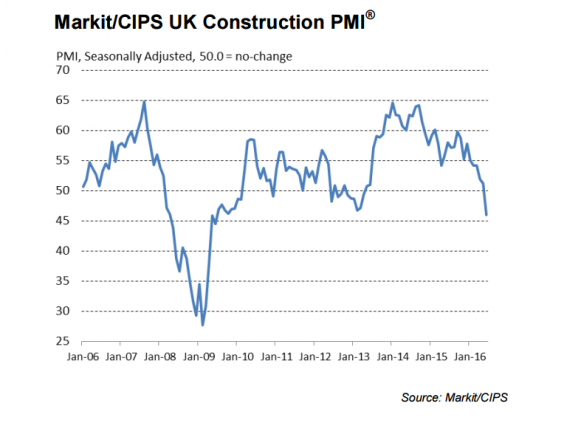
The weakest performing sector was residential construction, despite record house prices and a lack of supply. Commercial building work also suffered a sharp loss of momentum as new projects did not start to replace those that were coming to completion.
Civil engineering was the only sector not to record a fall in output.
EU referendum fears or sustained downturn?
Many respondents to the survey of construction industry managers cited uncertainty ahead of the EU referendum as a reason for the slowdown, with more than 80 per cent of the poll carried out before the Brexit decision last Thursday.
Tim Moore, senior economist at Markit, said: “Widespread delays to investment decisions and housing market jitters saw the UK construction sector experience its worst month for seven years in June.”
The economist stated that this could be more than a short-term, referendum-related blip. “The extent and speed of the downturn in the face of political and economic uncertainty is a clear warning flag for the wider post-Brexit economic outlook,” he cautioned.
“The worry is that the ensuing political turmoil will hit construction spending decisions for some time to come,” Mr Moore said. This feeling has been echoed in other industries in recent days.
PMI figures are based on hard data about purchasing in the construction industry, rather than opinion and as such are seen as a good predictive measure of things to come.
David Noble, chief executive officer at Cips reiterated the “gloomy” outlook, stating that “continuing insecurities in both the global and UK economies”, had led to clients being hesitant to commit to projects.
“The only glimmer of light through the brickwork is the rate of decline was not as sharp as that experienced during the last recession.”
Noble said the sector would now look towards remedies from the Bank of England and the Government.
Mark Carney, governor of the Bank of England recently hinted at a potential further lowering of interest rates and possible quantitative easing in order to stimulate the UK economy.
Shares of all of the major house builders have dropped today, with Britain’s largest home builder, Barratt Homes, down 4.5 per cent, Taylor Wimpey falling 7 per cent and Persimmon down 5.5 per cent at 14:30 pm. Crest Nicholson also fell 5 per cent and Berkely group was down 5.4 per cent.
House building
The figures, particularly in the residential sector, may come as a surprise to many prospective homeowners who have seen house prices rise to a record of over £300,000 in March owing to high demand and lack of supply.
House builders have been accused by some of deliberately restricting the supply of new homes in order to boost profits.
Berkeley chief executive Tim Pidgely received a £23.2m payout last year as profits soared 42 per cent, while executives at the UK’s second largest house builder Persimmon, which is due to deliver a trading statement tomorrow, are in line for a record bonus pot of up to £600 million after share prices have jumped over the past five years.
A spokesperson for industry body the Home Builders Federation said the figures should not be viewed in isolation and that long term trends for the sector were good.
"The past two years have seen a significant increase in output with 180,000 homes built last year. Overall there is still huge demand and the market is strong. We are still about one million homes short of what we need in this country," he said.
Barratt Homes said it would not comment on the figures ahead of its trading update next week. None of the other major house builders responded to requests for comment at this time.