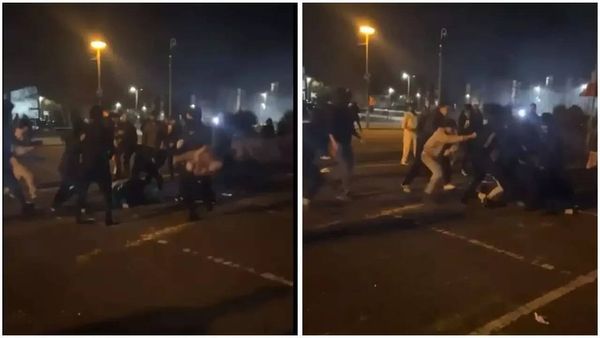
The UK and other countries have called on Belarus to halt its violent attacks on peaceful protesters in the wake of the Eastern European country's disputed presidential elections.
Britain's embassy in Minsk condemned "the brutal and disproportionate use of force" by police and the "abuse and humiliation of detainees".
A number of people have died amid the crackdown as thousands take to the streets to demand President Alexander Lukashenko, a Putin ally who has ruled for 26 years, step down amid claims the election was rigged.
In a joint statement with the missions of the US, Switzerland and the EU, the UK's embassy in Minsk called on the Belarusian authorities to stop the violence and immediately release all prisoners who were unlawfully detained following Lukashenko's controversial re-election.
The statement said: "We stand in solidarity with the people of Belarus who demand respect for fundamental freedoms and basic human rights through free and fair elections.

"We are struck by the continued peaceful demonstrations across Belarus.
"They show the determination and courage of the Belarusian people to seek democratic change.
"Since the elections, we have witnessed the brutal and disproportionate use of force by the law enforcement authorities against peaceful protesters and ordinary citizens.
"We have seen evidence of numerous injuries stemming from such use of force.
"We have been made aware of countless incidents of abuse and humiliation of detainees.
"We stand in solidarity with all the victims of violence and abuse.
"We join the families of the victims in their sorrow.
"It is with grief and in disbelief that we have witnessed the loss of life, the suffering, and violations of human dignity and justice in Belarus.


"We condemn the disproportionate use of force and urge the Belarusian authorities to stop the violence and the threats to use military force against the country’s own citizens and release immediately and unconditionally all those unlawfully detained.
"Intimidation and prosecution based on political grounds need to stop.
"We call on the Belarusian authorities to respect the country’s international obligations on fundamental democratic and human rights.
"We expect a complete and transparent investigation into all alleged crimes and abuses in order to hold those responsible to account.

"Only this will pave the way for a peaceful resolution of the crisis based on an inclusive national dialogue."
Lukashenko said he had ordered half the army to enter combat preparedness, and had agreed with Russian President Vladimir Putin,his ally, that their troops could unite in the event of a threat from the West.
Belarus is Russia's closest ex-Soviet ally and its territory is an integral part of Moscow's European defence strategy.
On Friday, Foreign Secretary Dominic Raab condemned the mass detention of journalists in Belarus.
The Foreign Secretary tweeted on Friday: "I condemn the mass detention of over 50 journalists last night in Belarus, including from @BBC, local & international media.
"This was a blatant attempt to interfere with objective & honest reporting.
"The Belarusian authorities must stop targeting journalists & #defendmediafreedom".
The BBC's Moscow correspondent Steve Rosenberg Tweeted on Thursday that he was among those detained and held at a police station for two hours for "document checks".

He said it was a "clear attempt to interfere with coverage" of the events in Belarus.
Belarus has seen widespread protests since Lukashenko was declared the winner of elections earlier this month.
Opposition figures insist the vote was rigged as Mr Lukashenko, an ally of Russian President Vladimir Putin, claimed election as president for the sixth time.
Lukashenko, facing a nearly three-week popular uprising since a disputed election, denies opposition accusations that he rigged the August 9 election to prolong his 26-year rule.

Opposition presidential candidate Sviatlana Tsikhanouskaya fled to Lithuania after the vote that her supporters say she won.
Lukashenko claims the protesters are funded by the West, and accuses Nato of massing forces on Belarusian frontiers, which the alliance denies.
He threatened on Friday to cut off European transit routes across his country if sanctions are imposed.
He said he would block European neighbours from shipping goods to Russia over Belarusian territory, and divert exports now shipped through ports in EU member Lithuania.
State media reported him as saying: "They got fat and forgot what Belarus is. And thought we could be frightened off with rockets and tanks.
"Well let's see who is afraid of whom. We'll show them what sanctions are."
He added: "If they (Nato troops) don't hold still, it's necessary to use a joint grouping of armed forces, the basis of which is the Belarusian army. The Russians must support us and follow us."
Putin has said the Kremlin had set up a "reserve police force" at Lukashenko's request, although it would be deployed only if necessary.
Neighbouring Lithuania, Poland and Latvia have pushed for Europe to take stronger action against Lukashenko.