The best city stories from around the web this week explore gentrification in Amsterdam, nostalgia in Iran’s former “oil city” and arson in Detroit, as well as the temporary transformation of Beijing into a ghost town.
We’d love to hear your responses to these stories and any others you’ve read recently, both at Guardian Cities and elsewhere: share your thoughts in the comments below.
Ugly saves the day
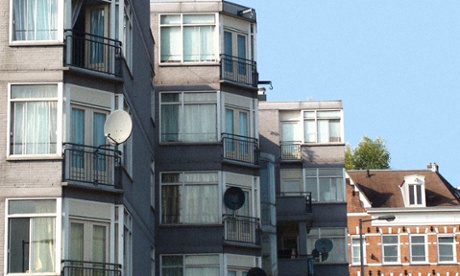
Gentrification follows attractive architecture around like a shadow. Rene Boer’s new photo essay in Failed Architecture, however, explores the “resilience” of ugliness in Amsterdam, a city experiencing high levels of problematic gentrification. Known for its historic architecture, the buildings that went up in the 1970s and 1980s were often criticised as “ugly” and ruining the city’s image.
Most of these relatively modern buildings contain social housing apartments; what’s more, they are proving resistant to the transformations currently impacting the city – transformations that include the sale of much of Amsterdam’s social housing stock still in its celebrated historic buildings.
“In times when the rest of the city is rapidly becoming extremely expensive,” writes Boer, “Amsterdam’s ugly light grey and pink-yellow housing blocks are staying affordable … their continued presence in the city is becoming a memorial for a once-existing Amsterdam, in which almost all space in the city was equally distributed.”
Iran’s oil city
“The forgotten story of a city in Iran reminds us that oil can also be the stuff of imagination, bringing life to a place, making people dream and remember,” Rasmus Christian Elling writes for Ajam Media Collective. This article tells the story of the southwestern Iranian city of Abadan, once home to the world’s biggest oil refinery but now long past its time as a hub of development. Elling, in conversation with Abadan’s citizens, explores the city’s complex past and the nostalgia surrounding it.
Detroit burning
Detroit, as we know, is a city of two narratives: decay and regeneration. It is also home to what Detroit News calls an “epidemic” of arson. In 2014, the city suffered 3,839 suspicious fires and spent $3.5 million to demolish at least 247 homes that have caught fire since 2010; this suspected arson, the article explains, is proving an obstacle to renewal efforts. “Nothing burns like Detroit,” said Lt Joe Crandall, a Detroit Fire Department arson investigator. The city’s new arson chief now has a five-year plan to halve the number of suspicious fires.
Beijing: ghost town
This week saw the largest annual human migration: Chinese residents returning to their hometowns for Chinese new year. Millions of people left Beijing, rendering the city bizarrely – and eerily – empty. CityLab’s gallery shows pictures of the vacant urban landscape taken by those left behind.
(Port)land of hipsters
We return again to the topic of gentrification: this time, with the news from Fusion that Portland has been named the “most gentrified” American city of the century so far. Data compiled by Governing Magazine shows the city experienced more gentrification than any other in America between 2000 and 2013. Some 58% of Portland’s lower-priced neighbourhoods gentrified in this time; Washington DC came in second, with 52% of its neighbourhoods experiencing gentrification since 2000.
How do you think cities around the world can be resistant to gentrification? Share your thoughts in the comments below