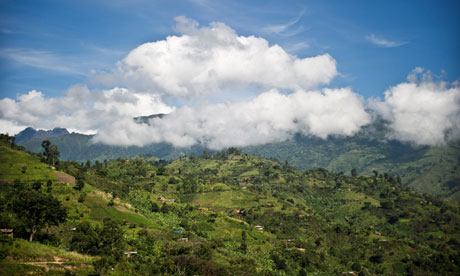
It's feels pretty perfect here. 1,300 miles south of Juba, the early morning mists have cleared to reveal a sun-dappled, warm, fertile valley, with coffee fields stretching up the hillsides, orchards of bananas, avacodos, pomegranates and lemons, and way above us, over the next range of hills the mysterious, seldom-seen Mountains of the Moon. This is Lukonzo village in the heart of Uganda's Rwenzori mountains, right on the equator at 4,000ft.
"We, the Muhkonzo people say this is the centre of the earth where God settled when he created the world. We are gifted with everything here", says Baluku Exavier, the chair of the village producers assiociation.
You can believe him, but reality comes from dozen or more smallholder coffee farmers who have come to meet us in the village sorting house. Along with thousands of other small coffee producers, they grow vast amounts or export to Europe and Japan, but they are not too sure that this is paradise.
"We have been experiencing lots of changes," says one.
"Now we have seasons but in the past we never had any," says another.
"We have lost 20% of our income," says a third.
"Ekihugho kyi Kasuma [the world becomes dry]," says the fourth.
One by one, the farmers, who mostly cultivate two acres of land each, tell us what they have observed in their lifetimes. "The springs are drying up"; "we find we can only plant crops twice'; "the coffee has started behaving differently; it flowers even as it fruits"; "we have more diseases"; "we have lost 20% of our income"; "there is less water from the mountain".
Coffee has been the cash crop king of Rwenzori for generations but climate change is tilting the crown, they argue. Less rain in the hills means the rivers now run slower, which leaves three hydroelectric plants in the region short of water and therefore unable to generate electricity all the year. Increased poverty down below leads to more people coming up the mountain in search of land, food and work.
Below we see the river Mobuku. Only 30 years ago, the bridge across it had to span a massive flood plain which was under water every year. These days the river is a relative trickle and the flood plain has barely been wet in years.
A local official says the trend is worrisome: "In the 1980s Rwenzori produved 15,000 tonnes of coffee. Now it's about 5,000 tonnes. The decline is not only because of climate change, because war has ravaged the estates, land has been sub-divided as populations have soared, and there was no investment for years. But now we face new challenges".
Back above in Lukonzo, villagers say they have no scientific understanding of why it is hotter and there is less rain, but they instinctively believe it's because there are fewer trees. Even though they are some of the lowest emitters of emissions in the world, they argue they should plant more.
"We must start with mitigation. Our message to the world leaders and the countries meeting in South Africa is to talk less and act more", says Januario Kamalha, a villager.
• John Vidal will be tweeting from the climate talks in Durban as @john_vidal. His journey was supported by the Guardian, Oxfam, and the African Investigative Journalism Conference at Wits University.