Bookended by events featuring the two best mixed martial artists to compete for the Ultimate Fighting Championship, January set up as an important start to the new year for the leading organization in caged combat.
Yet positive pre-fight drug tests for Jon Jones and Anderson Silva, shifted attention from UFC’s tremendous month of action and box office success to why two of the organisation’s biggest names were allowed to compete and get paid in the first place.
Jones tested positive for cocaine a month prior to defending his title against Daniel Cormier in Las Vegas on 3 January. On Tuesday, the UFC announced that Silva tested positive for two types of anabolic steroids prior to his decision victory on 31 January against Nick Diaz, also in Las Vegas. Both men were asked to provide random, out-of-competition urine samples to Nevada Athletic Commission collectors. Both men failed. Yet both men were allowed to fight because of supposed mistakes, oversights and inconsistent policy.
Silva, a Brazilian icon who boasts more than six million followers on Twitter, was asked by NAC, the regulatory body that oversees boxing and mixed martial arts in Nevada, to supply an out-of-competition urine sample on 9 January. The World Anti-Doping Agency defines “out of competition” as any sample not collected within 12 hours of competition. Results of the urinalysis, however, were not reported by the Sports Medicine Research & Testing Laboratory, a Wada accredited facility, until 3 February.
Were the commission aware that Silva tested positive for performance-enhancing drugs that promote muscle and tissue growth he would have been barred from competing, said Bob Bennett, who began serving as executive director of the NAC eight months ago. Instead, a temporary suspension would have been issued, and Silva would have been ordered to appear before the commission.
The fight went ahead as planned, prompting Bennett to take responsibility.
“I dropped the ball,” Bennett said. “The lab received the sample on 12 January. I didn’t receive results until 3 February. That’s three weeks. Just because we [regulated] six events in 30 days wasn’t an excuse not to call and ask about Silva’s out-of-competition results.”
Dr Daniel Eichner, the executive director of the Salt Lake City lab that analyzed Silva’s sample, indicated the length of time it takes to analyze drug tests can vary. “Sometimes it happens fast,” Eichner said. “Sometimes it takes a little bit longer. But you never rush out an adverse finding report. You need to make sure you know what you’re dealing with. If you’re dealing with substances, sometimes more than one, then you have to confirm and make sure you have all the necessary controls in place.
“We don’t receive information that maybe there’s an event coming up and we have to get the samples provided before that event. So any technician that’s doing the analysis, all they’re looking at is the sample number and you’re running it through the system to see if there’s any prohibited substances that show.”
Drug test results can be expedited, though that has not been standard practice in Nevada, Bennett said. Considering the purpose of pre-fight out-of-competition collection and the fact that Silva’s result wasn’t made available until after the bout, Bennett will seek a quicker turnaround from the Wada lab. Cost, offset by promoters like the UFC, won’t be an issue, he said.
“Upon speaking with Dr Eichner [on Tuesday], I said, quite frankly, having the collection on 9 January, the lab receiving the sample on 12 January and me receiving the result on 3 February is really unacceptable,” Bennett said. “In the future, because of this unfortunate situation, our goal is to ensure after we collect a sample and the lab receives it, we’ll get a result in seven working days.”
According to Dr Margaret Goodman, the president and board chairman of the Voluntary Anti-Doping Association (Vada), an independent testing organization focused on creating drug testing programs for boxers and mixed martial arts, the typical turnaround time for an anabolic steroid panel is five to 10 working days.
“I agree that in the Silva case this is not the fault of the lab,” said Goodman, a neurologist who was licensed as a ringside physician in Nevada from 1994 to 2005. “They receive thousands of specimens, and they are appropriately blinded as to who those specimens are on and when those athletes are scheduled to compete. It is not their responsibility.”
Silva released a statement on Wednesday declaring he did not take performance-enhancing drugs, and that he intended to fight the allegations and clear his name.
“I’ve been competing in this sport for a very long time,” Silva said. “This is my 19th fight in the UFC. I have been thoroughly tested many times and have never had a positive drug test.
“My stances on drug, and always will be, the same. I’m an advocate for clean sport.”
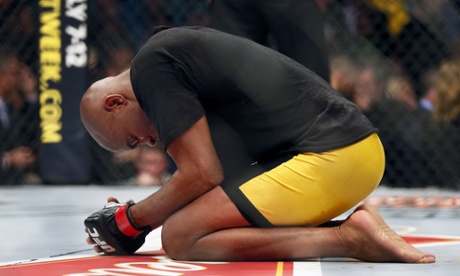
Silva’s unanimous decision over Diaz improved the Brazilian’s record to 34-6, though if the NAC issues a suspension his victory could be overturned to a no-contest. He would also be subject to a fine of his $800,000 purse, not including his cut of pay-per-view which would considerably increase his payday. The failure is expected to be addressed at a commission meeting on 17 February in Las Vegas.
Silva’s physician, Dr Marcio Tannure, who also acts as the medical director of the Brazilian MMA athletic commission, told Band News radio in Brazil that Silva is “disappointed” and “upset because he didn’t use steroids. He will ask for the confirmation test because he believes the only explanation is a contamination or a mistake from the lab. He told me: ‘I have an impeccable career history and I wouldn’t tarnish my image’.”
By Tuesday morning, Silva’s camp had already asked that his B Sample get tested, though Bennett said that request came with the caveat that a lab other than the Salt Lake City facility do the analysis. “We respect Mr Silva’s performance,” Bennett said, “but I’ve yet to see one of these tests come back inaccurate. If they want they can fly to Salt Lake City and see the B Sample tested. They can do that.”
Unlike Silva, Jones’s positive test for cocaine was known to the NAC and the UFC prior to his bout. Bennett called the result an “anomaly” and proclaimed “that matter is concluded.” Wada protocols, which NSAC follows insofar as prohibited substances go, do not regard cocaine as “performance enhancing,” and thus it should not be included on pre-fight drug screening panels.
The timing of the incidents and the fact that both stars were allowed to fight despite revelations of positive drug tests results prompted speculation on social media that the NAC, which receives 6% of the total gross receipts from live gates and up to $50,000 depending on the gross receipts of a broadcast, such as pay-per-view, deliberately kept results under wraps to preserve the cards. Unofficially, the NAC took in nearly $500,000 in fees based on the Jones- and Silva-headlined events.
Bennett called any claims to that effect “outlandish.”
Largely lost in the discussion following Silva’s positive test was the revelation that his opponent, 31-year-old star Nick Diaz, tested positive for marijuana for the third time in his career. Diaz is the fifth fighter Silva has faced who tested positive for a banned substance, illustrating the dirtiness of MMA’s drug-based culture during his time in the sport.
On the night of Silva’s first title defense on 7 July 2007, the co-main event featured a UFC lightweight title contest between Sean Sherk and Hermes Franca. Both fighters tested positive for anabolic steroids. The following year Silva stepped up in weight to meet James Irvin, who had methadone and oxymorphone in his system, and later admitted to struggling with addiction. On 8 August 2009, Silva against moved up in weight and knocked out Forrest Griffin, who tested positive after taking Xanax the night before the fight. Most famously, after Silva’s 7 August 2010, defense against Chael Sonnen, the challenger was caught with an abnormally high testosterone-to-epitestosterone ratio, beginning the testosterone-replacement therapy saga that plagued MMA until the NAC outlawed the treatment in February 2014. Two years later, Silva stopped Stephan Bonnar in the opening round. It was then revealed that Bonnar, who sits with Griffin in the UFC’s Hall of Fame, had Drostanolone in his system.
The UFC has at various points made steps to policing PEDs. Bennett praised the UFC for its effort in attempting to clean up the sport, though the promoter’s record is mixed. While the UFC instituted varying degrees of testing for events in locations that did not fall under the purview of regulators like NAC, particularly outside of the United States, recent news that UFC rescinded plans to institute random year-round, out-of-competition testing program opened the organization up to criticism.
Rather than hire a third party testing organization like Vada, or the government backed US Anti-Doping Agency, both of which provided proposals to the promoter, UFC president Dana White said the most prominent promotion in MMA will continue to rely on the loose regulatory structure that exists now.
“Any commission performing PED testing must have uniform policies, procedures and results management,” Dr Goodman said. “They must concentrate on educating the participants, and they must have their own experienced personnel, including a scientific director. The current situation is unfair to all – especially the fighters. A commission’s job is to protect the athletes, and to the best of their ability make certain the fights are fair, clean and safe.”
Nevada has a long-held reputation as the most stringent commission in the US. The commission will continue to refine drug screening policies and procedures, Bennett said.
“Every month we’re trying to improve,” Bennett said. “The Silva news is evident that we’re aggressive, but mistakes were made and we need to correct them.”