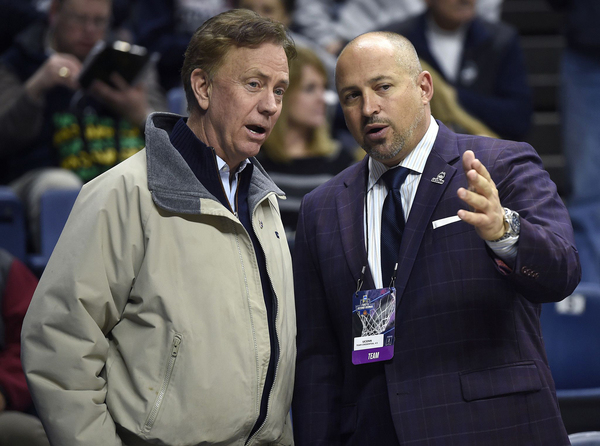
HARTFORD, Conn. — UConn Athletic Director David Benedict said Tuesday that he doesn't know how long the UConn men's basketball team will be shut down before they can resume their season.
The school is currently in the midst of gathering information on whether any more individuals are infected with COVID-19 on the men's side. A member of the program tested positive for COVID-19 Sunday, suspending play for an undetermined about of time. UConn's Big East conference opener against St. John's has been postponed, while nothing definitive has been announced for Sunday's matchup against Georgetown.
Benedict said that rather than adopting one-size-fits-all guidelines, the athletic department will work closely with Connecticut Department of Health officials and the school's medical leadership to determine how long individuals need to quarantine and when it's safe for the team to the return to the court.
This means that the CDC's updated quarantine guidance, while taken into consideration, didn't really change UConn's approach at all; rather it gave the school "more options."
The CDC's latest guidance still recommends the primary option of a 14-day quarantine period but as of last Wednesday says that "based on local circumstances and resources," two shorter alternatives are acceptable: a 10-day quarantine without testing and no symptoms and a seven-day quarantine with no symptoms and a negative test within 48 hours of quarantine discontinuation.
"Until we have more information and get further into the process of testing once we have a positive, we don't know what we're going to do, so to say that we're going to apply a seven-day quarantine every time someone tests positive is not how we're going to handle things here," Benedict says. "We're going to work with our DPH officials, we're obviously going to work with our medical folks on campus, and we'll make the best decisions based on the information that we're gathering and everyone's input."
Per the CDC, the residual post-quarantine transmission risk for the 10-day quarantine is about 1% with an upper limit of roughly 10%, while it's about 5% with an upper limit of 12% for the seven-day quarantine.
Benedict said the 48 hours leading up to a positive test and the 72 hours after it are important factors allowing the athletic department and medical officials to make educated decisions. If there's no community spread seven days following a positive COVID-19 test, for example, that would likely lead to a shorter quarantine than if there is significant spread.
UConn tests Tier 1 individuals three times a week using PCR tests exclusively, but has the ability to ramp up the frequency if the situation is warranted.