For some of those familiar with the travails of bitter Thursday nights in European outposts, the Europa League is the bane of a season. A nuisance that derails pursuits in higher-priority competitions and one best avoided if you want to prosper elsewhere. But before the malaise and cynicism sets in and the majority of big names join the competition, romance remains in seldom-trodden places.
None more so than at University College Dublin, the second-tier Republic of Ireland side who progressed for the first time in continental competition by overcoming Luxembourg’s F91 Dudelange on away goals, while two of the other three teams in the Irish Premier Division bowed out limply. “It was like we had won the competition,” the UCD manager, Collie O’Neill, said. On Thursday the tiniest of minnows continue living the dream away to Slovan Bratislava.
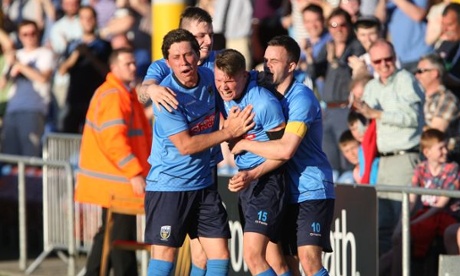
Leading 1-0 against Dudelange from the home leg, thanks to Ryan Swan’s goal, the plan was simple: shut up shop, do not give Dudelange a yard of space. Then Swan produced the goods again, scoring 17 minutes into the game at the Jos Nosbaum stadium.
They started to believe. Observers at home predicted they would stand no chance – one tabloid columnist asserted that UCD would “embarrass” the league, a comment that O’Neill used to motivate his troops by pinning on the dressing-room wall – but here they were surprising everybody, including themselves. Fearlessness and exuberance were trumping the physicality and experience of their opponents.
Suddenly catastrophe struck. The defender Sean Coyne was sent off – which was ironic considering, like West Ham United, they qualified via Uefa’s fair play league – and by half-time UCD were 2-1 down on the night, clinging on to an aggregate lead thanks to Swan’s header. “When we went down to 10 it wasn’t just parking the bus, it was parking the plane,” O’Neill says. “We got a bit lucky, to be honest.”
Luck combined with the performance of a lifetime from the goalkeeper, Niall Corbet. Dudelange had 41 attempts on Corbet’s goal but could find no way past. When the final whistle blew, UCD’s players sunk to their knees disbelievingly. This was the greatest moment in the club’s 120-year history – their only previous European experiences were against Bulgaria’s Velbazhd Kyustendil in the 2000-01 Intertoto Cup and Everton in 1984-85, when Howard Kendall’s team went on to win the Cup Winners’ Cup, despite struggling to beat the College 1-0 on aggregate.
Dudelange, hardly a household name but with a couple of internationals in their ranks, had arrived in Dublin for the first leg believing it would be a foregone conclusion, they would progress in second gear. That underestimation played into UCD’s hands, according to the captain, Robbie Benson.
“We noticed in the home leg how laid-back the whole travelling party were, it was almost as if they felt all they needed to do was show up,” Benson says. “You could really see a change in their approach after losing the first game and they certainly had more bite to them in the second leg. They might have fallen in to the same trap after they scored the second goal last week because they celebrated as if they had the tie won at that stage. They weren’t expecting us to be as determined as we were to hang on though.”
There was an added twist for O’Neill, whose pregnant wife, Jenny, was 11 days overdue. The team had flown to Luxembourg the day before the game but he wanted to wait in Dublin until the last minute in case he missed the delivery. The couple were kept waiting and he joined the squad via Brussels and a rented car hours before kick-off.
He arrived back home at 2am and, exhausted from their excursion, headed straight for bed. “Forty-five minutes after getting to sleep, I got an elbow.” It was time. Things were complicated when the baby was breech, but at 5.40am Carl entered the world. “He spent 36 hours in intensive care, but he is home now and all is well,” O’Neill adds. “It was the most surreal 48 hours of my life.”
Carl O'Neill born at 5:40am, so good of my wife to hold on till I got back from Luxembourg
— Collie (@collieoneill) July 10, 2015
He flew out with the rest of the squad to Slovakia on Wednesday morning, with the aim of keeping the tie alive for the second leg. It will be an onerous task. “Their striker, Robert Vittek, scored four goals at the 2010 World Cup, so it’s going to be levels above anything we have experienced before.”
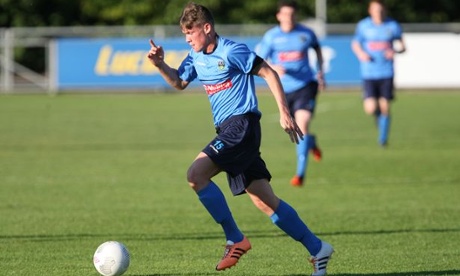
As the name suggests, UCD’s squad is made up mostly of students – combining degrees with semi-professional football. Corbett, whose task will be to keep Vittek at bay, studies food science. A couple of the squad have only finished their Leaving Cert – the Irish equivalent to A-levels – and another, Dylan Watts, still has a year remaining before taking his secondary school exams. “Fourteen of the main squad are either in UCD or will be going to UCD once they get the required results in school,” O’Neill says. At that point they will be given scholarships, a system modelled on US colleges.
Behind the scenes, the club rely on volunteers. The kitman, Josh Dolan, is a fan who offered his services after “falling in love with the team”. He also films games for post-match analysis, provides match reports for the club website and helps out with other odd jobs. “You know everybody, you can chat to everybody. No one’s above speaking to anyone no matter what their rank is in the club,” Dolan says.
The press officer, Conor McCarthy, is dealing with the increased attention and media requests while studying for his final accountancy exams, organising a media day for a team that are often lucky to have their results printed in some Irish newspapers. “I really don’t think it would,” McCarthy says when asked if the club would survive without volunteers. “There’s a brilliant spirit around the place, and everyone just gets the job done.”
Qualifying for the second round also brings the club a relative embarrassment of riches: defeating Dudelange was worth €410,000, the combined total of prize money in their league is €75,000. They sit in third at the moment, three points behind the leaders, Wexford Youths.
The real challenge will be attracting new fans through the door. There were more than 1,000 at the Dudelange fixture compared to an average league gate of 239. They expect to sell out their 1,400-capacity Belfield Bowl, positioned at the back of the university’s Health Sciences Centre and shared with the rugby union team, for next week’s second leg against Slovan, who have requested 500 tickets. However their next home league fixture, against Waterford, will see the crowd drop back into the low hundreds.
No wonder O’Neill admits the players “don’t want to go back to the league now, they want to play in the Europa League forever”.