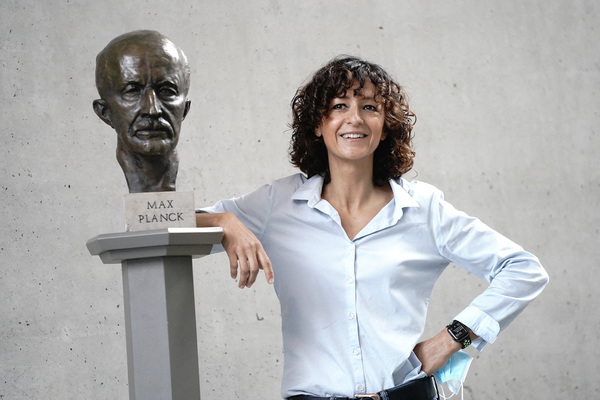
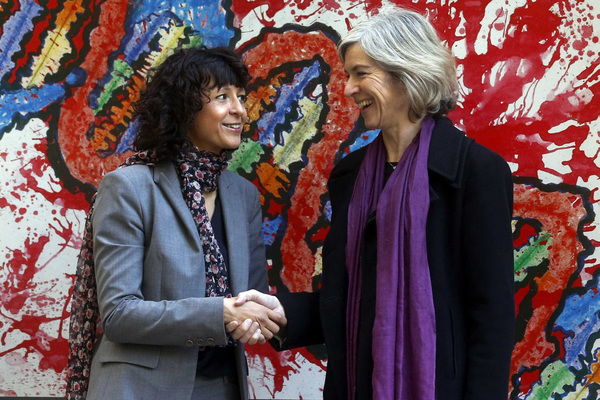
LONDON _ The Nobel Prize in chemistry was awarded Wednesday to UC Berkeley biochemist Jennifer A. Doudna and French scientist Emmanuelle Charpentier for their pioneering work on the so-called CRISPR tool for gene editing, a discovery that holds out the possibility of curing genetic diseases.
The Nobel Committee said the two women's work on developing the CRISPR method of gene editing, likened to an elegant pair of "molecular scissors," had transformed the life sciences by allowing scientists to target specific sequences on the human genome.
This could, for example, allow doctors to fix cells with sickle-cell anemia. It also paves the way for such developments as plants and livestock with greater disease resistance and safer transplants of animal organs into humans.
"There is enormous power in this genetic tool, which affects us all," said Claes Gustafsson, chair of the Nobel Committee for Chemistry. "It has not only revolutionized basic science but also resulted in innovative crops and will lead to groundbreaking new medical treatments."
He added that "the enormous power of this technology means that we need to use it with great care. But it's equally clear that this is a technology and method that will provide humankind with great opportunities."
Pernilla Wittung-Stafshede, another member of the chemistry committee, added: "The genetic scissors were discovered just eight years ago but have already benefited humankind greatly. ... Perhaps the dream of curing genetic diseases will come true."
Washington-born and Harvard-educated Doudna is a professor at UC Berkeley. The French-born Charpentier is director at the Max Planck Institute for Infection Biology in Berlin.
The prizes were announced in Stockholm by the Royal Swedish Academy of Sciences.
"I literally just found out. I'm in shock," Doudna, reached at home by the Associated Press, said. "I was sound asleep. ...
"My greatest hope is that it's used for good, to uncover new mysteries in biology and to benefit humankind," Doudna said of the CRISPR technology.
"I was very emotional, I have to say," Charpentier, 51, told reporters by phone from Berlin after learning that she had won.
It is the first time that the prize has been shared by two women. Charpentier said she hoped it would send "a positive message" to girls and young women "who would like to follow the path of science and ... show them that, in principle, women in science can also be awarded prizes but, more importantly, that women in science can also have an impact through the research."
Last year saw the first attempt in the U.S. to use the CRISPR tool to treat cancer patients. Doctors took immune-system cells from the patients' blood, altered the cells genetically to help them recognize and fight cancer, and reintroduced them into the patients. Whether the treatment will improve their chances of survival is still too early to say.
The ability to edit genes comes fraught with difficult ethical questions, which Doudna expounded in her book "A Crack in Creation: Gene Editing and the Unthinkable Power to Control Evolution." The book, which she wrote with her former student Samuel H. Sternberg, said that CRISPR technology offered "both the greatest promise and, arguably, the greatest peril for the future of humanity."
"It's widely available and it's accessible to people around the globe," Doudna told the Los Angeles Times when the book was published in 2017. "That's what's wonderful about it, but also one of the real challenges. How do you control something like that?"
The CRISPR breakthrough has also spawned a protracted legal fight over patents on it. Other scientists have conducted significant research on the technology, but Doudna and Charpentier are the two who have been most consistently recognized for turning it into an easily usable, readily available tool.
The Nobel chemistry prize frequently honors research that leads to practical applications in wide use. Last year's winning trio pioneered the lithium-ion battery, a lightweight, rechargeable power supply that is ubiquitous today.
The chemistry award is one of the six 2020 Nobel Prizes that are being announced through Monday. Andrea Ghez, a professor at UCLA, was one of the joint winners of the physics prize, which was announced Tuesday.
The other Nobel Prizes are awarded in medicine, literature, peace and economics.
The award comes with a gold medal and more than $1.1 million, drawn from a bequest left by Swedish inventor Alfred Nobel, who established the prizes that bear his name.