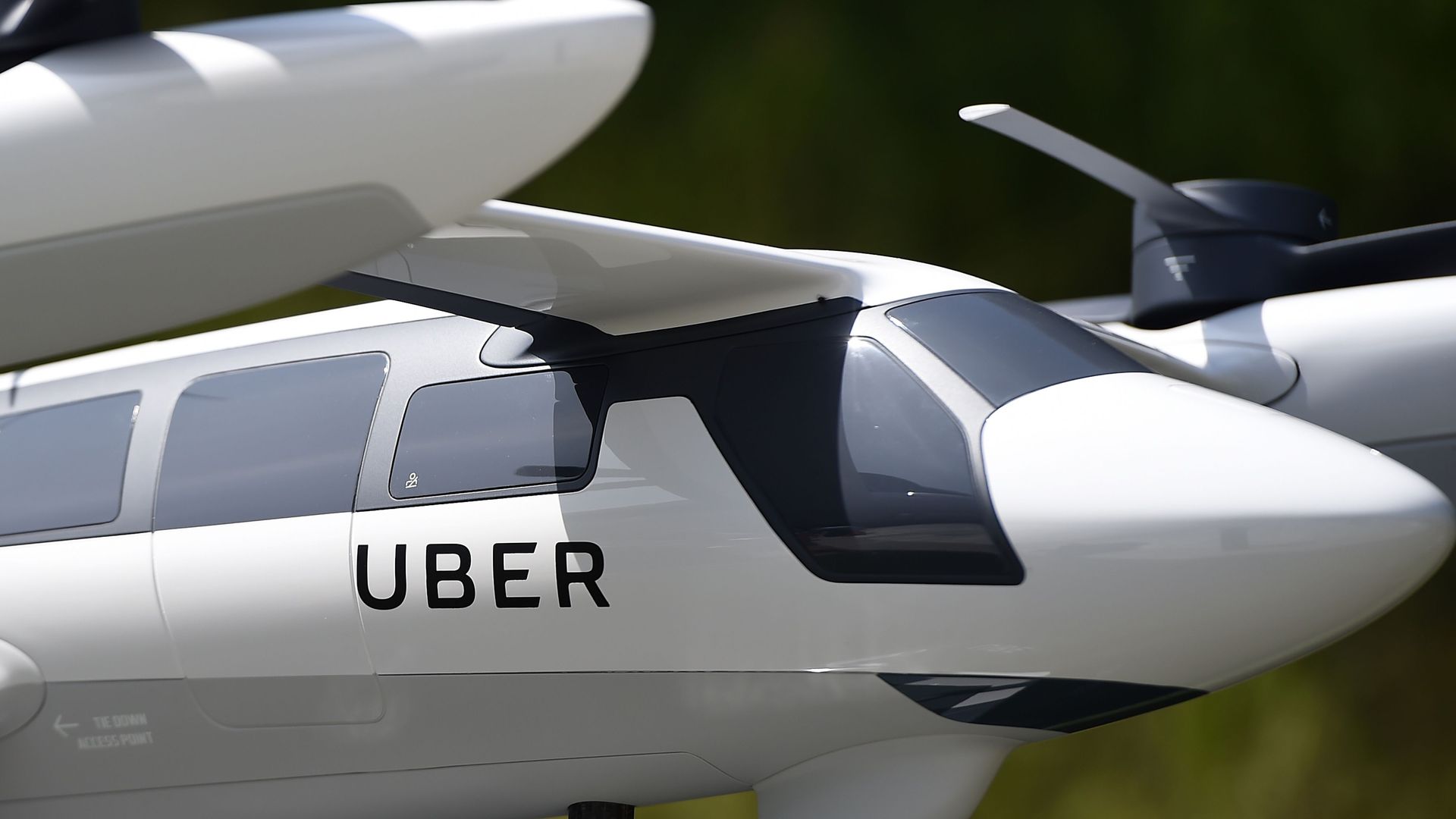
Uber's IPO prospectus highlights $457 million in spending last year on its Advanced Technologies Group and other initiatives, including the flying car program called Uber Elevate: "Our initial efforts through Uber Elevate focus on shared air transportation between suburbs and cities, with the goal of ultimately addressing air transportation within cities."
The big picture: Flying electric cars could play a "niche role" in sustainable transportation, but using them for short commutes would not be climate-friendly, a recent study in Nature Communications concludes.
Why it matters: In addition to Uber, companies including Boeing are developing vertical takeoff and landing vehicles (VTOLs). Deployment timelines are uncertain, but it's no longer a distant fantasy.
- University of Michigan and Ford researchers compared emissions from hypothetical VTOLs with ground-based cars.
What they found: Trip length matters a lot. VTOLs use lots of energy to gain altitude, but then run more efficiently.
- For trips of 100 kilometers, or 62 miles, a VTOL with a pilot and 3 passengers would generate 52% fewer emissions per "passenger kilometer" than an internal combustion car and 6% less than an EV. (That result assumes 1.54 occupants per ground car.)
- Overall, VTOLs are better than gas-powered cars for trips of around 22 miles or more. But for the average commute of around 11 miles, it doesn't make sense from a climate standpoint.
- The LA Times has a good look here.
What they're saying: "The implications are we shouldn't use VTOLs for urban taxis, but rather for longer trips inside or outside of a metropolitan area," Carnegie Mellon University's Costa Samaras, who was not involved in the study, tells Axios.
- He notes internal combustion cars sold today will be around for 20 years, and believes VTOLs for some passenger and freight uses will arrive in that window.
- "[W]e should be thinking about policies to encourage sustainability, safety, and livability with urban air mobility systems pretty soon," he said in an email.
Go deeper: A sky full of driverless flying cars in just a decade