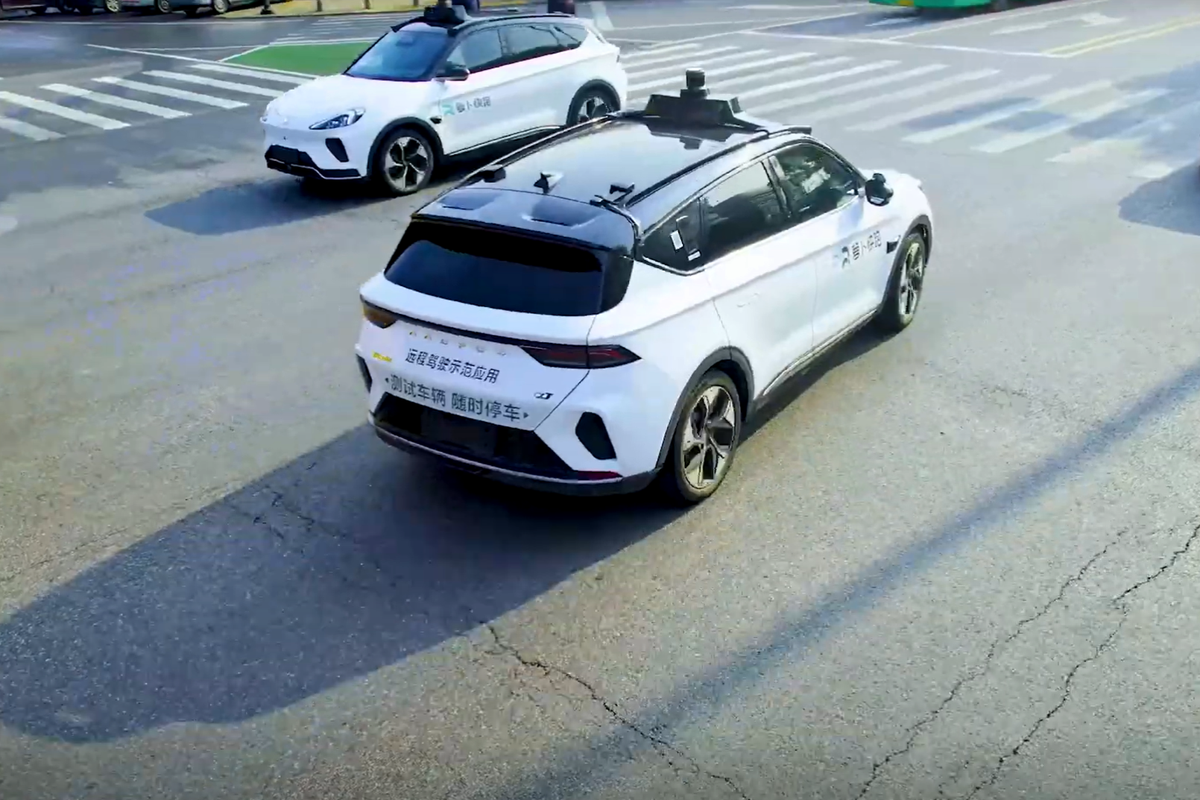
London is to become a key battleground for the development of driverless taxis in 2026, as Uber and Lyft partner with Chinese tech giant Baidu to bring self-driving cabs to the capital.
The new trial will see fully electric, driverless vehicles begin testing on London’s streets as early as next year. Under the agreement, London riders will be the first in the UK to experience Baidu’s purpose-built Apollo Go electric vehicles, with a fleet of dozens of cars expected to begin testing in 2026, pending regulatory approval.
The agreement between Uber, Lyft and Baidu follows Waymo – the self-driving car division of Alphabet, owner of Google – which recently began testing driverless cabs of its own in London, and plans to offer rides to the public in 2026. Both initiatives will set out to prove self-driving technology can handle the busy, narrow and often complex streets of a major European city, not just the simpler, gridiron road layouts more common in the US and modern Chinese cities.
The move also underlines London’s growing role as a proving ground for autonomous vehicle technology. Although practically unknown in the UK and Europe, Chinese tech giant Baidu describes itself as the world’s largest autonomous vehicle operator, having already completed more than 17 million cumulative rides across 22 cities globally.

Baidu says its autonomous driving systems have covered more than 240 million kilometres (149 million miles) in total, with over 140 million kilometres completed in fully driverless mode. It also says it now completes more than 250,000 autonomous rides every week – a figure also reported by Waymo, which operates in a handful of US cities, in April 2025.
The vehicles earmarked for London are Baidu’s RT6 models; fully electric cars designed specifically for ride-hailing use. Unlike converted production cars, like the Jaguar I-Pace fleet used by Waymo, the RT6 has been developed from the outset to operate without a driver, with a layout and technology stack intended to maximise passenger space, safety and efficiency in urban environments.
Lyft – which launched in 2012 but only entered the UK market in 2025 through its purchase of ride-share firm Freenow – says the service will operate as part of a “hybrid network”, with autonomous vehicles working alongside human-driven cars, rather than replacing them outright. The company says this approach is designed to ensure London’s full range of travel needs can be met while creating new opportunities within the wider ride-hailing ecosystem.
Work is already said to be under way with Transport for London, regulators and local communities to prepare for the introduction of the vehicles. As with all autonomous vehicle deployments in the UK, the programme will be subject to regulatory approval and close oversight, particularly in its early testing phase.
The announcement comes as momentum builds around driverless technology in the capital. In October, Waymo confirmed plans to deploy its own autonomous taxis on the streets of London, signalling a new phase in the city’s transport evolution. Together, the announcements suggest that fully driverless ride-hailing is moving rapidly from pilot projects to real-world urban deployment in the UK.
For Londoners, the arrival of Baidu’s Apollo Go vehicles would represent the first opportunity to experience a mature autonomous ride-hailing platform that has already been operating at scale elsewhere in the world. In China, Baidu’s robotaxi services are already available to members of the public in multiple cities, with vehicles operating without safety drivers on board in defined areas.
Lyft has positioned the partnership as part of a broader strategy to expand its autonomous vehicle capabilities internationally, while working with established technology providers rather than developing its own self-driving systems in-house. For Baidu, London offers a high-profile European showcase for its technology and a chance to demonstrate that its systems can operate safely and effectively outside its home market.
While firm dates for a public launch have not yet been confirmed, other than Uber saying it would be in the first half of 2026, all companies have made clear that London is only the beginning. If testing proves successful and regulatory hurdles are cleared, the planned expansion to hundreds of vehicles could significantly change how people move around the capital, particularly for short urban trips.
For now, the focus remains on preparation and approval, but the direction of travel is clear. With Baidu, Uber and Lyft joining Waymo in targeting London, the city is fast becoming one of the most important testbeds in the world for autonomous mobility. If these plans come to fruition, hailing a driverless electric taxi in London could soon move from novelty to everyday reality.
I’ve been driving the new Tesla Model Y Standard, here’s my honest review
Mercedes-Benz S-Class review: The S-Class of plug-in hybrids
Range Rover Velar review: Pretty SUV kept fresh by plug-in hybrid tech
Tesla Model Y Standard review – less is more for Tesla’s cut-price SUV
Living with an electric Hyundai Ioniq 9: your move, Range Rover
I’ve seen the new Jaguar GT uncovered – here’s my honest verdict
Chery Tiggo 9 review – it’s big, clever and goes a long way in luxury