U.S. trio win Nobel for finding Einstein's gravitational waves
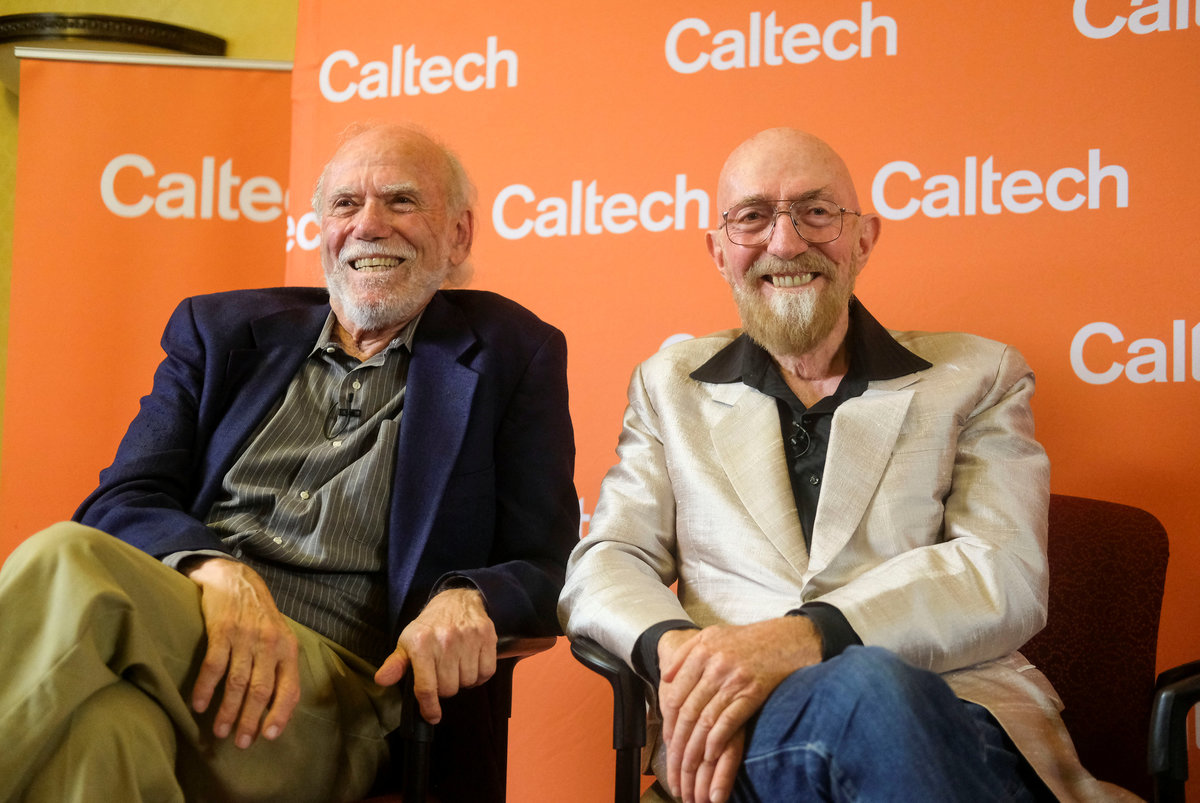
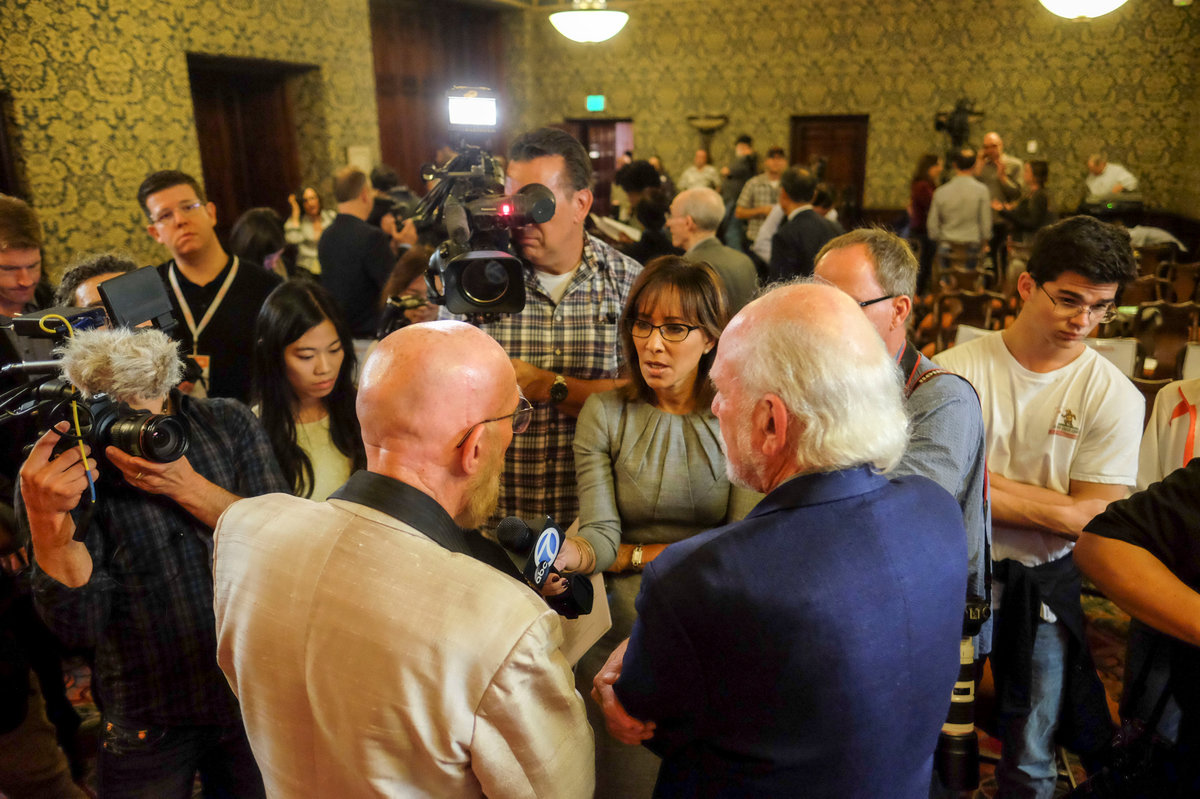
California Institute of Technology physicists Kip S. Thorne (R) and Barry C. Barish attend a news conference after winning the 2017 Nobel Prize for Physics, which they share with MIT's Rainer Weiss, in Pasadena, California, U.S. October 3, 2017. REUTERS/Ringo Chiu
STOCKHOLM/LONDON (Reuters) - Three U.S. scientists won the 2017 Nobel prize for physics on Tuesday for opening up a new era of astronomy by detecting gravitational waves, ripples in space and time foreseen by Albert Einstein a century ago.
The work of Rainer Weiss, Barry Barish and Kip Thorne crowned half a century of experimental efforts by scientists and engineers.
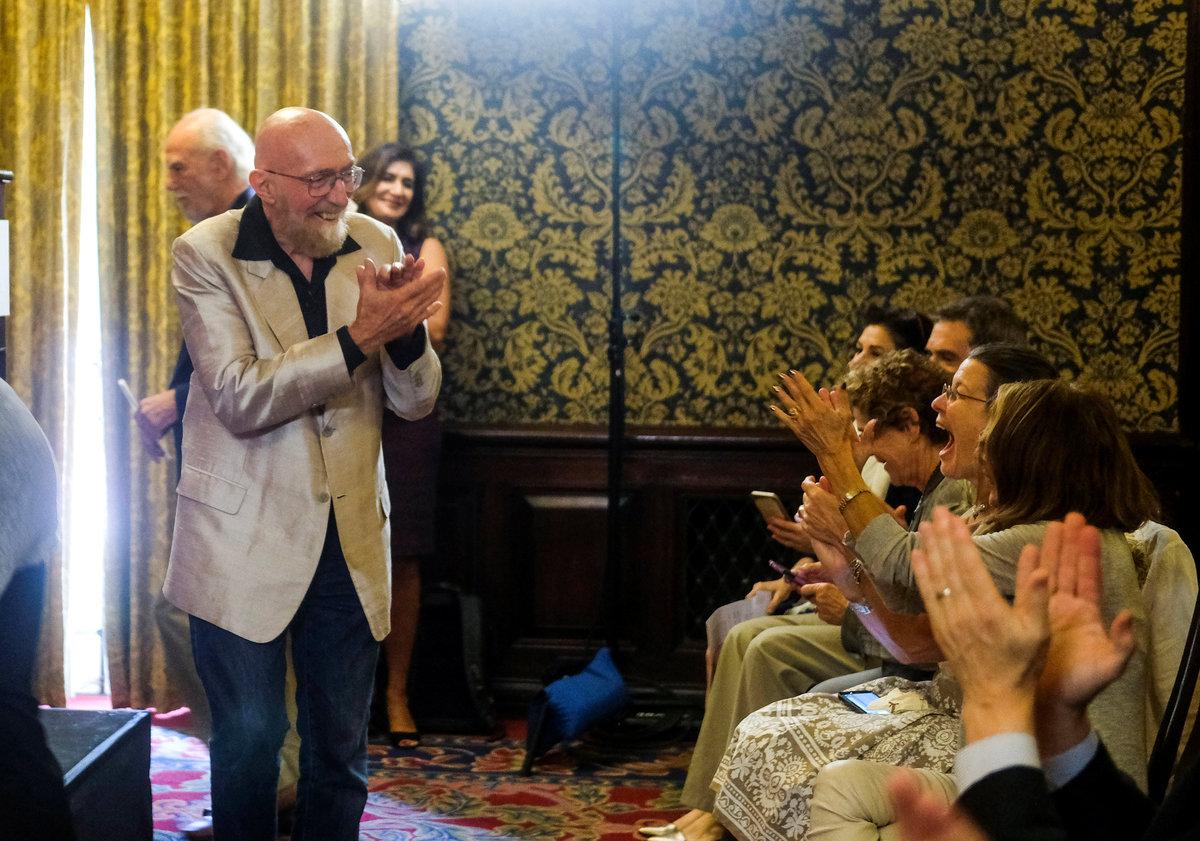
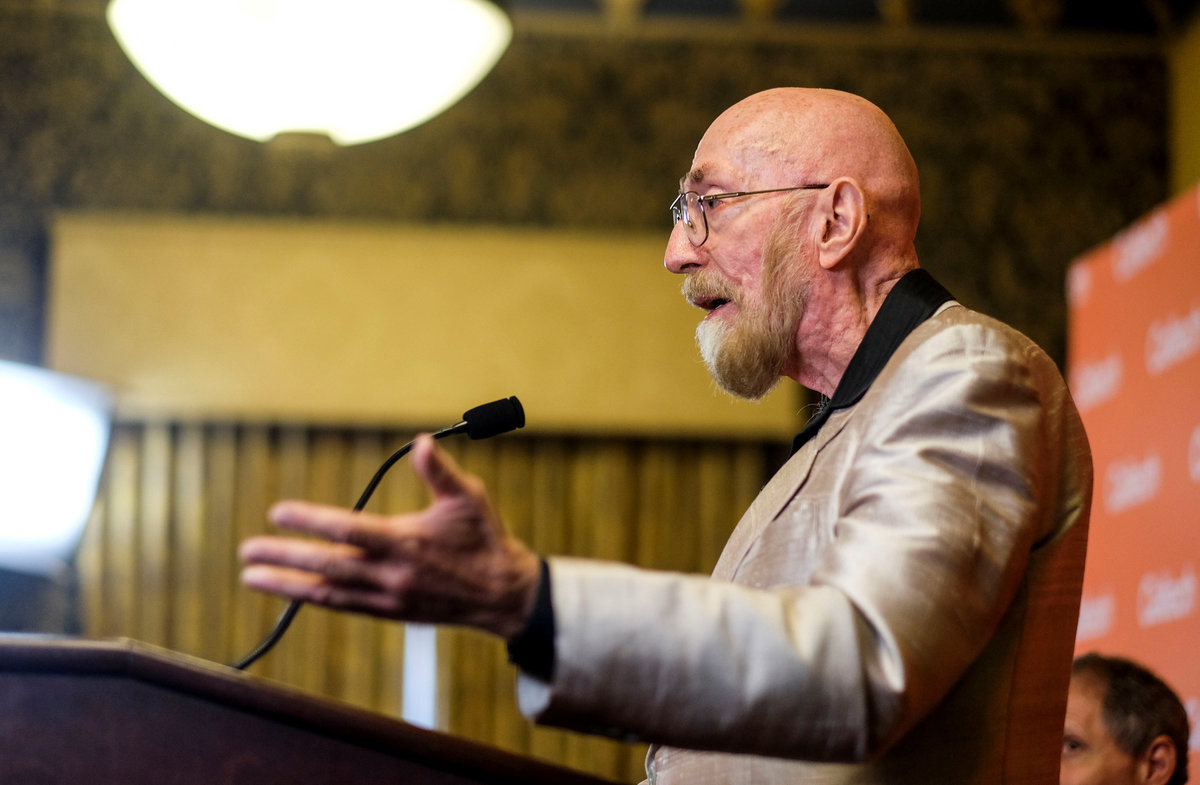
California Institute of Technology physicist Kip S. Thorne greets as he arrives at a news conference after winning the 2017 Nobel Prize for Physics, which he shares with MIT's Rainer Weiss and Caltech's Barry C. Barish, in Pasadena, California, U.S. October 3, 2017. REUTERS/Ringo Chiu
Measuring gravitational waves offers a new way to observe the cosmos, helping scientists explore the nature of mysterious objects including black holes and neutron stars. It may also provide insight into the universe's very earliest moments.
The first detection of the waves created a scientific sensation when it was announced early last year and the teams involved in the discovery had been widely seen as favourites for Tuesday's prize.
"We now witness the dawn of a new field: gravitational wave astronomy," Nils Martensson, acting chairman of the Nobel Committee for Physics, told reporters.
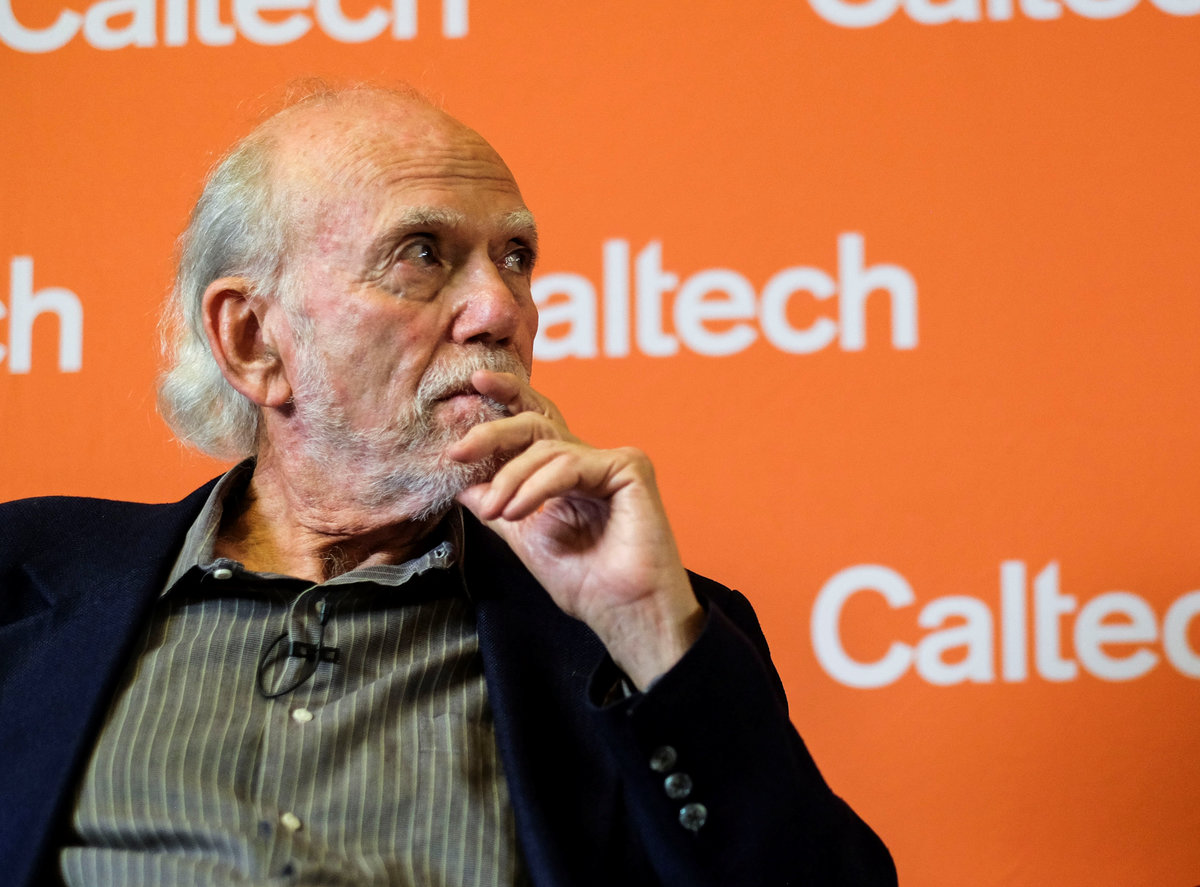
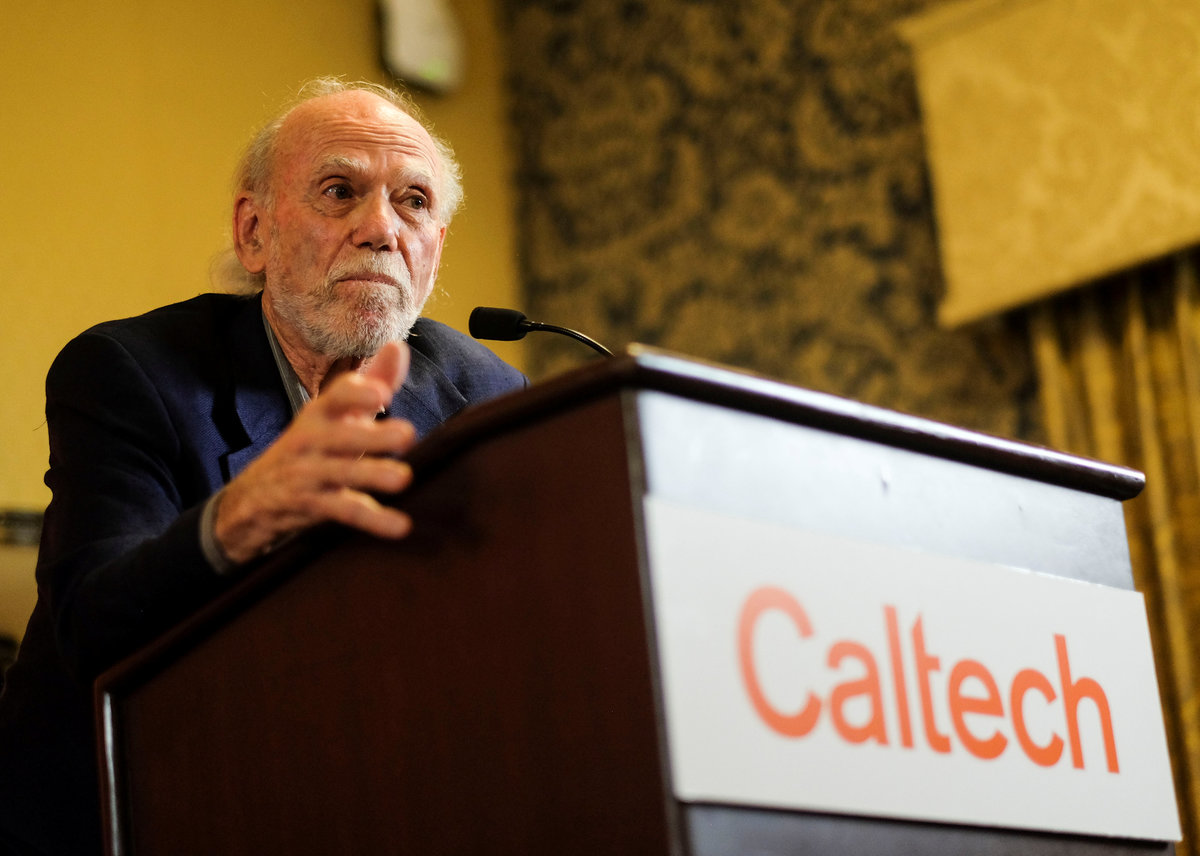
California Institute of Technology physicist Barry C. Barish attends a news conference after winning the 2017 Nobel Prize for Physics, which he shares with Caltech's Kip S. Thorne and MIT's Rainer Weiss, in Pasadena, California, U.S. October 3, 2017. REUTERS/Ringo Chiu
"This will teach us about the most violent processes in the universe and it will lead to new insights into the nature of extreme gravity."
Weiss said the award of the 9 million Swedish crown ($1.1 million) prize was really a recognition of around 1,000 people working on wave detection.
Two U.S.-based instruments working in unison, called the Laser Interferometer Gravitational-Wave Observatory (LIGO), detected the first waves caused by colliding black holes. A European sister facility, known as VIRGO based in Italy, has also detected waves more recently.
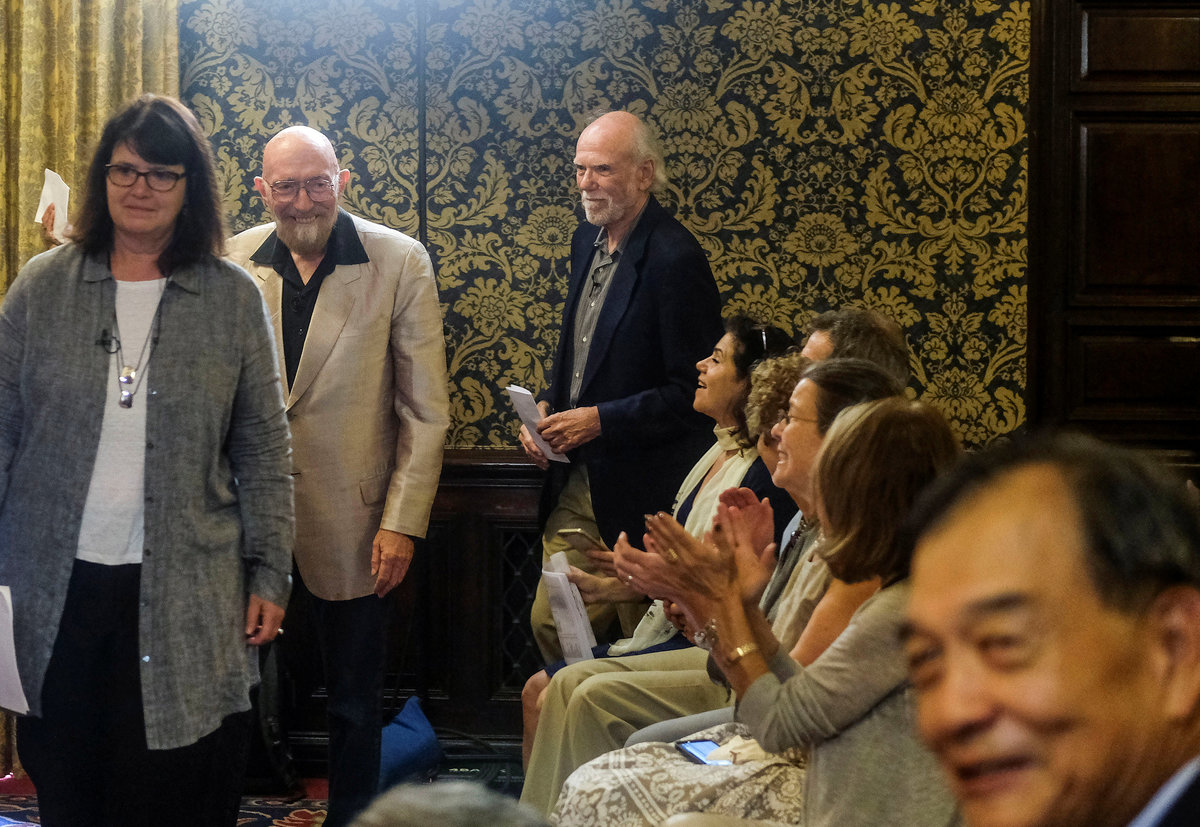
California Institute of Technology physicists Kip S. Thorne and Barry C. Barish arrive at a news conference after winning the 2017 Nobel Prize for Physics, which they share with MIT's Rainer Weiss, in Pasadena, California, U.S. October 3, 2017. REUTERS/Ringo Chiu
Those spotted so far have come from very distant black holes - extraordinarily dense objects whose existence was also predicted by Einstein - that smashed together to form a single, larger black hole.
JUST THE START
California Institute of Technology physicists Kip S. Thorne and Barry C. Barish attend a news conference after winning the 2017 Nobel Prize for Physics, which they share with MIT's Rainer Weiss, in Pasadena, California, U.S. October 3, 2017. REUTERS/Ringo Chiu
Weiss believes this is just the start.
"There are a huge amount of things ... in the universe that radiate gravitational waves. The black holes are the most obvious but there are many, many others," he said in a telephone call with the Nobel committee.
Other experts share that excitement and said LIGO and VIRGO offered new ways to explore the fundamental nature of the universe that have so far been impossible, even with the most sophisticated telescopes.
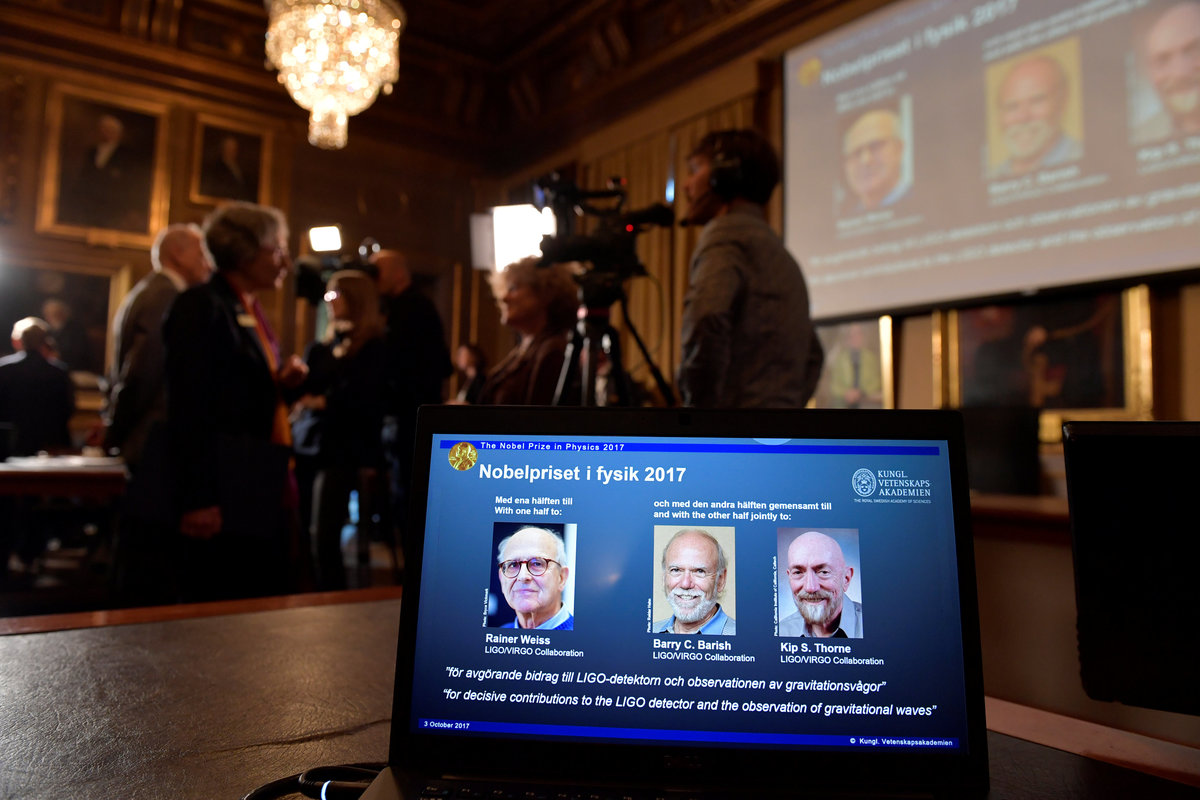
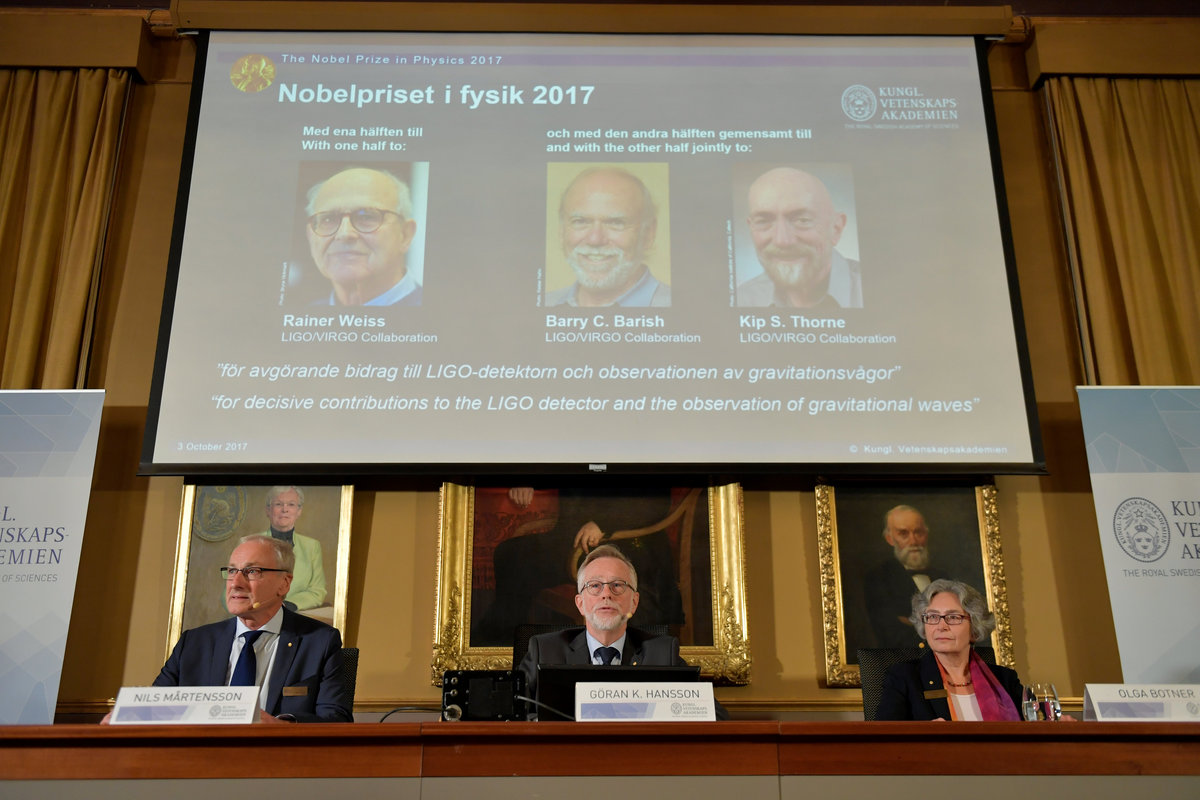
The names of Rainer Weiss, Barry C. Barish, Kip S. Thorne are displayed on the screen during the announcement of the winners of the Nobel Prize in Physics 2017, in Stockholm, Sweden, October 3, 2017. TT News Agency/Jessica Gow via REUTERS
Because gravitational waves are radically different from electromagnetic waves such as radio waves, visible light, infrared light and X-rays, they are expected to reveal previously inaccessible features.
"This is just the beginning of a new roller-coaster exploration of the universe," said Alberto Vecchio of the University of Birmingham's Institute of Gravitational Wave Astronomy.
The signals from gravitational waves are extremely weak when they reach Earth and therefore require exquisitely accurate measurement.
California Institute of Technology physicist Kip S. Thorne attends a news conference after winning the 2017 Nobel Prize for Physics, which he shares with Caltech's Barry C. Barish and MIT's Rainer Weiss, in Pasadena, California, U.S. October 3, 2017. REUTERS/Ringo Chiu
"These represent some of the most precise measurements that are made by physicists," Nobel committee member David Haviland told Reuters.
Designed to pick up tiny vibrations as they pass through the Earth, the laser detectors spot changes thousands of times smaller than an atomic nucleus.
The scientists then convert the wave signal into sound waves and can listen to the "chirps" of the black holes merging.
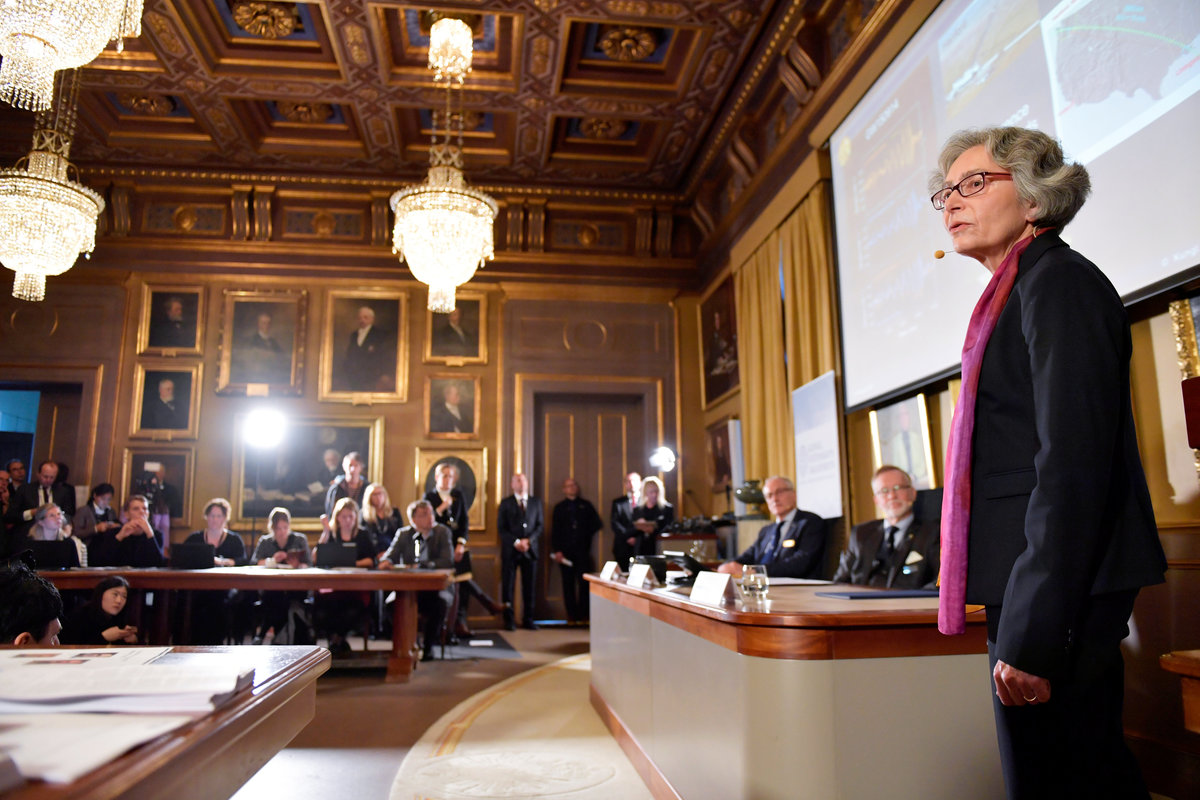
Nobel Committee for Physics member Olga Botner, Professor of Experimental Elementary Particle Physics, explains the work on observing gravitational waves, during the announcement of the winners of the Nobel Prize in Physics 2017, in Stockholm, Sweden, October 3, 2017. TT News Agency/Jessica Gow via REUTERS
Physics is the second of this year's crop of Nobel Prizes and comes after Americans Jeffrey Hall, Michael Rosbash and Michael Young were awarded the Nobel Prize for Physiology or Medicine on Monday.
The prizes for achievements in science, literature and peace were first awarded in 1901 in accordance with the will of Swedish business tycoon Alfred Nobel, who bequeathed much of the fortune he generated from his discovery of dynamite.
Among the science prizes, physics has often taken centre stage with laureates including superstars such as Einstein, Niels Bohr and Marie Curie, one of only two women to win a Nobel prize in physics.
California Institute of Technology physicist Barry C. Barish attends a news conference after winning the 2017 Nobel Prize for Physics, which he shares with Caltech's Kip S. Thorne and MIT's Rainer Weiss, in Pasadena, California, U.S. October 3, 2017. REUTERS/Ringo Chiu
Weiss won half of this year's prize, with Barish and Thorne sharing the other half.
REFILE - CORRECTING TYPO IN SECOND NAME The names of Rainer Weiss, Barry C. Barish and Kip S. Thorne are displayed on the screen during the announcement of the winners of the Nobel Prize in Physics 2017, in Stockholm, Sweden, October 3, 2017. TT News Agency/Jessica Gow via REUTERS
(Additional reporting by Niklas Pollard, Simon Johnson, Helena Soderpalm, Daniel Dickson and Johannes Hellstrom; editing by John Stonestreet)
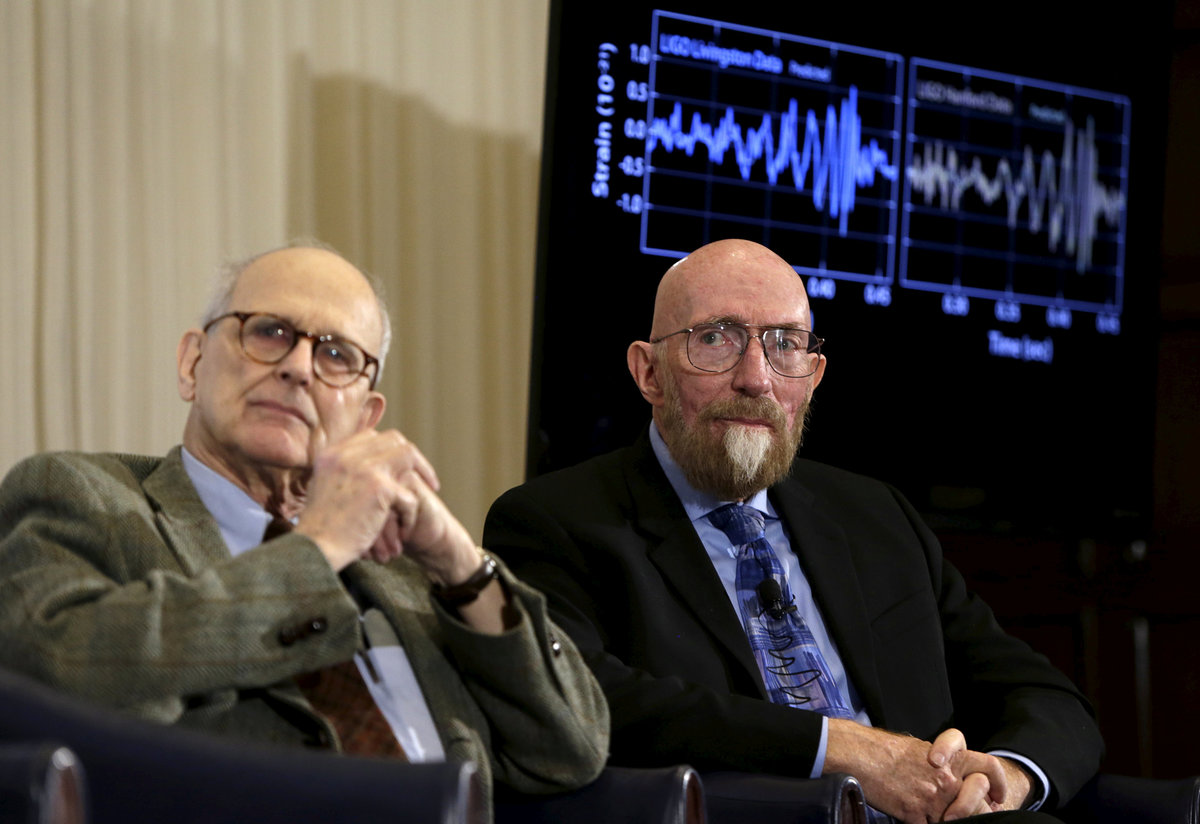
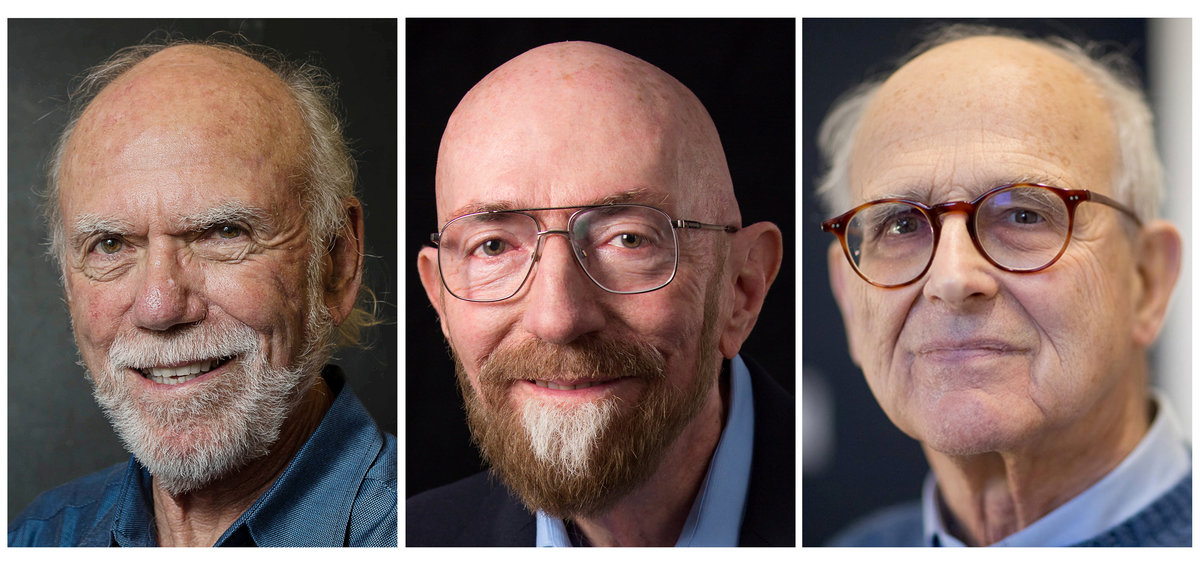
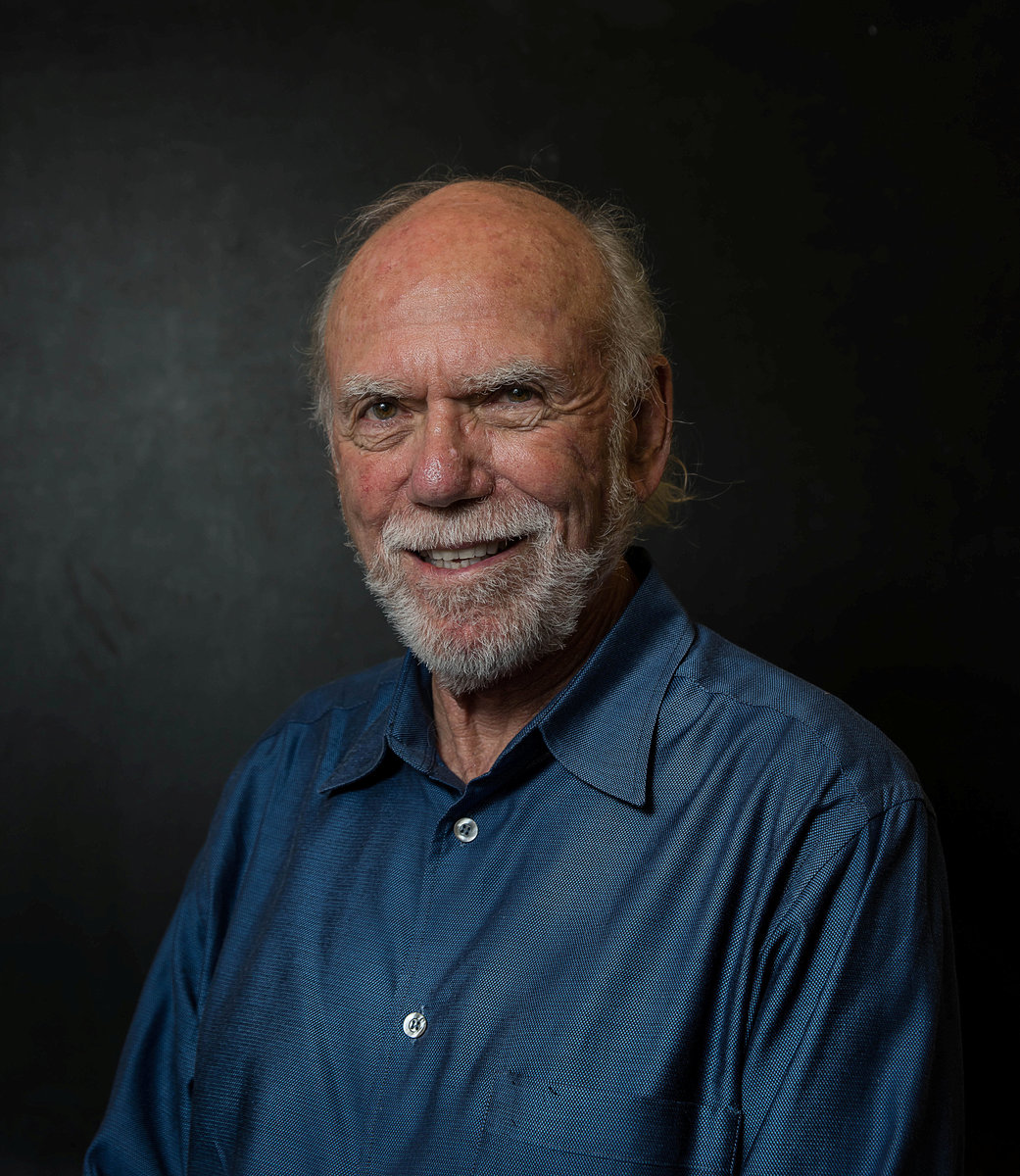
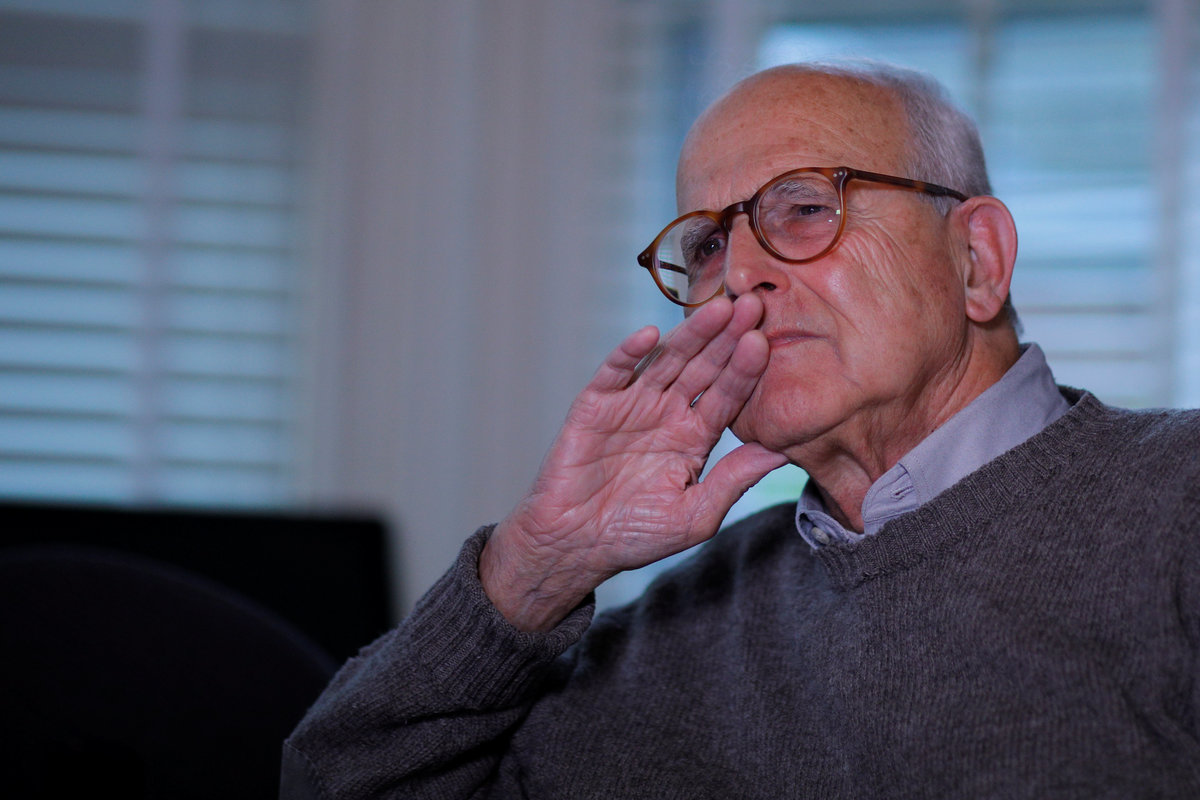
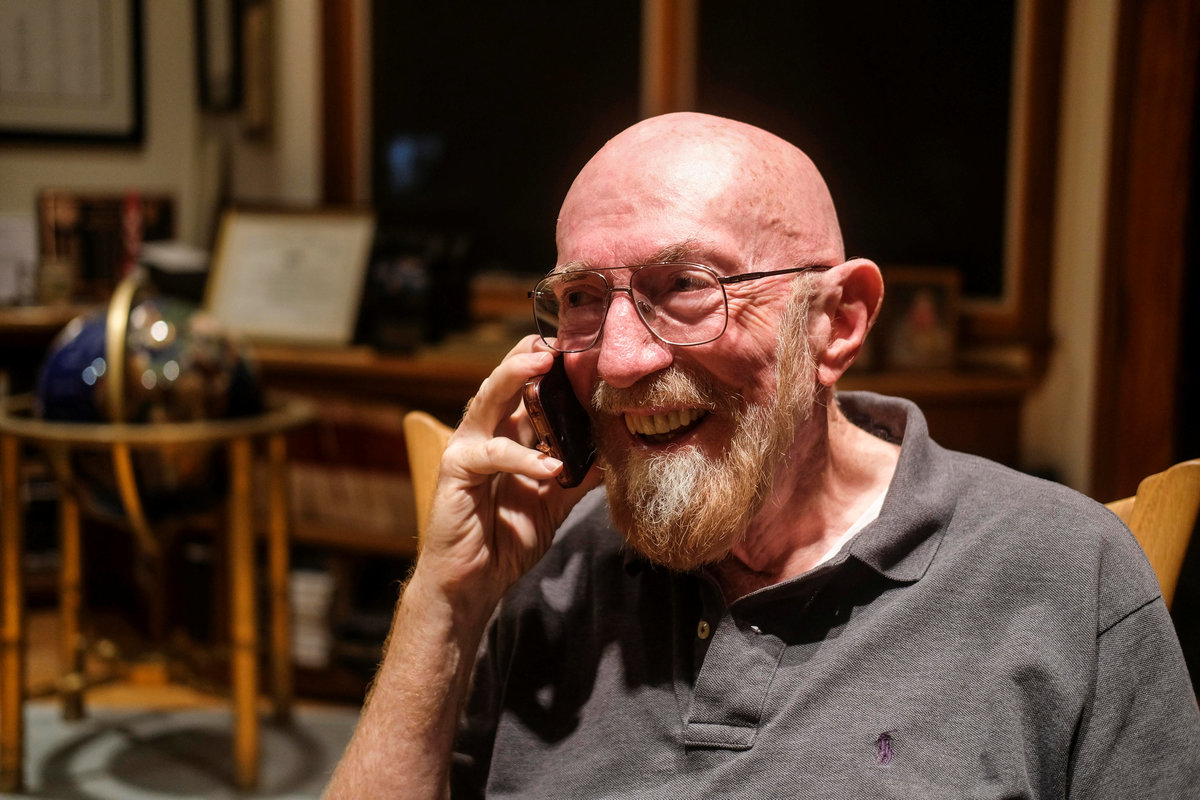
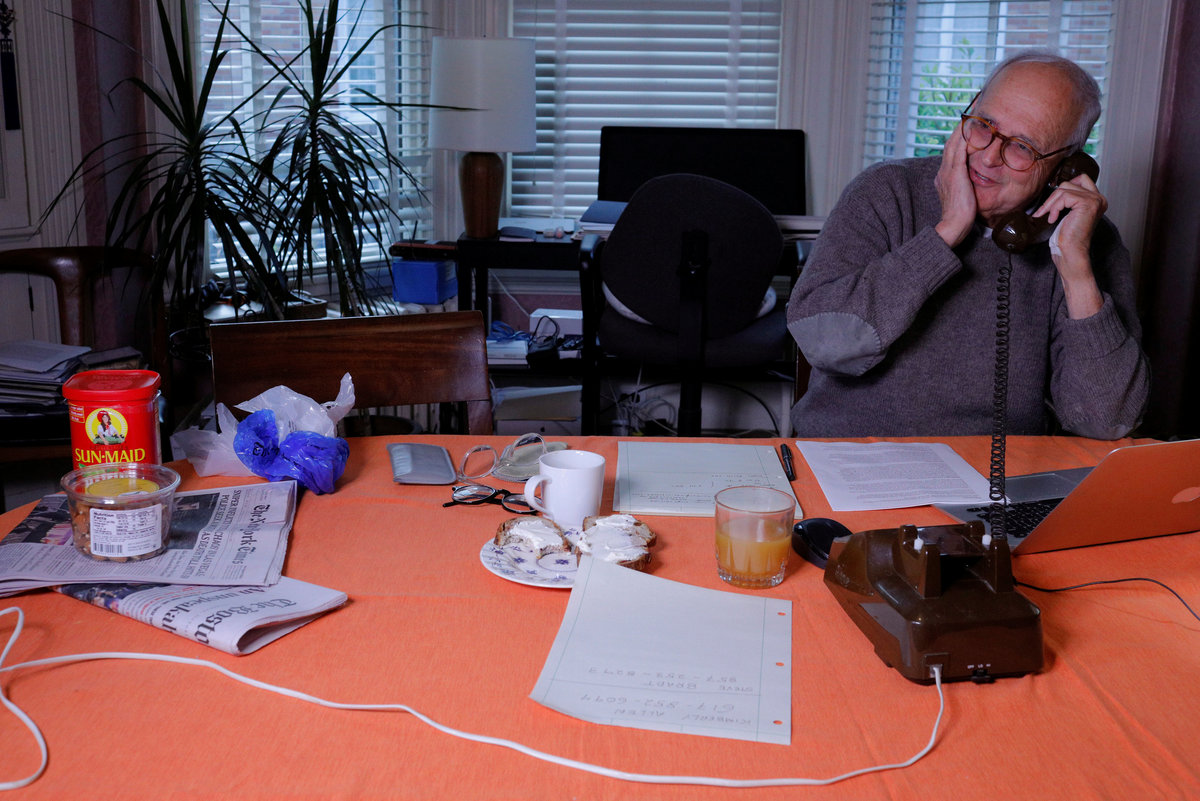
FILE PHOTO: Dr. Rainer Weiss, emeritus professor of physics at MIT, (L) and Dr. Kip Thorne of Caltech (R) listen during a news conference to discuss the detection of gravitational waves, ripples in space and time hypothesized by physicist Albert Einstein a century ago, in Washington February 11, 2016. REUTERS/Gary CameronCalifornia Institute of Technology (Caltech) physicists Barry Barish and Kip S. Thorne and Massachusetts Institute of Technology's (MIT) Rainer Weiss (L-R), who share the 2017 Nobel Prize for Physics, pose in a combination of undated handout photos. Courtesy of California Institute of Technology/Massachusetts Institute of Technology/Handout via REUTERS California Institute of Technology (Caltech) physicist Barry barish, who shares the 2017 Nobel Prize for Physics with Caltech's Kip S. Thorne and MIT's Rainer Weiss, poses in an undated photo. Courtesy of California Institute of Technology/Handout via REUTERS Massachusetts Institute of Technology (MIT) professor emeritus Rainer Weiss is interviewed after being announced as a co-winner of the 2017 Nobel Prize in Physics at his home in Newton, Massachusetts, U.S., October 3, 2017. REUTERS/Brian SnyderCalifornia Institute of Technology physicist Kip S. Thorne talks on the phone in his home after winning the 2017 Nobel Prize for Physics, which he shares with Barry Barish and Rainer Weiss, in Pasadena, California, U.S. October 3, 2017. REUTERS/Ringo ChiuMassachusetts Institute of Technology (MIT) professor emeritus Rainer Weiss, co-winner of the 2017 Nobel Prize in Physics, talks on the phone at his home in Newton, Massachusetts, U.S., October 3, 2017. REUTERS/Brian Snyder
Sign up to read this article
Read news from 100’s of titles, curated specifically for you.