The U.S. government has urged North Korea to declare its entire nuclear program within the next few weeks, The Yomiuri Shimbun learned on Saturday.
U.S. Secretary of State Mike Pompeo plans to press Pyongyang at his upcoming talks with a senior North Korean official -- which could be held as early as this week -- to provide a relevant declaration at an early date, according to a source close to the U.S. government.
Pyongyang's commitment to work toward "complete denuclearization" was included in the U.S.-North Korea joint statement released after the recent summit meeting between the two countries.
The latest U.S. push is also aimed at determining whether North Korea intends to expeditiously work toward denuclearization, the source said. It is yet to be disclosed how Pyongyang responded to Washington's request.
North Korea's declaration of its entire nuclear program is seen as a major precondition leading toward its complete, verifiable and irreversible denuclearization.
If Pyongyang provides the declaration, the administration of U.S. President Donald Trump aims to draw up a road map for denuclearization to address such issues as the verification of nuclear facilities and materials in North Korea.
Washington intends to proceed with the denuclearization process by setting a specific deadline, which could be within 2-1/2 years, as Pompeo has previously said.
"It is incredibly important that we get a full understanding of [North Korea's nuclear program] as quickly as possible," the secretary of state said on Thursday. "As part of the efforts that will be undertaken in the week and weeks ahead, we will work with the North Koreans to come to have a fuller understanding of [the program]," he added.
As part of denuclearization measures, Pompeo has pointed to the need to verify such items as weapon stockpiles, knowledge bases, warehouses, and fissile material production facilities. For such verification, he has also expressed his intention to invite experts from countries other than the United States.
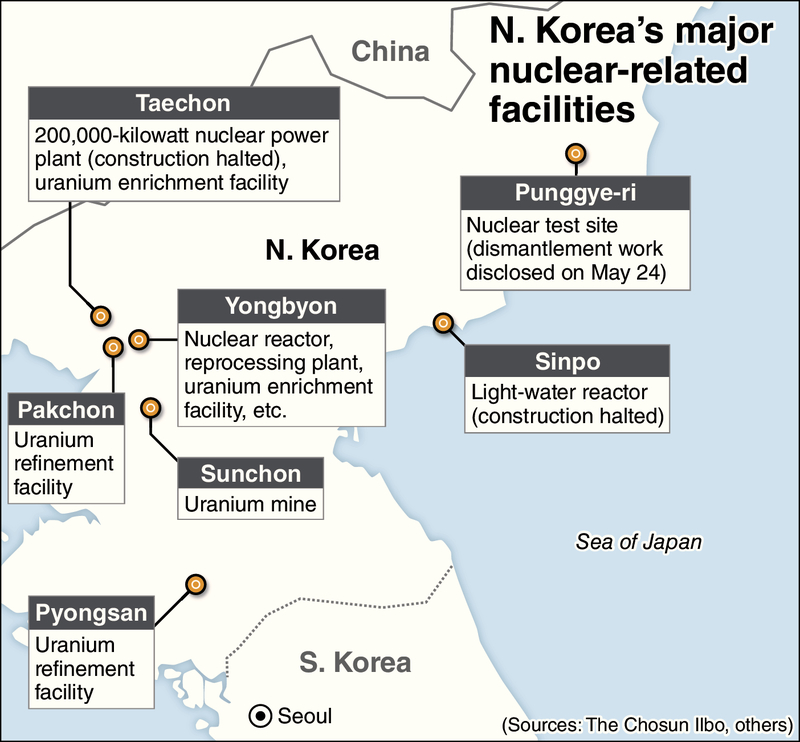
North Korea has such nuclear sites as a graphite-moderated reactor in Yongbyon and a test site in Punggye-ri, which it blew up on May 24. However, North Korea has likely established nuclear facilities and weapons warehouses underground, which would make it hard for U.S. reconnaissance satellites to detect them.
It seems probable that North Korea will agree to disclose some relevant information. Even so, U.S.-North Korea talks may face an uphill struggle over how much authority would be given to inspectors responsible for verifying Pyongyang's declaration, and under what conditions they can work.
Regarding North Korea's declaration of its nuclear program to denuclearize, the six-party talks' joint statement in October 2007 confirmed Pyongyang's agreement to "provide a complete and correct declaration of all its nuclear programs" by the end of the year.
Nevertheless, the declaration was not only provided belatedly -- as late as June 2008 -- but it was also incomplete, as it did not include such information as the true condition of North Korea's highly enriched uranium and the number of its nuclear warheads.
Read more from The Japan News at https://japannews.yomiuri.co.jp/