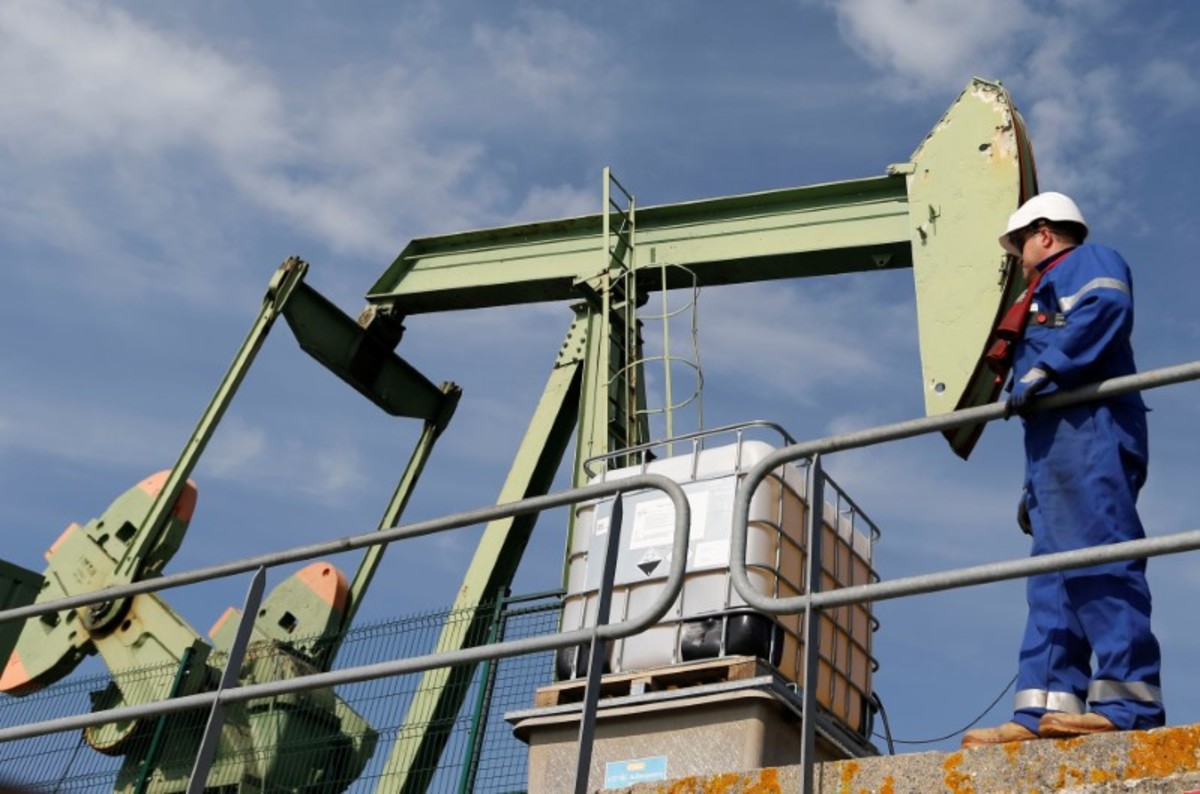
HOUSTON (Reuters) - Oil prices dipped for a second straight day on Tuesday, driven by ongoing evidence of rising U.S. crude output, while wary investors sold off stocks, bonds and commodities.
Brent crude futures <LCOc1> for March delivery settled down 44 cents, or 0.6 percent, at $69.02 a barrel after touching a session low of $68.40.
U.S. West Texas Intermediate futures <CLc1> fell $1.06, or 1.6 percent, to close at $64.50 a barrel.
Futures traded weaker in post-settlement trading after weekly inventory figures from industry group the American Petroleum Institute showed a 3.2 million-barrel increase in crude oil stocks for last week. [API/S]
If the U.S. Energy Department data on Wednesday also shows an increase in inventories, it would break an 11-week streak of drawdowns. Analysts polled by Reuters forecast an average 100,000-barrel build in crude stocks.[EIA/S]
"We certainly will get some post-settlement weakness carrying into tomorrow's EIA data," said Mike Sabo, senior market strategist at RJO Futures in Chicago.
"We've seen a substantial rise of $10 for WTI move in the last 60 days. This could be the beginning of a possible correction," he added.
U.S. blue-chip stocks opened under pressure, weighed down by a jump in government bond yields and an earlier rise in the dollar <.DXY>. [.N][USD/]
U.S. stocks fell for a second straight day, with the Dow Jones Industrial Average [.DJI] down 362.59 points, or 1.37 percent. It was the biggest daily percentage decline since May 2017 and the second-biggest single-day drop since the election of Donald Trump, ahead of his first State of the Union speech on Tuesday.
"There are some concerns that when you get a pull-back in the stock market it may be killing the bullish argument that the economy is strong," said Phil Flynn, analyst at Price Futures Group in Chicago.
With oil's negative correlation to the dollar reaching its strongest in a month, even continued signs of robust demand for crude were not enough to ward off profit taking following last week's rise to three-year highs.
Oil's inverse relationship to the dollar, whereby a stronger currency makes it more expensive for non-U.S. investors to buy dollar-denominated assets, has reasserted itself this week.
U.S. production is already on par with that of Saudi Arabia, the biggest producer in the Organization of the Petroleum Exporting Countries (OPEC). Only Russia produces more, averaging 10.98 million barrels per day (bpd) in 2017.
(Additional reporting by Amanda Cooper in London and Henning Gloystein in Singapore; Editing by Marguerita Choy and Lisa Shumaker)