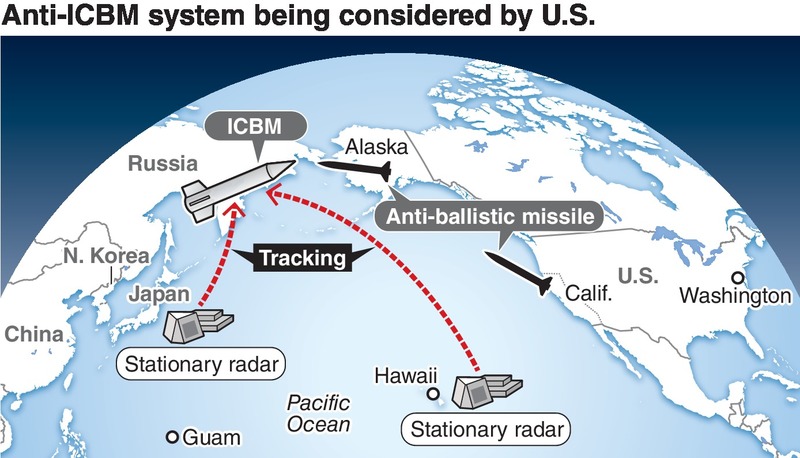
The U.S. government is considering asking Japan to deploy a large stationary radar in this nation, to help reinforce the U.S. system aimed at intercepting intercontinental ballistic missiles (ICBMs, see below) targeting U.S. territories, The Yomiuri Shimbun has learned.
Washington intends to sound out Tokyo on the plan soon, according to multiple sources close to the Japanese and U.S. governments. The U.S. government is believed to envision possible attacks by China, Russia or North Korea.
According to the sources, the U.S. government is considering deploying in Japan a new radar called the Homeland Defense Radar (HDR). The HDR tracks ICBMs heading for the U.S. mainland as well as Hawaii, the U.S. territory of Guam and elsewhere, from locations close to the launch.
The U.S. government also plans to use the radar for monitoring killer satellites that attack satellites, and for observing space debris. It intends to share information obtained from the radar with the Self-Defense Forces, the sources said.
The U.S. military plans to start operating a radar of the same kind in Hawaii in 2023. Washington aims to deploy the HDR in Japan by the end of 2025 and operate the radars in Japan and Hawaii in coordination, according to the sources.
At present, the United States has the Ground-Based Midcourse Defense (GMD) system, a land-based anti-ballistic missile system to protect the country. Under the system, missiles are deployed in Alaska and California to intercept attacks, which are tracked by radars deployed in California and other locations.
However, in recent years, it has become difficult to observe signs of missile launches, as shown in the example of China developing an ICBM that can be transported by vehicles. In order to intercept ICBMs with greater accuracy, it is necessary to obtain various information in a short amount of time after launch. Therefore, the U.S. government is believed to have decided to prepare a system capable of tracking missiles from locations near launch sites.
In the Missile Defense Review (MDR) released on Jan. 17, U.S. President Donald Trump pointed out the threat of ICBM attacks by China, Russia and North Korea, and announced his intention to reinforce the country's missile defense system. The development of the HDR is part of the plan.
The U.S. military has already deployed the mobile TPY-2 radar, also known as X-band radar, in Aomori and Kyoto prefectures to track ballistic missiles with shorter ranges than those of ICBMs. However, to install a stationary radar like the HDR, it is necessary to secure a site that can be used constantly. The impact of electromagnetic waves on nearby residents is another of the issues that must be considered.
For these reasons, the Japanese government will carefully examine whether it is possible to accept the HDR after officially receiving a request to deploy it in Japan from the United States, according to the sources.
The Japanese government has decided to introduce the land-based interception system Aegis Ashore with missile attacks by North Korea and other issues in mind. While the Ground Self-Defense Force is expected to operate the system from around fiscal 2025, there is strong opposition in Akita and Yamaguchi prefectures, where the system is scheduled to be deployed.
-- Intercontinental ballistic missile (ICBM)
ICBM is a general term for missiles that can fly between continents. In the Strategic Arms Limitation Talks 2 (SALT II) agreement that the United States and the then Soviet Union signed in the Cold War era, an ICBM was defined as a missile with a range of 5,500 kilometers or more. The United States, Russia and China possess ICBMs, and North Korea has repeatedly conducted test launches.
Read more from The Japan News at https://japannews.yomiuri.co.jp/