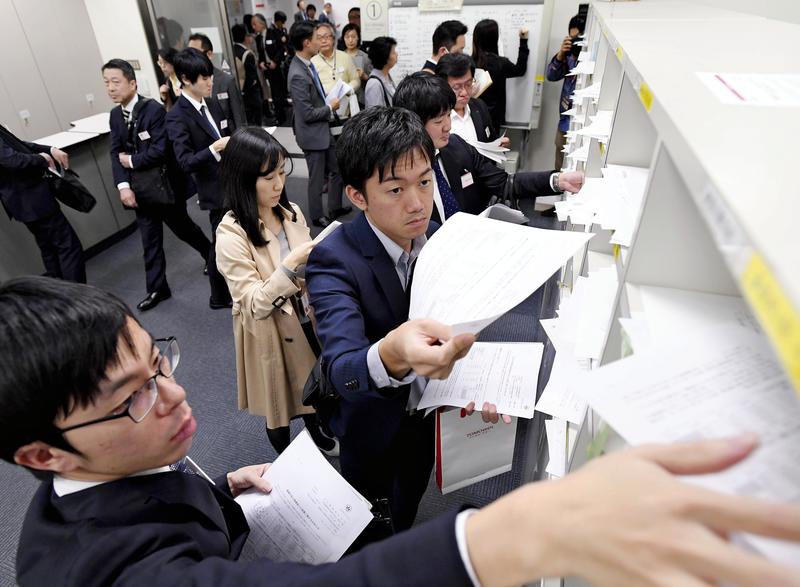
Announcements of interim financial results for the fiscal half-year ended in September by listed companies reached a peak Friday with the manufacturing industry showing damage from U.S.-China trade friction, while nonmanufacturing industries have been supported by solid domestic demand, with some firms logging increased profits.
While some analysts expect manufacturing performance to pick up, conditions will likely continue to be under the sway of U.S-.China trade relations and the trajectory of the Chinese economy.
Blow to exports
"Around summer, Chinese manufacturers suddenly started inventory adjustments and we see no signs of a turnaround," Mitsubishi Chemical Holdings Corp. Chief Financial Officer Hidefumi Date said.
Firms have been holding press conferences on their financial results since the start of November.
Many executives expressed distress over a decelerating Chinese economy. Among them, Mitsubishi Chemical Holdings logged a 32.4 percent drop in net income compared to the same period last year.
When production in China slows down, it hurts exports of Japanese production equipment, materials and other products.
According to Finance Ministry trade statistics, exports to China in the fiscal first half were valued at 7.23 trillion yen, down 9.1 percent from the same period last year. This put China below the United States, making it Japan's second-largest export destination.
Many manufacturers are struggling with sluggish exports to China.
The performance of the steel industry has been negatively affected by poor demand for automotive steel in China, in addition to the deterioration of overseas market conditions. Kobe Steel Ltd. logged a 6.2 billion yen loss in net profits.
"We thought we could hold out, but we have no choice but to cut production," a company executive said.
Businesses serving Chinese consumers have not performed well either. Mazda Motor Corp. reported that it sold 18 percent fewer vehicles in China compared to the same period last year. When added to an 8.9 percent decline in North America, the automaker reported net income 30.3 percent lower than the same period last year.
Solid domestic demand
On the other hand, results from nonmanufacturing industries were relatively strong.
According to SMBC Nikko Securities, among the 398 nonmanufacturing companies that had reported results as of Thursday, sales were up 3.9 percent and net income was down 5.5 percent, with some firms showing strong results.
East Japan Railway Co. (JR East) recorded record highs in sales and net income, which were up 2.1 percent and 5.4 percent, respectively, thanks to strong ridership on shinkansen bullet trains during the 10-day holiday in spring, by increasing foreign tourists and from other factors.
The construction industry is increasingly willing to pass on the amount of increase in material and labor costs, resulting in higher construction costs. Taisei Corp. reported a 27.4 percent increase in net income, reaching a record high.
Retail performance was supported by last-minute demand before the consumption tax rate rose. Isetan Mitsukoshi Holdings Ltd. reported strong sales of luxury items such as jewelry, with net income up almost double from the same period last year at 7.5 billion yen.
"More than 20 percent of sales was due to the last-minute spike in demand," President Toshihiko Sugie said at a press conference Thursday.
Ramping up investment
The future for Japanese firms remains murky.
"In the second half [of the fiscal year], with the exception of steel and nonferrous metals, the decline in business performance will bottom out and profits will start to increase," said a division chief of investment strategy at Nomura Securities.
Many analysts believe U.S.-China friction will not get worse and businesses will start to make serious investments, such as in the 5G next-generation communication standards.
The stock market appears optimistic, with the Tokyo Stock Exchange's key Nikkei 225 average continuing to hit highs for the year despite the many declines in profits and downward revisions to earnings forecasts.
Nevertheless, many executives have expressed caution at press conferences on their financial results.
"We expected a recovery in the second half, but things might remain how they are for the time being," said Tadashi Kawagoishi, executive officer of Mitsubishi Electric Corp.
"We've been expecting a gradual recovery, but we don't understand these conditions," said Panasonic Corp. Chief Financial Officer Hirokazu Umeda.
Read more from The Japan News at https://japannews.yomiuri.co.jp/