For the first time in years, U.S. military personnel are operating on Venezuelan soil as part of a large-scale humanitarian mission following the twin earthquakes that devastated the South American nation, marking an extraordinary moment in relations between Washington and Caracas.
The deployment came in the aftermath of the powerful magnitude 7.2 and 7.5 earthquakes that struck June 24, killing more than 1,400 people, injuring thousands, and leaving 68 thousand missing (NGO extraofficial data) as rescue crews race against time to find survivors.
"Searching through shadows and rubble to save lives. U.S. Marines navigate hazardous debris and collapsed structures in Venezuela to locate survivors following the June 24 earthquakes"," said a statement from the U.S. Southern Command, known as SOUTHCOM, posted on social media.
"The Marines are working around the clock to support international search and rescue operations in the hardest-hit areas. At the direction of SOUTHCOM, assigned U.S. military forces are supporting State Department-led U.S. disaster assistance to the people of Venezuela," it added.
Major General Kevin J. Jarrard is serving as the senior U.S. military official on the ground, overseeing logistics and coordinating with Venezuelan authorities and international partners to move personnel, equipment and humanitarian supplies into disaster zones.
U.S. Southern Command (SOUTHCOM):
— Open Source Intel (@Osint613) June 29, 2026
"Searching through shadows and rubble to save lives.
U.S. Marines navigate hazardous debris and collapsed structures in Venezuela to locate survivors following the June 24 earthquakes.
The Marines are working around the clock to support… pic.twitter.com/EQyiQ3iXe5
According to SOUTHCOM, the mission is being conducted in support of a State Department-led humanitarian operation and was launched after Venezuelan authorities requested U.S. assistance. American military aircraft, including fixed-wing transport planes and Marine Corps MV-22 Osprey aircraft, are being used to move rescue teams, medical supplies and emergency equipment throughout the affected regions. Additional C-17 aircraft have also transported urban search-and-rescue specialists, including teams from Miami-Dade County, to assist with life-saving operations.
Life-saving support in Venezuela:
— U.S. Southern Command (@Southcom) June 29, 2026
A @usairforce search and rescue team boards a @USMC MV-22 Osprey at Simón Bolívar International Airport, Venezuela, June 28, 2026.
At the direction of #SOUTHCOM, assigned U.S. military forces are supporting @StateDept-led U.S. earthquake… pic.twitter.com/BdZNvMZ3Wg
The Trump administration has pledged $150 million in emergency assistance while deploying more than 250 U.S. personnel to support rescue efforts. The American contingent includes Urban Search and Rescue teams, logistics specialists and emergency management personnel working alongside responders from more than 20 countries.
Maj. Gen. Kevin J. Jarrard y el personal militar de EE. UU. realizarán un relevamiento del puerto en el Puerto de La Guaira.https://t.co/5DeAT3sddN
— Pedro Jaimes Criollo (@MeteoAero) June 28, 2026
One of the most dramatic rescues credited to the American response occurred over the weekend when members of Virginia Urban Search and Rescue Task Force 1 pulled a 9-month-old baby and her mother alive from the rubble of a collapsed building. Both survived with only minor injuries after being trapped for days beneath the debris, a rescue celebrated by the State Department as a symbol of hope amid the catastrophe.
The presence of U.S. personnel inside Venezuela is particularly notable given the historically strained relationship between the two countries. Until recently, diplomatic ties had been largely frozen, making the current cooperation one of the most significant examples of bilateral coordination in years. Analysts say the earthquake response is also testing the Trump administration's revised approach to humanitarian assistance following major changes to U.S. foreign aid programs earlier this year.
International rescue operations continue around the clock as hopes of finding more survivors begin to fade. Rescue workers from the United States, Mexico, Colombia, Spain, France, the United Kingdom and several other nations remain deployed across the hardest-hit areas, supported by dozens of search dogs, heavy equipment and specialized technical teams.
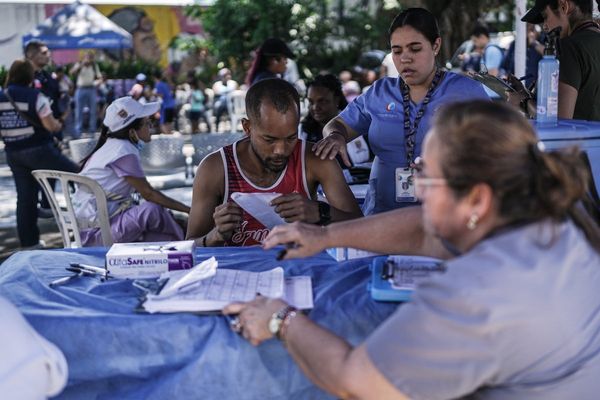
Despite the unprecedented international response, many Venezuelans have expressed frustration over the pace of the domestic emergency effort, with residents reporting that neighbors and volunteers carried out many of the initial rescues before heavy equipment arrived. International crews continue to supplement local responders as aftershocks complicate search operations and engineers assess the safety of hundreds of damaged structures.
As the humanitarian mission enters another critical phase, U.S. officials say their focus remains on saving lives and delivering emergency assistance, while SOUTHCOM has pledged to continue supporting the international response for as long as requested by Venezuelan authorities.