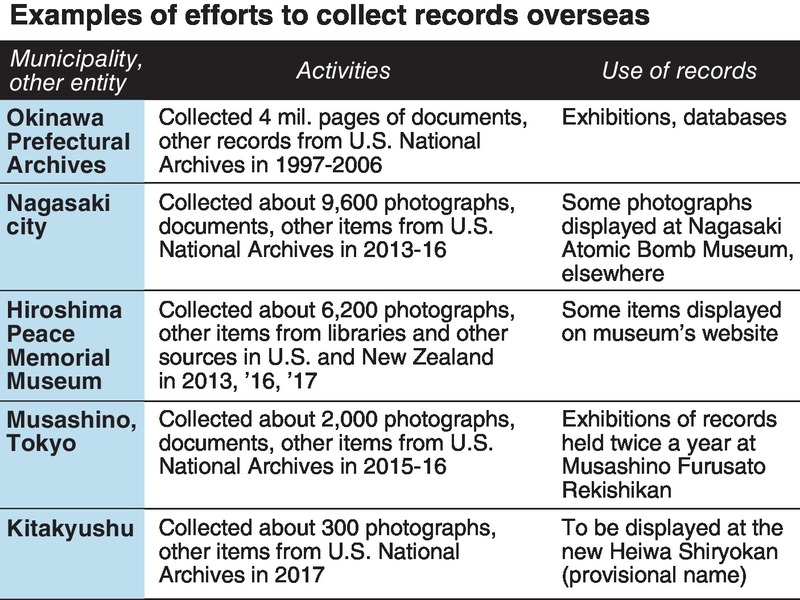
With the number of people who experienced World War II dwindling 73 years after its end, Japanese local governments have been seeking wartime records from large collections in the United States.
However, these efforts have exposed a need to train domestic specialists who can organize and preserve official records.
"The moment I saw color photographs, a war that had felt far away suddenly seemed real to me," Kazuhiko Nakamoto, a specialist at the Okinawa Prefectural Archives, said as he showed bundles of photographs of the Battle of Okinawa.
Nakamoto, 53, spent nine years from 1997 at the U.S. National Archives in the state of Maryland gathering materials on the battle and the U.S. occupation of Okinawa.
He made duplicates of photographic film, photographed records on microfilm, made copies of documents, and used other means to eventually bring home a trove that included 4 million pages of documents, 20,000 photographs and 3,500 aerial photographs.
Color photographs and images taken by the U.S. military landing in Okinawa in 1945 show cannons firing and other wartime scenes. Yet they also show that the sky and sea were just as blue then as they are now.
Clear records needed for future
The Okinawa Prefectural Archives opened in 1995, a half century after the end of the war. Almost no Japanese records remain that describe the Battle of Okinawa.
Nakamoto, who had been a high school English teacher, responded to an ad seeking people to go overseas and gather materials.
The U.S. National Archives and Records Administration was founded in 1934 and stores more than 12.5 billion pages of diplomatic records, wartime documents and other materials.
What surprised Nakamoto was how thorough the U.S. government was about document management.
"There's a deep-rooted awareness of keeping clear records so things like the procedures by which policies were decided can be verified in the future," he recalled.
Handwritten notes, rough drafts and other such records are preserved in their original forms.
As a child, Nakamoto heard from his mother about the ferocious bombardments carried out by the U.S. military during the Battle of Okinawa.
But seeing films of the attacks and reading materials on mass suicides by residents gave him a clearer image of the war, he said.
He is currently engaged in creating a database of the materials he gathered, putting together exhibitions and other work.
"U.S. records look at things from the side of the occupier, but multiple viewpoints are needed to approach the true history. I want to use records from Japan and overseas to tell generations who feel the war is far away about what happened," he said.
Now or never
From 2013 to 2016, the Nagasaki municipal government collected photographs, documents and other records in the United States that showed what the city was like after the atomic bombing.
"We can still envision the tragedy and try to understand it from testimonials of people who experienced the atomic bombing. But the day will surely come when we can't hear from these people directly. Photographs that convey what things were like at the time are precious," said a city official in charge.
The city of Musashino in western Tokyo spent two years starting in 2015 collecting records in the United States. The city, which was home to a factory of the Nakajima Aircraft Company, which made engines for Zero fighters and other planes, suffered repeated aerial bombardments during the war.
However, some U.S. records are also deteriorating.
Yoko Nagasaka Myers, 55, who works at the U.S. office of Nichimy Corp., a Tokyo-based private research firm with long experience in gathering materials from the National Archives at the request of municipalities and other entities, said that wartime documents were printed on poor-quality paper, and sometimes disintegrate when touched.
There's an urgency to collect things now or never, she said, adding that the results of surveys can be conveyed to the public not only through exhibitions but via movies and other means and they should be shared with many people.
Need to train specialists
The Public Records and Archives Management Law, which went into force in 2011 and lays down rules on document management for government agencies and ministries, requires that local governments also carry out adequate document management. But training specialists is not easy for individual local governments.
Therefore, the central government is considering creating an official qualification system to certify archivists to manage and oversee archives of original legislation and other documents.
The National Archives of Japan in Tokyo already holds training sessions for specialists.
An archives official said: "Determining what has historical value and should be preserved is a heavy responsibility. I'd like to convey to the general public in an easy-to-comprehend way the importance of document management."
Read more from The Japan News at https://japannews.yomiuri.co.jp/