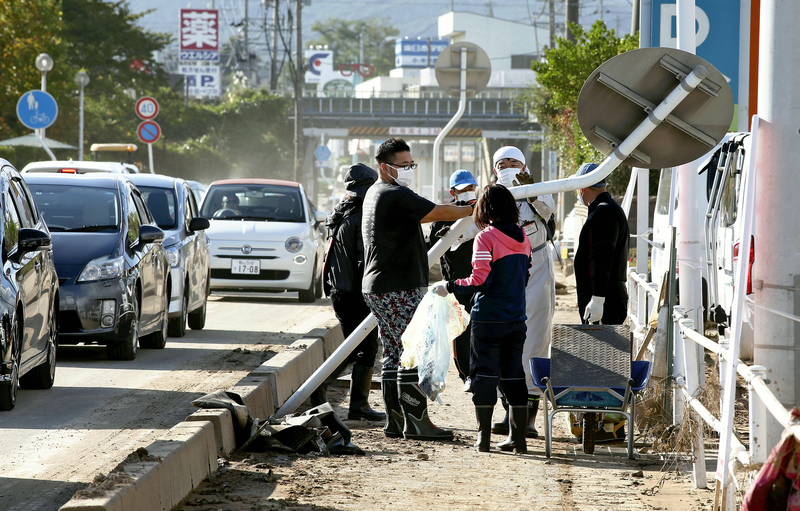
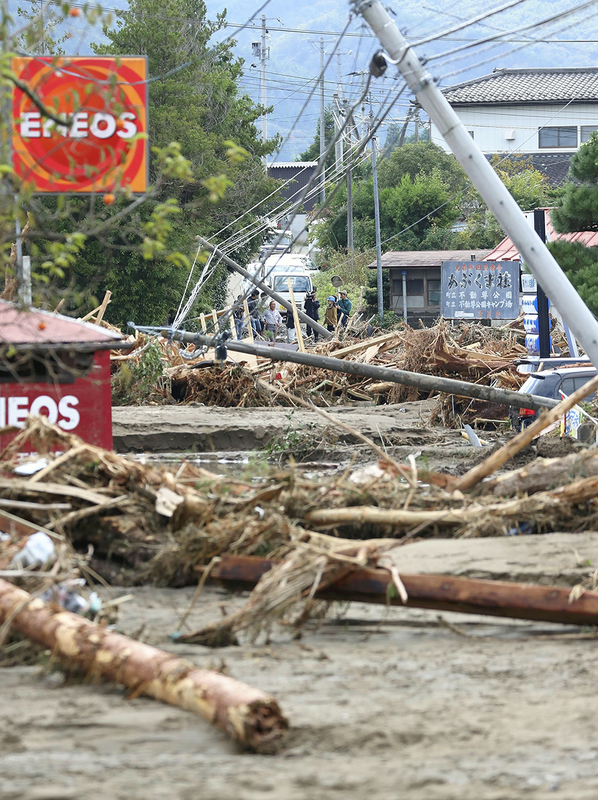
The full extent of the damage caused by record-setting rainfall from Typhoon No. 19 is gradually becoming clear. The most serious damage appears to be in the Tohoku region. The largest number of deaths occurred in Fukushima Prefecture at 27, with 14 deaths in Miyagi Prefecture, according to figures compiled by The Yomiuri Shimbun as of Tuesday. Why was the damage so bad in the Tohoku region?
At a press conference Friday, the day before the typhoon made landfall, a Japan Meteorological Agency official said that "heavy rain would occur from western Japan to the Tohoku region" and that the storm would "move toward Tohoku."
As an example of a similar storm, the official mentioned the Kanogawa Typhoon of 1958, which killed more than 1,200 people. The official described how "about 1,000 people died in area of Izu" and "record rainfall was seen across the Kanto region."
The agency sometimes refers to past disasters at press conferences to give people a sense of the scale of a disaster.
The agency's official, who spoke at the press conference, said he tried "to convey a considerable sense of impending crisis, [but] the words 'Kanogawa Typhoon' might have given people the impression it was about the Izu Peninsula."
The peak of the rain in the Tohoku region occurred late at night when evacuation is more difficult, which may have had an impact. Special warnings for heavy rain were issued at 7:50 p.m. Saturday for Fukushima and Miyagi prefectures and at 12:40 a.m. Sunday for Iwate Prefecture.
In Motomiya, Fukushima Prefecture, the bodies of multiple victims have been discovered on the first floors of homes and apartments. These people are thought to have waited too long to escape.
Fewer typhoons
Typhoons weaken as they move northward into cooler air. This means the Tohoku region sees fewer of the big storms. From 1951 to 2018, 256 typhoons came within 300 kilometers of the Kyushu region, compared to 215 typhoons for the Kanto-Koshin region and 175 for the Tohoku region.
Still, Typhoon No. 19 brought record 24-hour rainfall to 34 observation posts in five of the six prefectures in the region -- all except Akita. This included 588 millimeters in Marumori, Miyagi Prefecture, and 441 millimeters in Kawauchi, Fukushima Prefecture. This was more than 200 millimeters over the previous record in Marumori. This rain was too much for soil and rivers to absorb, which is what seems to have caused the flooding.
"Tohoku has fewer typhoons and major rainstorms than Kyushu and other regions, so their embankments don't anticipate so much rain. The heavy rain from this storm exceeded expectations, which is what probably caused the flooding," said Hiroshi Niino, a professor emeritus of meteorology at the University of Tokyo.
"As global warming progresses, there is a greater possibility of strong typhoons approaching the Japanese archipelago. Regions that have not experienced much heavy rainfall in the past will need to increase their preparations," he added.
Read more from The Japan News at https://japannews.yomiuri.co.jp/