CHICAGO — When filmmaker Ashley O'Shay began work on her documentary "Unapologetic," two Chicago police killings were at the forefront of efforts for accountability and reform: That of Rekia Boyd, the 22-year-old Black woman who was fatally shot in the back of the head by Dante Servin, an off-duty police detective, and Laquan McDonald, the 17-year-old Black teenager who was shot and killed by Chicago police Officer Jason Van Dyke.
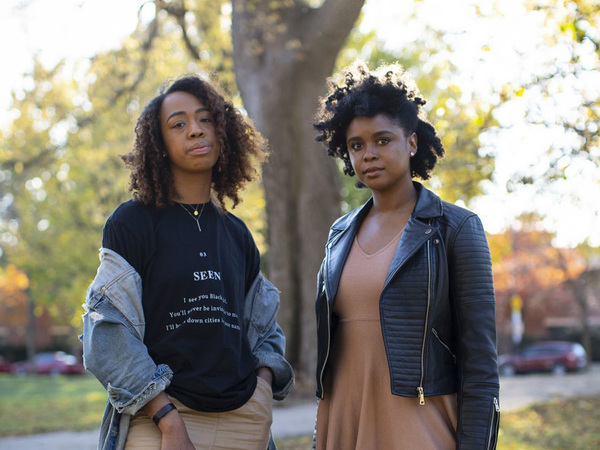
The lives and work of two young Black women activists, Janae Bonsu and Ambrell Gambrell (who raps under the name Bella Bahhs), are at the center of "Unapologetic," which has its Chicago premiere this week and will be available to stream through Nov. 20 as part of the Siskel Film Center's all-virtual edition of its annual Black Harvest Film Festival.
The documentary's opening scene is a tremendous piece of observational filmwork and journalism, as it follows a group of Black activists into Chicago-area brunch spots that are filled with white diners. "While you are here celebrating over brunch, Black families are struggling to keep themselves safe from CPD," they chant.
Every white person looks uncomfortable. One is barely stifling an embarrassed smirk. Another has guilty tears in her eyes. Others just look on impassively and unmoved.
"They went to about five or six restaurants in the Lincoln Park neighborhood on New Year's Day in 2016. And they went in for about 10 or 15 minutes at a time," said O'Shay. "Because of the way equity and segregation are set up in our city, you can live on the North Side and be completely oblivious to something like that, when on the other side of town it's all people are being confronted with."
Eventually the police are called. A restaurant employee wearing an elf sweater tells an officer: "This guy right here was real sarcastic with me, this lady as well, as I was trying to get them out of here, so they just disrupted the brunch of about 200 people." Later he asks, "What is this helping, though?" An activist off-camera recipes, "We think it's very important." The employee's response: "Really, to disrupt everyone's brunch? No, we all have TV. We watch the news."
It's a moment that encapsulates the white apathy activists like Bonsu and Bahhs are pushing back against. As the film illustrates, the Movement for Black Lives has been building for years on their work and the work of many others.
For example, O'Shay captures footage of a Chicago Police Board meeting — where Lori Lightfoot presides in the years before she became mayor — as activists push for Servin to be fired. (He would eventually resign before that hearing process could begin, which meant his pension was unaffected.)
"Those police board meetings, when young Black organizers went to try to actively get Dante Servin off the police force, nobody was going to those before 2015. As much as people think that this (the protests of the past several months) kind of came out of nowhere, this really set the stage for that."
At the time the documentary was filmed, Rahm Emanuel was mayor, Anita Alvarez was the state's attorney, and Garry McCarthy was the police superintendent. All three have since been replaced, but many of the same issues remain.
Morgan Elise Johnson is a producer on "Unapologetic" and she points to the social commentary the film offers in hindsight. "Here we have evidence that young organizers helped to change the landscape of the city by putting pressure on Rahm Emanuel, putting pressure on the state's attorney and Garry McCarthy. But it also makes the case that if we don't reform the system and continue to just organize around elections, then we won't actually see any kind of systematic change.
"Another thing about the movement for Black Lives is, they're raising public consciousness and raising up a generation that's more civically engaged," she said. "So even though Mayor Lightfoot kind of ignored that public survey that went out (which found nine out of 10 people wanted resources reallocated away from the police department), I think we can start to credit those organizers for getting young people involved. I think there's something very interesting happening in terms of civic engagement. Even though it may not seem to play out electorally right now, we see the ways in which the Movement for Black Lives is shaping the language and conversation that will eventually shape progressive public policy in the future."
O'Shay called the upcoming screening at the Siskel a full-circle moment. She currently earns a living as a freelance cinematographer, but was a projectionist at the Siskel until she left last year to work on the film full-time.
Johnson is not only a film producer but also co-founder of the digital news publication The Triibe, which is essential reading and an invaluable contribution to the local media landscape with its focus on young Black people in Chicago. She launched the website and became a producer on the film in the same month.
Together, O'Shay and Johnson intentionally centered the film on women.
"Part of my initial interest in the project was because I was attending a Chicago Police Board hearing that the organizers shutdown and the leaders in that space were primarily women," said O'Shay. "So that was just not something I had really seen a lot of in my formal education around Black people in social movements.
"But in my upbringing and the community I have been in, there are always Black women leading: In church, in organizations, in my home. For a lot of Black people, Black women are the foundation of their family and their whole community. So I really wanted to reflect how that was being centered in political organizing. And in doing that, how that changes the conversation around how we move toward change — because there are a lot more things you have to consider than if you're just prioritizing men or more masculine-leaning ideas."
Johnson added: "And also because the Movement for Black Lives in itself, in its politics and everything that it stands for, it's centering Black women and queer voices their actual organizational leadership. So any film that centers the movement should be through that lens.
"In all of the work that I do," she said, "I'm always looking for, what is the narrative that's not being told? Who's voice is not being brought to the center? And when we're looking at political movements over time, Black men are always at the center. As a young Black businesswoman and person in this media space, I'm looking for examples like me. Like, who am I supposed to look up to? And who do my future kids and great granddaughters, who do they have to look up to? What images of ourselves are we presenting in this media landscape? And when it comes to the civil rights movement and movements prior to that, there's only a couple of names that come to mind and are told over and over again, like Rosa Parks and Coretta Scott King, and we leave out so many names.
"So that's what makes this film unique and that's why I wanted to be involved. And that's why we put Black women at the center."
"Unapologetic" is available to stream through Nov. 20 as part of the Siskel Film Center's Black Harvest Film Center. Go to www.siskelfilmcenter.org.