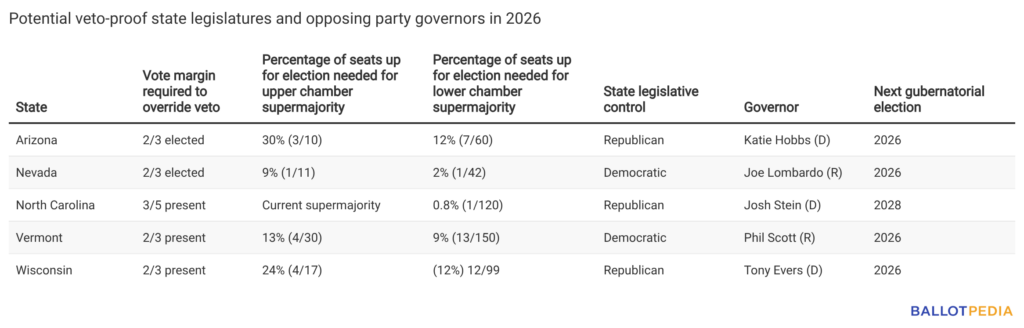
Heading into the 2026 elections, there are two states with a governor of one party and a veto-proof state legislative majority of the opposing party: Kansas and Kentucky. At least one legislative chamber is up for election this year in both states, meaning their veto-proof majority status could change.
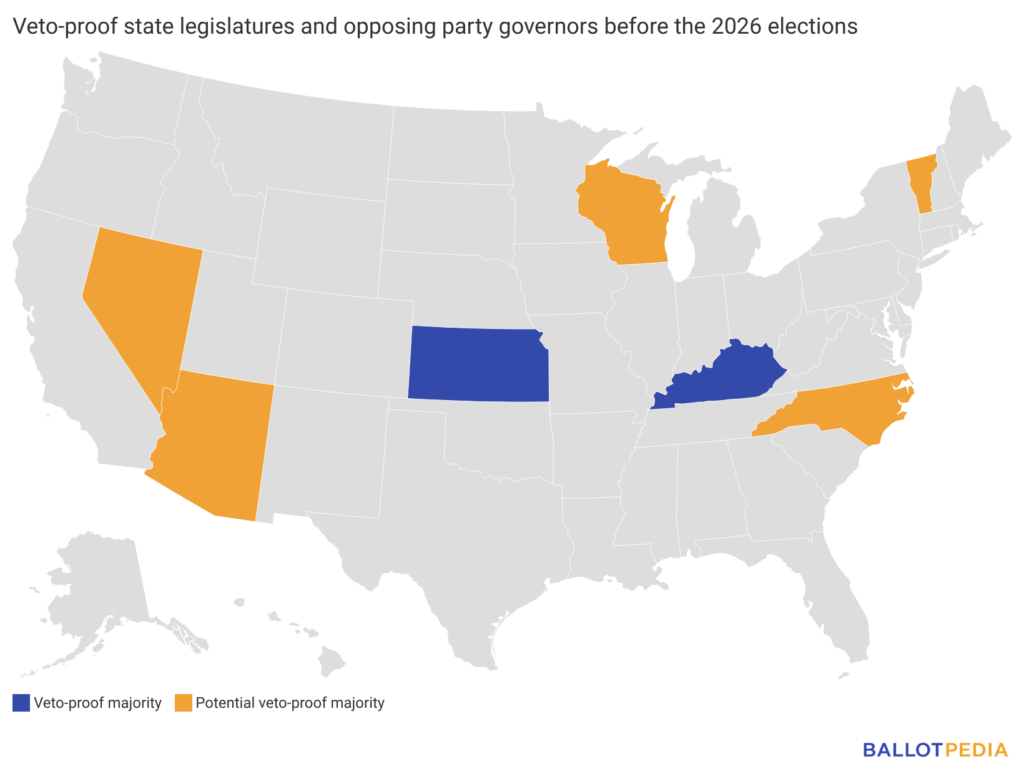
Voters in Arizona, Nevada, North Carolina, Vermont, and Wisconsin could elect veto-proof legislative majorities this year opposite their current governors' parties. Four of those states — Arizona, Nevada, Vermont, and Wisconsin — are also holding gubernatorial elections.
Governors have the power to veto legislation, and legislatures have the power to override those vetoes. In each state, the number of votes needed to override a gubernatorial veto ranges from one-half to two-thirds of the legislature. A veto-proof majority is when one party controls enough seats to overturn a gubernatorial veto without any support from the other party.
States with a veto-proof legislative majority and an opposing-party governor
In Kansas, Republicans have an 88-37 majority in the Kansas House of Representatives and a 31-9 majority in the Kansas Senate. That's more than the two-thirds of the Kansas Legislature that is needed to override a veto.
If Democrats win at least five seats in the state House, they will break Republicans' veto-proof majority. If Republicans lose fewer than five seats or gain seats, they will retain their veto-proof majority. No state Senate seats are up for election. Kansas is also holding a gubernatorial election this year. The state's incumbent Gov. Laura Kelly (D) is term-limited. As of July 28, The Cook Political Report and Sabato's Crystal Ball rated the gubernatorial general election as lean Republican. Inside Elections rated it as a toss-up.
In Kentucky, Republicans have an 80-20 majority in the Kentucky House of Representatives and a 32-6 majority in the Kentucky Senate. That's more than the simple majority in the Kentucky General Assembly that is needed to override a veto.
If Democrats win at least 30 seats in the state House or at least 13 seats in the state Senate, they will break Republicans' veto-proof majority. If Republicans lose fewer than 30 seats in the state House and fewer than 13 seats in the state Senate, or gain seats, they will retain their veto-proof majority. The governorship in Kentucky is not up for election until 2027, when incumbent Gov. Andy Beshear (D) will be term-limited.
States that could potentially elect a veto-proof legislative majority with an opposing-party governor
We consider a state to have a chance at electing a veto-proof majority with an opposing-party governor if a party would need to win fewer than 15% of the seats up for election in at least one legislative chamber to gain a veto-proof majority, and the opposing party controls the governorship.
There are 11 states with divided governments. In five of those states — Arizona, Nevada, North Carolina, Vermont, and Wisconsin — one party currently has majorities in both legislative chambers, and the other party holds the governorship.