
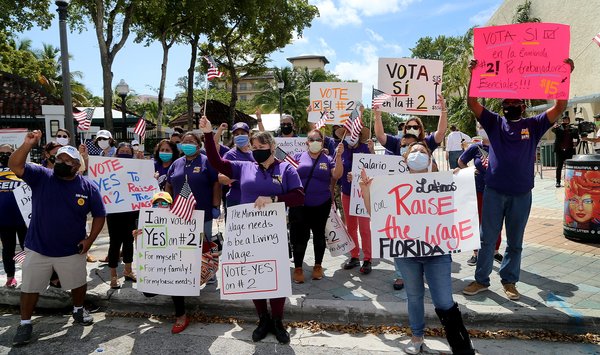
Here are some of the things that Odeimy Melendres would do if she earned $15 an hour: keep a savings account, go to a nice restaurant once in a while, and pay for needed medication her insurance doesn't cover.
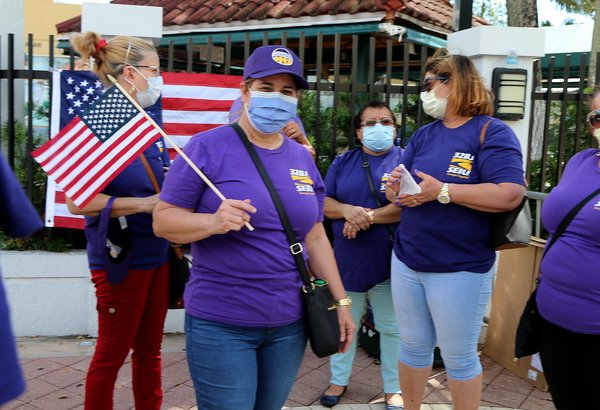
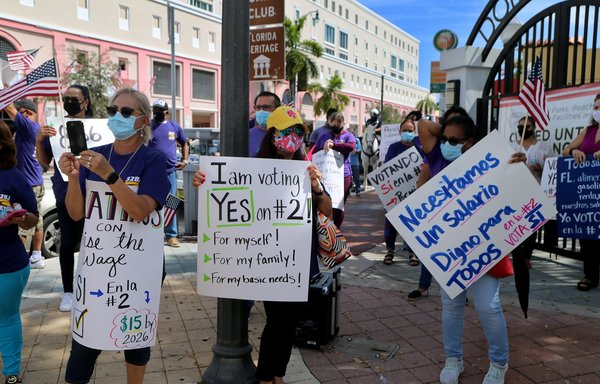
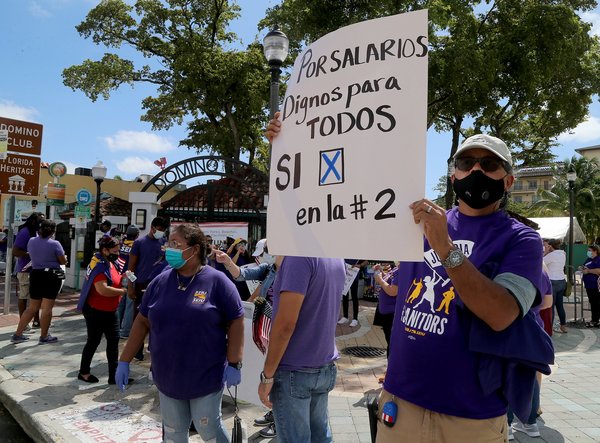
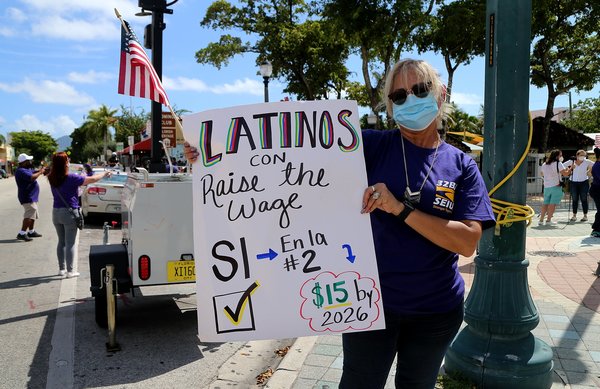
For now, as a University of Miami janitor making $11.15 hourly, she lives month-to-month. Though Melendres is not yet a citizen and can't vote, Wednesday she and about two dozen others rallied on Calle Ocho in favor of Amendment 2, a ballot initiative that would raise the minimum wage in Florida to $15 an hour.
In November Floridians will decide whether to change the constitution and scrap the state's current minimum wage of $8.56 an hour. The amendment would implement a gradual change that will raise that figure to $10 hourly starting next September. The wage would increase by $1 yearly thereafter until it hits $15 in 2026.
Those in favor argue that the current wage is not enough. According to MIT's Living Wage Calculator, a childless worker in the Miami-Fort Lauderdale-West Palm Beach metro area would need to earn at least $13.17 an hour working full-time to make ends meet.
Someone with one child needs $27.25, according to the tool, which takes into account factors such as cost of living and taxes.
But opponents say the amendment would be a job killer that will kneecap small businesses.
"I think it was a bad idea before the pandemic; post-pandemic I think it's economic policy malpractice," said Sean Snaith, director of the Institute for Economic Forecasting at the University of Central Florida.
The move would fast-track automation and force employers to cut workers and hours, he said, particularly as businesses struggle to recover from the pandemic. The one-size-fits all approach would also devastate rural, poor counties in the state where businesses would be unable to absorb the burden, Snaith added.
PNC Financial Services Group economist Abbey Omodunbi sees the issue differently. While the timing isn't great, he said, ultimately the pros will outweigh the cons if the amendment goes through.
"There are two sides to it," Omodunbi said. "But it's going to be a net benefit because many of those workers will more than likely spend their money and stimulate economic growth."
Additional fiscal stimulus targeting small businesses would provide the needed support for them to weather the increases, Omodunbi said.
Arguments in favor
Other economists argue that alarm is unfounded.
"There are always opponents who say it's going to put a lot of people out of business, but many studies have found that the businesses are able to adjust and they don't let workers go," said Michael Reich, economics professor at the University of Berkeley. Demand tends to stay steady and prices go up minimally, he said.
Economic literature has not reached a consensus on the issue. One initial study on the effects of a $15 minimum in Seattle found that workers fared worse after the move because businesses cut hours and increased prices. But that study was later criticized by others that found the losses were canceled out by an increase in better-paying jobs.
Raising the wage would have a positive domino effect on the economy, added Reich, who co-authored a recent study that found the unintended consequences of raising wages would be minimal. In fact, higher wages lift children in particular out of poverty, according to his analysis, which looked at the impact of an increase in low-wage counties.
"Workers do better, there's less poverty, there's more stable employment situations," he said. "Those who get a higher minimum wage and run into any kind of problem _ such as a car that breaks down _ are able to get a used one and have more reliable transportation. They can add medical care and child care. When you're in a more stable economic situation your credit improves _ those are all consequences of not being so poor."
Workers like Desiree Kimbrough agree. The 24-year-old has worked at a Popeyes restaurant in Fort Lauderdale since she was 16. She started at $8.75 before a 25-cent raise nudged her up to $9 an hour.
She dreams of moving out of her mom's house and being able to buy a pair of shoes without worrying that it will bite into the money she sets aside to pay bills. Making more money would mean upgrading her car so she won't have to take four buses every day to get to and from work.
It would mean having the ability to put money aside so that she can stay afloat when an emergency comes up _ such as the COVID-19 diagnosis she received over the summer that put her out of work for a month.
"I'm living paycheck to paycheck," she said. "I can't do any extra activities. I don't know what it's like to sit at a movie theater. I don't know what it's like to go shopping. I have to get exactly what I need and that's all I can do."
Dangers, concerns
A study by Ohio's Miami University and Texas-based Trinity University paints a less rosy picture. The analysis, which received support from Save Florida Jobs, Inc, a group that opposes Amendment 2, concluded that the state will lose 158,000 jobs if the measure passes. Most of those losses would be concentrated in the restaurant industry, with 43,000 jobs lost by 2026.
And while the wage increase sounds good in theory, it's less so in practice, said Carlos Gazitua, chairman of the government relations committee for the Florida Restaurant and Lodging Association and CEO of Sergio's, a chain of Cuban restaurants and cafes in South Florida.
For people like Kimbrough it could mean being replaced by a touchless screen, Gazitua said. He's gotten calls from business owners across the state who worry about the amendment and about being seen as heartless if they publicly denounce it.
"Everyone wants higher wages, and Amendment 2 is trying to do that, but unfortunately I think we'll get unintended consequences," Gazitua said.
He expects the move would force staff reductions, price increases and automation. While bigger businesses will be able to adapt, small business owners won't have the capital to offset these costs.
"My concern is we could be eliminating these entry level positions so many people live on," Gazitua added.
If the amendment passes, Gazitua could face a total payroll increase of $40,000-$60,000 per year at each of his six Sergio's locations, according to a tool on the Florida Restaurant & Lodging website that predicts the amendment's payroll effect on businesses with tipped employees. By year four, it could mean an additional $200,000 per store in extra costs. Applied to six locations, he'd be in for more than one million dollars in additional costs by year five.
The Florida Chamber of Commerce has officially opposed the amendment, along with 30 regional chambers across the state including the Miramar Pembroke Pines chamber. The Greater Miami Chamber of Commerce has yet to take a position.
For Gazitua, if the threat of impacting businesses and employees is not enough to deter supporters of the amendment, he wishes it were taken back to the drafting table instead of being forged into the state's constitution, where it will become difficult to modify. He'd like for the issue to be worked on legislatively so that it can be molded into something that takes into account the business models of different industries.
"No one doesn't want others to make more money," he said. "The question is how do you get there."
Small business response
Not everyone agrees that small business owners will lose out if the amendment passes.
"A lot of studies show that low-income people spend most of their money in the community, while higher income people might invest or travel," said Helene O'Brien, Florida director of the 32SBJ union.
"Businesses are going to get that money back," said O'Brien. "These workers are going to turn around and shop in your stores. It means someone might start buying two scoops instead of one at the ice cream shop across the street," O'Brien said, pointing to Azucar Ice Cream, across from the rally Wednesday.
Suzy Batlle, who owns Azucar, would love that. But the move to $15 an hour could leave her without a business before that happens.
"As a person I love it," Batlle said of the amendment. "But as a business owner, I would have to close my business."
Batlle employs 32 people, many of them high school students. They start at the minimum and quickly jump to $9 or $10, in addition to tips, she said. But taking it up to $15 would be breaking the bank. She imagines having to cut her staff in half to make ends meet.
Still, not all small business owners are opposed.
Meredith Webb Goldstein's wellness company in North Miami has been at a standstill since the pandemic started, but she plans to support the amendment.
Paying her half a dozen employees Florida's current minimum wage has never crossed her mind, she said.
"That's not a living wage in South Florida," Webb Goldstein said. "I personally don't have the conscience to have an employee that can't afford to live. If you can't have a viable business and pay people then you don't have a viable business."
The benefits go two ways, she said.
"I don't have turnover," Webb Goldstein said. "Long term you're building a loyal employee."
And as a consumer? She said it won't bother her to contribute.
"If things need to cost more I know I'm willing to pay a little more if I know the company is treating their employees well," she said.
Local case in practice
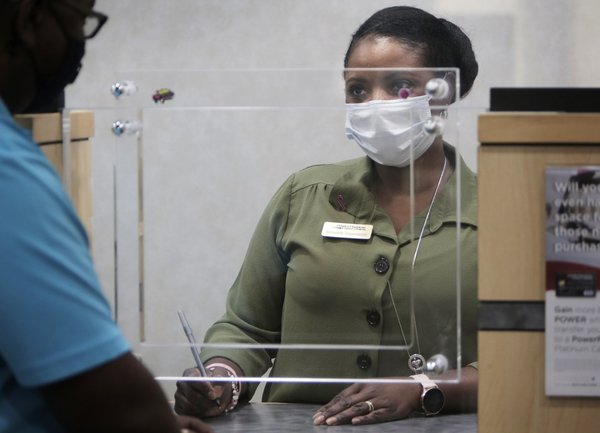
The local Power Financial Credit Union is among companies _ including Ikea and Walmart _ that have raised their minimum wage in recent years.
Earlier this year, Power Financial implemented a $15 minimum wage. It wasn't a huge financial lift, CEO Allan Prindle acknowledged, since the lowest paid employees did not earn the state's minimum wage and instead averaged $11 to $12 an hour, but the move went a long way toward boosting morale.
While businesses may fear the costs incurred by the amendment, Prindle thinks the pandemic has made consumers more aware and sympathetic to low-wage workers who have been hardest hit. There's a renewed sense of togetherness, with more people buying local for instance, that he thinks will make consumers more amenable to modest price increases.
"The advice I would give is to consider your most important asset," said Prindle. "Replacing people is far more expensive than simply bumping up the minimum wage in a given time frame. Look at it as an investment in your people rather than a cost increase."