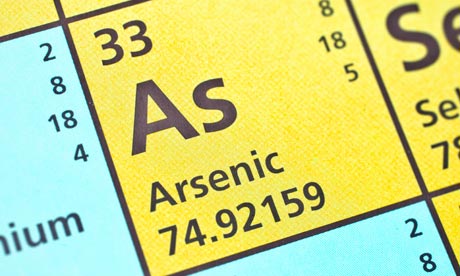
As names go, element 114 (the number that refers to the number of protons in its nucleus), or its "placeholder" name ununquadium are not particularly inspiring. The same goes for element 116, or ununhexium. But the good news is they won't be staying.
With the discovery of two new additions to the periodic table, announced this week, begins the hunt for two new names. The reported suggestions currently awaiting approval are flerovium, after the Soviet nuclear physicist Georgy Flyorov, and moscovium, after the Russian capital – the discoveries were made at the Joint Institute for Nuclear Research in Dubna, 100km north of Moscow, in collaboration with scientists from the Lawrence Livermore national laboratory in California.
Both of these names follow trends for naming elements, says Sam Kean, science writer and author of The Disappearing Spoon, his fascinating book about the periodic table. "It's trendy these days to name elements after great scientists," he says. "For better or worse, western cultures venerate individual geniuses, and while you can't say the periodic table has succumbed to modern celebrity culture, even something as seemingly timeless can't escape the fashions of its time." Others named in this tradition include the last element to be added to the table in 2009, copernicium, named after the astronomer Nicolaus Copernicus.
"The other trend," says Kean, "is naming elements after places, a sort of chemical patriotism." (Names, according to the International Union of Pure and Applied Chemistry, should end in "-ium" for "linguistic consistency".)
While the discovery of new elements is the result of years of complicated experiments – with only 92 naturally occurring elements, new heavy elements are produced synthetically by smashing the nuclei of atoms together – the bestowing of a name can be the final difficulty.
From the 60s to the end of the 90s, disputes over the right to name new elements regularly occurred between the University of California and the Dubna laboratory in the so-called Transfermium wars. "These latest elements were discovered by a collaboration between those two places," says Kean. "So while the periodic table was almost a proxy for the cold war before, now the relationship has thawed."
• This article was amended on 10 June 2011. The original stated that there are 94 naturally occurring elements. This has been corrected.