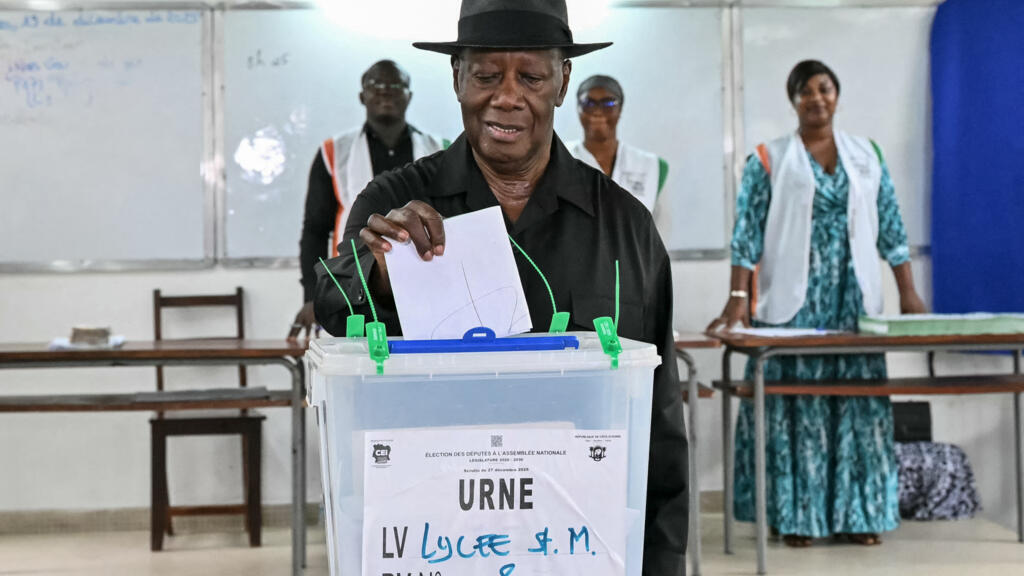
Following the reelection of President Alassane Ouattara on 25 October, Côte d'Ivoire is heading back to the polls – this time to elect the 255 members of the National Assembly.
With the campaign for the legislative elections having ended on Christmas Eve, more than 8.7 million voters are called to the ballot box on Saturday.
Given the absence from the running of the African People's Party (PPA-CI) of former president Laurent Gbagbo, many anticipate a two-horse race between the ruling Rally of Houphouëtists for Democracy and Peace (RHDP) and the Democratic Party of Côte d'Ivoire-African Democratic Rally (PDCI-RDA), the main opposition.
The PPA-CI has chosen to boycott the vote, arguing that the conditions for free, fair and credible elections have not been met.
The party says the political environment in Côte d’Ivoire has been marked by repression, judicial harassment and restrictions on political freedoms. The boycott is also closely tied to the party’s rejection of the results of the October presidential election results – in which Gbagbo was not allowed to run – which it labelled fraudulent and illegitimate.
Pledges on prisoners
In the Abidjan district of Abobo, one of the country's most populated municipalities, supporters of RHDP candidate Téné Birahima Ouattara, the country's current minister of defence, treated residents to a showing of Côte d'Ivoire's Africa Cup of Nations match against Mozambique – in which the former, the defending champions, claimed a 1-0 victory.
"We visited the various ethnic communities here in Abobo, the different charities and groups," he told RFI's correspondent. "Everyone is happy to have us. Everything is going well and we hope for a very large turnout."
PDCI candidate Jean-François Dibi – supported by the Ivorian Popular Front (FPI) – opted for a meeting with Baoulé traditional chiefs.
He pledged that, if victorious, he would introduce a general amnesty law for "prisoners of conscience" – referring to the opposition supporters and activists arrested and jailed in the run‑up to and aftermath of the October presidential election.
"By having a majority in the National Assembly, we will be able to obtain this general amnesty law to release all those who are in prison," he said. "And we will give ourselves the means to pass this law so that the perpetrators are brought to justice."
Six parliamentary seats are up for grabs in Abobo, where the electorate is estimated at more than 438,000 people – but where only 42 percent of registered voters turned out in October.
Ouattara wins landslide fourth term as Côte d'Ivoire president
Tidjane Thiam's opposition PDCI-RDA on Thursday claimed there had been incidents of electoral fraud in a central district of the country – including the illegal collection of personal data, and the promises of money and motorcycles.
The party said in a statement it believes the objective is "to organise massive electoral fraud in favour of the RHDP candidate".
The PDCI also raised the disappearance of more than 25,000 voter cards in the Port-Bouët district – although the president of the Independent Electoral Commission insisted: "There is no cause for concern."
Beyond the binary
Alongside the traditional political parties, there are numerous independent candidates in the running. Among them is 34-year-old Zakaria Koné, who says he has been focusing primarily on direct contact with voters.
"We are more focused on door-to-door campaigning. We talk to the people, we engage [with] them on their [daily] realities and we ask them to choose progress and change, so that Abobo can escape this precarious situation," he told RFI.
Young voters in Côte d'Ivoire want jobs, change – but most of all, peace
The new ADCI party – full name: "Today and Tomorrow Côte d'Ivoire" – hopes to embody a third way.
Led by Tiémoko Assalé, barely 18 months after its creation it is represented in 38 constituencies, and is aiming to secure a parliamentary group. But raising its profile wasn't easy.
In Abidjan's heavily populated district of Cocody, the party's candidates organised a tour. Serge Djibré is their lead candidate there. "People have their own lives – they have trouble sitting down to listen to political debates, so we need to go to them," he told RFI.
Fourteen lists are competing in Cocody, but a duel between the PDCI and the RHDP is expected – which could reflect the outcome at a national level.
Djibré believes the ADCI has got closer to the voters than other parties, saying: "We distinguish ourselves from traditional parties with a new approach based on accountability to our voters, but above all the closeness we demonstrate in our campaign."
But many locals remain sceptical.
“It doesn’t really mean much to me,” one woman told our correspondent. “It’s a new party we don’t know about,” said another passerby. “I didn’t really pay attention to what they were saying,” a third confessed.
This article has been partially adapted from this report by RFI's correspondent in Abidjan, Abdoul Aziz Diallo.