Less than five miles from the White House, where Barack Obama’s address to the American people seemed full of political certainties, the randomness of US immigration policy is all too apparent in a small suburban sitting room.
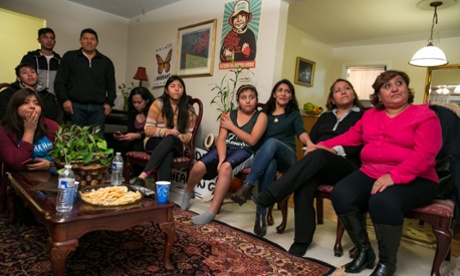
Like so many others this time in the evening, it has the television on. Children are returning from school basketball games. Pizza is being ordered for visiting friends. Two neighbouring families share stories of long hours and high hopes.
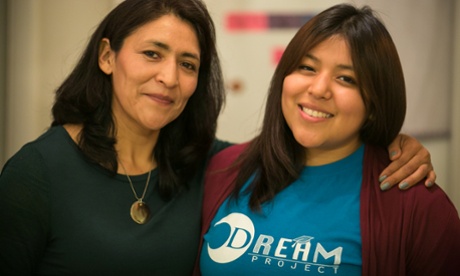
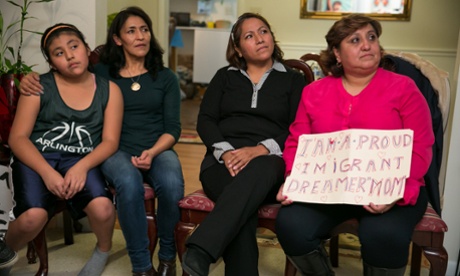
In most respects, the people here have as much in common with each other as they have with the rest of this country. Ingrid Vaca, a 51-year-old divorced cleaner from Bolivia, is there with her two handsome sons: Gustavo, 21, and Diego, 19. Next to her sits Betty Andrade, a 46-year-old Bolivian-born nanny, and her two eldest daughters: Hareth, 21, and Haziel, 16.
Both families have been living in the Washington area for well over a decade after entering the country on tourist visas. They have been brought together by a shared fight to have their US-educated children recognised under the law.
Obama’s Deferred Action for Childhood Arrivals (Daca) program in 2012 had transformed the lives of these so-called Dreamers. Social security numbers and driving licences meant the Vaca boys were able to drive and take up a soccer scholarship at a local college. Hareth Andrade channeled her relief at not having to return to a country she barely knew into a national campaign against the deportation of her father, Mario, whose sudden arrest for drink-driving plunged the Andrade family into panic last year.
But their reaction to Obama’s speech on Thursday offering similar temporary legal status to 5 million older undocumented migrants is coloured by one important difference between the two families: the Andrades have a third child, 10-year-old Claudia, the basketball player, who was born at the local Children’s Hospital.
In the president’s speech, which the families watch silently side by side, Obama portrays his decision to include parents of US citizens – Betty and Mario – but not parents only of Dreamers – like Ingrid – as an attempt to chart a rational course between two unpalatable extremes.
“Mass amnesty would be unfair,” he says. “Mass deportation would be impossible and contrary to our character. What I’m describing is accountability – a common sense, middle ground approach: If you meet the criteria, you can come out of the shadows and get right with the law.”
Many immigration experts suggest a less deliberate drawing of the line. “If you look closely at the advice he got from government lawyers, this was basically as far he could go,” says Edward Alden of the Council on Foreign Relations. “Including parents of citizens and green card holders was deemed to be lawful executive action; extending it to parents of those who already got relief under Daca would have required action from Congress.”
But whatever the reason, and however much the compromise had been signalled in careful White House leaks over the preceding 24 hours, those watching had still hoped for a last-minute change of heart.
“I am happy for my friends, but it’s just not fair,” say a sobbing Ingrid as her shell-shocked sons try to comfort her. “We have lived here for many years. We work hard. We pay taxes. We follow the rules. We try to be good people. We are human beings also. We want to live free, but I still feel scared.”
Many critics who are opposed to the relaxation of US immigration rules might look at Ingrid’s case with limited sympathy – after all, there are many around the world who would like to work here who do not break their visas and settle without documents in this way.
But Ingrid also fits perfectly the description given by Obama during one of the more emotional portions of his speech: “Are we a nation that tolerates the hypocrisy of a system, where workers who pick our fruit and make our beds never have a chance to get right with the law?”
For 14 years, this single mother who trained as a teacher in Bolivia has done the only work she can find without papers. Often, from 6am to 10 or 11 at night, she has been out cleaning the houses of Washington’s policymakers and public servants – usually three houses a day, on her own.
“Sometimes I was crying. It was very lonely. Sometimes I’d get home and I was just too tired to eat,” says Vaca, who has nonetheless spent thousands of dollars putting two sons into college and also found time to petition various members of Congress and Virginia’s attorney general as a campaigner.
For six of those years, she was unable to drive because of a lack of paperwork, catching two buses and a train into town and carrying her vacuum cleaner in a rucksack. Even when she did manage to get a driving license by providing a false address in Maryland, which has less strict rules than Virginia, she lived in fear of being pulled over by police, like her friend Mario Andrade.
But whereas Mario and his wife can now dream of a stable life – perhaps even one day returning to their careers as accountants and architects – Ingrid remains in limbo, waiting for another president, or for Congress to make a different speech.