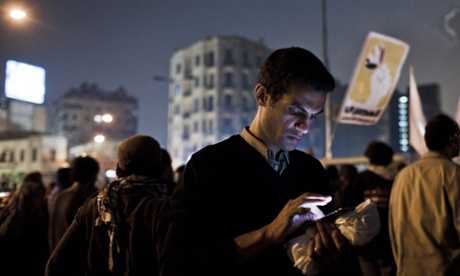
A 24-hour stream of consciousness from a Cairo taxi driver. A conversation between girls in Ramallah and Haifa. Thoughts on the dangers of atheism in the Middle East.
Thanks to Twitter, such conversations and interactions – once restricted by geography, borders and conflict – are endlessly broadcast for people across the world to read and engage with. Now, this revolution in the way we communicate and respond to world events is to form the basis of a production at this year’s Edinburgh festival.
Here is the News from Over There (Over There is the News from Here), by the Northern Stage theatre company, will bring together Twitter and theatre to offer a unique and engaging perspective on life in the Middle East .
Twenty playwrights, whose nationalities include Iraqi, Egyptian, Algerian, Iranian and Lebanese as well as Palestinian and Israeli, have been commissioned to write pieces that could be fictional, journalistic, personal testimony or poetry, where the narrative is built up through a series of tweets, ranging from 20 to more than 100.
“We receive a very limited set of stories about what the Middle East is, about what life is like there, the concerns people have and the politics,” said Northern Stage artistic director Lorne Campbell, who is directing the production. “So it is about creating a space that a lot of different voices can talk into in this idiosyncratic way, with no responsibility to represent anything except their own thoughts and their own perspective.”
Over the course of the Edinburgh festival, each of the plays will be broadcast on Twitter, where the narrative will unfold through dialogue between the fictional characters and others, tweeted directly from the Here is the News from Over There Twitter account.
Responses will also be recorded and two of the plays will be performed each night, incorporating the original text as well as the replies and interactions from others on Twitter.
Campbell said: “Twitter has become this social and political tool in the Middle East over the past four or five years. It was a key source of real information during the Arab spring and it has remained a place where people can speak either completely candidly as themselves or completely candidly anonymously.”
The 20 writers had no brief other than to tell a story that felt personal to them. The pieces they have submitted range from 24 hours in the life of a Cairo taxi driver to more journalistic narratives exploring religion and a satirical piece on the plans to build a new Egyptian capital.
Ishy Din, one of the playwrights, drew inspiration from the blockade of Gaza, where the amount of food let in by the Israelis was reportedly based around a calculation of the calories that people needed to survive, and tells the narrative of the play through two girls – one in Ramallah on the West Bank and the other in Haifa in Israel – who are discussing dieting over Twitter.
“I thought it would be really interesting to juxtapose this idea of a restricted calorie intake because of politics and conflict and the global obsession with dieting and the pressure for women to have perfect bodies,” said Din. “The only stories you hear from the Middle East are the ones that make sexy headlines, so I think this is a really interesting way to explore what normality means in the region.”
The pieces will be performed by a core team of five, with others from the Northern Stage company helping out.
An Iranian-British music duo will perform each night, improvising pieces to accompany the plays. Campbell is also bringing some traditional Scottish weavers to the stage. They will create what he calls a “textile response” to the play, in a nod to the rich textile traditions across the Middle East. At the end of the festival, these pieces of woven cloth will be sewn together.
“I just thought there was something very interesting to be drawn from that juxtaposition of the very ancient and very gradual process of weaving and the immediate process of storytelling through social media today,” he added.