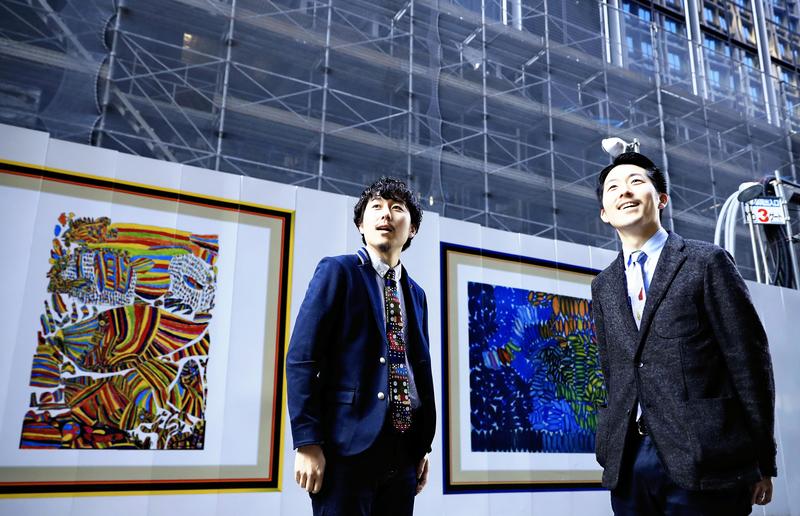
Twin brothers in Hanamaki, Iwate Prefecture, are promoting the art of disabled people who have their own unique perspectives.
Takaya and Fumito Matsuda, both 28, run Heralbony Co., a planning firm for welfare-related businesses based in the city.
Until the end of this month, an outdoor exhibition of artworks is being held in the Marunouchi district of Chiyoda Ward, Tokyo. The brothers have been organizing projects like this with a belief that disabilities are no obstacle to creating exceptional art.
In the Marunouchi district, which is packed with businesspeople every day, colorful paintings with geometric patterns adorn the white safety walls surrounding a construction site.
The people and animals depicted in the paintings leave such a strong impressions that viewers may feel as if they are going to pop out of the frames.
Displayed as part of an event called Karigakoi Art Museum, the pictures were painted by mentally impaired people. Heralbony organizes these exhibitions of disabled artists' paintings on temporary safety walls as part of its activities.
Fumito, who once worked for a construction company, devised the exhibitions. The displays have also taken place in Morioka, Sendai and Shibuya Ward, Tokyo.
The artists receive part of the fees paid to Heralbony by the companies behind the construction projects around which safety walls are erected.
Fumito said, "I hope people will naturally begin to consider disabilities in much the same way as art can be integrated into the landscapes of cities."
The twins have a 32-year-old older brother, Shota, who is autistic. In their childhood, the three siblings played together, took baths together and generally spent time enjoying themselves.
But when Fumito and Takaya were junior high school students, they began keeping their distance from Shota. Recalling his feeling in those years, Fumito said, "I wanted others around us not to see our brother."
A turning point came soon after the twins became working adults. Takaya mainly studied the arts at university and then worked for an advertising agency. On a holiday, he visited an art museum where he saw pictures painted by a mentally impaired person. He was deeply impressed by the paintings' creativity.
At the time, Takaya said, "I wanted to introduce such art to society more widely." So, he suggested his idea to Fumito, and the twins considered how to carry it out while continuing to work their regular jobs.
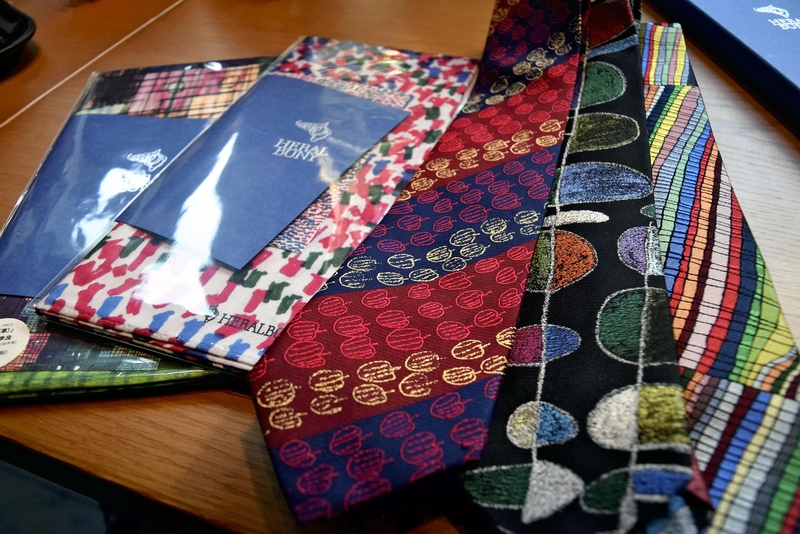
The first art-related products the twins devised were silk neckties. The ties featured 3D patterns -- combinations of circles, diagonal lines and pictorial figures -- created by a mentally impaired person.
The twins called around to companies asking them to produce the neckties as commercial products, but their proposals were turned down repeatedly for such reasons as the technical difficulty of producing them.
Finally, a long-established clothing store in Tokyo's Ginza district became interested and agreed to produced the neckties.
The neckties went on sale in November 2016 priced at 22,000 yen each.
Takaya said: "The price was never low. But I wanted to create a stir, because the current situation is that items made in facilities to help disabled people work are sold at low prices."
The twins said that sales of the neckties have been brisk.
Heralbony was established in July 2018. The name of the company was chosen from among lots of words that Shota had written down in a notebook. Takaya and Fumito chose the name because of their desire to commercialize things that look meaningless at first but are actually valuable to society.
To date, the company has sold six necktie designs and 16 handkerchief designs, while collaborating with more than 100 artists.
Both the ties and hankies became popular on online clothing sites and other places. Some of the products have been given as thank-you gifts by the Hanamaki city government to people who donated money in the furusato nozei tax break scheme.
Late last year, the company let artists produce works that used the walls at JR Kichijoji Station and Hanamaki Station as their canvases. The creations became popular mainly on social media sites.
The twins point out that disabled people have their own personalities, and offer possibilities that do not exist elsewhere. Their dream is to change people's ways of thinking about the world of the disabled.
Read more from The Japan News at https://japannews.yomiuri.co.jp/