We’ve been steadily running down our favourite TV shows of 2014, but the year was also littered with TV that fell flat, ended terribly, and was prematurely cancelled. We asked five of our critics to tell us which moment was their TV nadir in 2014.
Brian Moylan on Selfie v Trophy Wife:
Sadly, ABC left Trophy Wife for something younger, better, and considerably more vapid
One of the problems with network television these days is it keeps tossing quality product in search of something that has the potential to be a hit. That’s what happened to Trophy Wife, ABC’s awfully titled, moderately rated, critically adored comedy about a blended family. After a full season of the show starring Malin Akerman, Marcia Gay Harden (an Oscar winner!), and Bradley Whitford, ABC decided that it had some better horses in its stable that might win the ratings race on Tuesday nights in 2014. Those horses were Selfie, an awfully titled remake of Pygmalion, and Manhattan Love Story, a high-concept sitcom in which two New Yorkers meet and fall in love and the audience can hear what they’re thinking via voice-over.
I don’t have a problem with networks chasing what is going to be a big hit, but what angers is me is when they cut off something in its prime, like Trophy Wife, so that they can try some dreck that obviously has no chance of catching on. Selfie and Manhattan Love Story were two of the first shows cancelled this season. Sadly, ABC left Trophy Wife for something younger, better, and considerably more vapid. ABC left behind a good marriage for a trophy wife. In the end, the title was as ironic as it was awful.
Gwilym Mumford on Sherlock’s bromance issue:
It’s increasingly hamstrung by what used to be its main selling-point: the relationship between Holmes and Watson
Given that we get so few of them – nine since 2010 – each episode of Sherlock now feels like its own wildly anticipated mini-event. The downside of this, of course, is that each weak offering of Steven Moffat and Mark Gatiss’s detective drama seems more conspicuously disappointing than it would do if, like its US cousin Elementary, it were part of a longer run. Season three of Sherlock had some good moments – Watson’s disastrous bachelor party in The Sign Of Three, Lars Mikkelsen’s brilliantly oily performance as the media baron Charles Magnussen in His Last Vow – but was increasingly hamstrung by what used to be its main selling-point: the relationship between Holmes and Watson. Too often their bromance was prioritised at the expense of the show’s usually meticulously plotted mysteries, with the case at the centre of opening episode The Empty Hearse (a terrorist plot to blow up the houses of Parliament) feeling particularly uninspired. Moreover, there was a sense of the show disappearing into what Veep writer David Quantick described on Twitter as “a forest of self-reference”; the “there is no correct answer” meta-commentary that played out around Sherlock’s surviving of the rooftop fall might have seemed like a clever idea in the writers’ room, but came across as navel-gazing in the extreme on screen. Hopefully, when the show returns in 2015 to tackle its next big conundrum – how Moriarty survived shooting himself point-blank in the head – we’ll actually get a satisfying answer.
LaToya Ferguson on How I Met Your Mother’s ending:
All the series finale had to do was stick the landing – it didn’t
It was the best of sitcoms, it was the worst of sitcoms. That’s How I Met Your Mother in a nutshell now. The series’ final season had the loftiest of goals from the get-go: have the story all take place in the span of a weekend and make an audience of millions fall in love with The Mother before Ted Mosby even meets her. When you look at it simply that way, How I Met Your Mother completely succeeded. All the series finale had to do was stick the landing – it didn’t. While most can agree to disagree on whether the final season’s approach to having the whole story take place in three days actually worked (depending on the episode, it either nailed it or failed miserably), even more can agree that showrunners Bays and Thomas completely dropped the ball at the finish. After all these years, Robin and Barney don’t work out as a married couple. Barney goes back to his Lothario ways, knocks up a girl, and only really finds peace once he meets his newborn daughter (something Robin could never give him). And Ted does meet and fall for The Mother (Tracy) ... only for her to die fairly soon into their marriage. To twist the knife more, it turns out that the series as a whole was a roundabout way for Ted and Tracy’s kids to give him permission to be with this true love, Robin, after he’s already gotten the life he wanted (the wife, the kids, etc.) but couldn’t have gotten with Robin before. Talk about a bummer.
Monica Heisey on the pain of Two And A Half Men:
I am thrilled to see it go, but …
This year saw a TV announcement I’ve been waiting for since 2003: the end of the televised dick-joke carnival and weekly misogyny convention known as Two and A Half Men. It was revealed in March of this year that the last episode would be pumped out by whatever lazy stereotype factory is responsible for this nightmare on 19 February 2015. I am thrilled to see it go, but my ire here lies in the fact that it took twelve years to reach this decision. Twelve years and the total public breakdown of its original jerk star, his replacement with a new jerk star, the departure and public condemnation of the show by of another of its stars, and the replacement of him (the “half-man” of the show’s title) with a woman. But she’s a lesbian, so she’s kind of half-man too, get it? #boobs. Good riddance, Two and A Half Men. I’m disappointed in you, longstanding audience of over 10 million viewers.
Lanre Bakare on Orange Is The New Black season 2’s trudge:
It was hard going at times
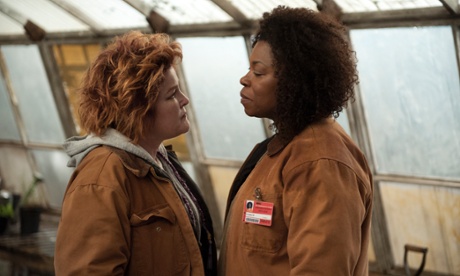
The first season of OITNB was a revelation: a slowly unfolding bit of magic from Netflix which made the prospect of streaming specific content seem viable. Season two should have been equally impressive. The idea of blending the backstory of the varied inmates with the main Piper storyline was innovative and captivating, but ultimately, there was far too much of one character, namely the queen bitch: Vee. She was forced down the viewer’s throat so many times I just wanted to shout “yeah, I get it. She is really evil” at the TV. But even when we did veer away from Vee into the backstory of, say, Sister Ingalls, it felt like an enforced pit stop before more relentless grimness and eyeballing. Season two will probably age well, as season two of the Wire did, for example. It may become a necessary outlier that improves the show as a whole – but it was hard going at times.