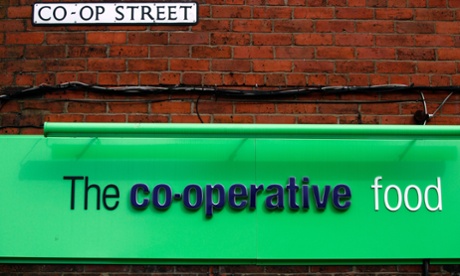
The turnover of all the co-operatives in the UK has fallen for the first time in almost 10 years, according to a report that found the John Lewis Partnership has overtaken the Co-operative Group as the largest organisation in the sector.
The employee-owned retailer John Lewis, while technically not a co-op, falls under the scope of the definition used by the researchers at Co-operatives UK, the body that compiles the annual outlook for the sector. John Lewis’s turnover of £10.9bn in 2014 surpassed the £10.8bn reported by Co-op Group, which has traditionally dominated the sector.
Co-operatives UK found that the turnover of the entire sector was £37bn, down 2.8% on a year earlier. It was the first year-on-year fall since the data was collected in 2006 and the result of the reduction in the Co-op Group’s stake in the Co-op Bank.
The Co-op Group cut its stake in the banking arm to 20% during 2014 as it scrambled to fill a hole in its books, first exposed the previous year. The capital shortfall in the Co-op Bank sparked a crisis in the Co-op Group, which slumped to a loss for 2013, and was forced to sell off parts of its business, including its farms and security company. It now focuses on supermarkets and funeral homes.
The way membership of the sector is calculated has been changed by Co-operatives UK. It said the sector had almost 15 million members in 2014, which it described as a record number. In the past, Co-ops UK has said the sector had more than 15.4 million members in 2013, although this figure has since been revised to 14.4 million.
Ed Mayo, secretary general of Co-operatives UK, said the sector was resilient: “The Co-operative Group is coming out of a challenging period into one of renewal, and this of course has had an impact on the sector. Yet innovation and growth amongst co-operatives large and small, in everything from solar power to social care, have meant that the co-operative sector is growing and in good health.”
Co-operatives UK found that Alston in Cumbria, the highest market town in England, is also home to more co-ops than any other - with a co-op baker, wholefood store, school, community owned shop and post office, broadband service and food store from the Co-operative Group. It also said that businesses that start as co-ops are more likely to survive than those that do not. Eight out of 10 businesses which began as co-ops in the last five years are still in existence, compared with four in 10 that were not set up as co-ops.