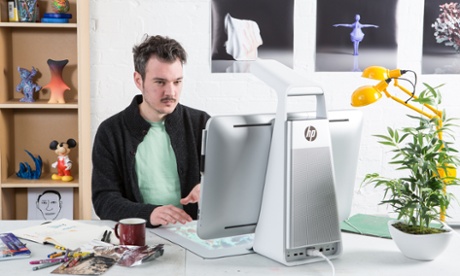
The line between art and technology is disappearing, and the latest technology is allowing artists and designers to attempt increasingly ambitious projects.
Matthew Plummer-Fernandez is a designer and artist, best known for his work with 3D printing, particularly his 2012 Digital Natives Collection – everyday objects, including a watering can, an action figure and
a dolphin-shape lamp were scanned and distorted using his own software. His project Disarming Corruptor, in which he used an app to disguise 3D print files as “glitched artefacts”, won a Prix Ars Electronica Award of Distinction.
“My approach is to make sculpture with scans and printing,” says Plummer-Fernandez, who has a BEng in computer-aided mechanical engineering from King’s College London and an MA in design products from the Royal College of Art. His work examines algorithms, bots, automation, copyright and file-sharing. He is working on a practice-based PhD at Goldsmiths, University of London.
When Plummer-Fernandez was asked to work with Sprout by HP, a revolutionary creative space that combines immersive, multi-touch technology with a fully functioning PC, he really wanted to test its creative possibilities. He came up with the concept of testing the Sprout in unusual ways to see just how far he could push the machine’s capabilities.
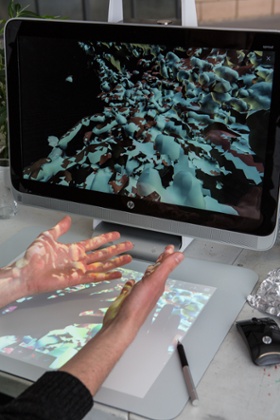
“As an early user of the Sprout, I wanted to push the boundaries and preserve the results in highly detailed renders,” he says. “This creates an aesthetic language unique to the product – much like the distortion and feedback of a guitar amplifier that was explored by its early adopters.
“I started with things that are hard to scan, such as glass and reflective objects. I discovered that scanning aluminium foil produces really interesting results, strange 3D blobs, like mercury, with lots of particles floating in space.”
The second test involved a gaming app called Fuse that builds virtual avatars. “Within the app there is an archive of body parts – heads, legs and torsos – you can just touch the screen to change the proportions, sculpting the human form,” Plummer-Fernandez explains.
“As part of the test I pushed this avatar creation tool as far as it would go, making body shapes that are beyond humanly possible.”
His remaining tests involved waving his hands in front of the scanner. He then exported and rendered the results using a tool called Blender, which he had installed on the Sprout.
Plummer-Fernandez says the Sprout provides other benefits. “I normally work with 3D models, so I was keen to integrate the Sprout into my workflow,” he says. “I usually start with the physical, move it to digital and then take it back to physical, so the Sprout facilitates a creative process that appeals to me.
“I also want to use the top screen as a drawing surface, sketching on it to develop drawing apps. I like developing apps that are intuitive, where you can stretch and grab things, click on the screen and rotate the figure. The Sprout makes this kind of development obvious because you can manipulate it with your fingers.”
As a forward-thinking artist and designer, Plummer-Fernandez used the Sprout to create a series of unique artwork. As well as being a functional addition to your office, the Sprout’s creative technology allows you to explore your own artistic imagination.
The ultimate creative space
Create whatever you can imagine thanks to Sprout’s revolutionary, immersive, multi-touch technology and Sprout Workspace, the app for capturing, creating, and sharing your ideas. With the powerful Intel i7 Processor and 1TB of storage, Sprout has everything you need to express yourself and get your work done. Find out more about the Sprout by HP here.