The railway bridge that crosses the Clyde, linking the bohemian Merchant City quarter of Glasgow to the Gorbals on the other bank, still bears one of the pink banners proclaiming “People Make Glasgow”, raised to stir the spirit in the runup to the Commonwealth Games. Battered by autumn rain, the motto still makes a good introduction to the Turner prize favourite Duncan Campbell, one of the people who is making Glasgow, by making things in Glasgow.
The video artist has lived in the city for 17 years since coming over from his native Dublin to study and he now works in a studio in the converted fish market known as the Briggait. As one of four artists shortlisted for the annual December prize run by the Tate (alongside Ciara Phillips, James Richards and Tris Vonna-Michell) Campbell has been prominent this month not just because his work has been widely hailed as the strongest in the 2014 lineup, but also because his nominated film, It for Others, takes a swipe at the British Museum, mentioning its director, the venerated Neil MacGregor, by name.
His film is a response to an admired 1953 French documentary film made by Chris Marker and Alain Resnais called Statues Also Die, which set out to show how symbolic artefacts taken from Africa and placed in the London museum immediately lost much of their meaning and, worse, had other, handier meanings foisted upon them by western academics.
“The issue of repatriation is incredibly complicated and there are some arguments I don’t agree with on both sides,” said Campbell, 42, this weekend, “but there are very compelling arguments about the ownership of these objects, to do with how they are used and with who gets to draw the limits on the sort of knowledge that is drawn from them.”
Campbell’s low-level clash with the British Museum came about when he asked to film the objects first used in the French film. “At first the museum came up with conditions that were perfectly understandable because they were to do with preservation of the objects and the materials,” he said. Campbell did not have a full script for his film, and so he asked the museum if that was “a deal-breaker”: “They seemed as if they didn’t want to say no to me, but then they didn’t say yes either. So I am quite confused by the whole process.”
Of MacGregor, also a Glaswegian – though by birth rather than residency – Campbell had a pretty good opinion, he added. “I haven’t met him, but he is a very good broadcaster. I do quote him in the film and in fairness he has responded by welcoming the film and the debate, but that is not necessarily to say we are in agreement about everything.”
The artist’s respect for the Marker/Resnais film is based on its skilfully “nuanced” position on the issue of the repatriation of African artworks taken in the colonial era. “It is not a perfect film, but it really manages to open up the burgeoning movement for independence in Africa and to look at the intellectual and cultural colonisation of Africa. That is its big achievement for me.”
Campbell’s own film was eventually made using replica objects, but this had helped to move the argument on, he suspected. “I ended up using second- or third-generation replicas by dint of not getting access to the objects in the British Museum. That seemed a bit of a disaster at first, but if you go back to the Statues film, they begin to look at that same process of commercial reproduction.”
The artist is happy to be open about his creative process and his fallibility. In fact, he believes this transparency is crucial to his art and to what he is trying to say.
“It is quite essential that people understand that. If you go back to my other films, say the one I made about the Irish republican activist Bernadette Devlin McAliskey, I made it explicit that you are not going to find out everything about her from my film. It is a beginning, and it deliberately unravels because the intention behind it is to point out that it is an edited film. It is not ‘a truth’ and it questions the idea there are truths out there to be discovered.”
Campbell’s childhood in an Ireland riven with opposing religious certainties and political “truths” might, he admitted, be part of his drive to find ways to show the complexities of cultural arguments. It was not, he insisted, simply that he had strong views that he was hiding inside his art. Instead, he was interested in making work that “acknowledges my own limitations and then sort of points outwards”, he said. “All my art is very aware of propaganda and in some instances I don’t have a problem with art that has a contingency, a certain purpose in the world. But my film is like a snapshot of a thought process that is continuing. My thinking on it is evolving.”
He argued that histories were always constructed for a purpose and it was unpacking this that interested him. Formal documentaries were structured, with building tension, towards a closure at the end, while his own films were a kind of “improvisation”.
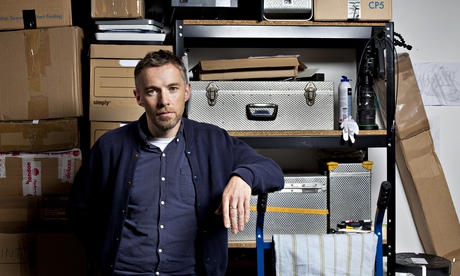
As he sat in his studio, Campbell’s head was accidentally framed between two minimalist black stools placed on a workbench behind him. They were clearly recognisable as key props from his Turner prize film, which included a monochrome dance sequence filmed from above in collaboration with Michael Clark’s dance company.
“I’ve known Michael for six years or so and seen a number of his performances as a fan. We were both reading Marx’s Das Kapital again back in 2008, as I was researching the Resnais film, and there was a lot in there to do with the commercialisation and commodification of art and how that contributes to the death of purpose of those art forms,” said Campbell. They began to work together, filming the dancers from above, as objects, in a manner characteristic of Clark’s choreographic films. “I am not a super-whiz with a camera, so it was about seeing what happened. We shot about eight vignettes we had blocked out on paper, a lot more than we ended up using.”
Campbell enjoyed this collaborative approach and “the benefits to be had from involving other people in the process”. It worked against the solitary ethos of the lone artist, an ethos he distrusts. So will he now follow fellow Turner nominees Steve McQueen, the director of 12 Years a Slave, and Sam Taylor Johnson, the director of Fifty Shades of Grey, into full-scale feature film-making?
“Well, if something came up and I thought it could be interesting, it would certainly be worth exploring,” said Campbell, pointing out that film funding boards now frequently turn to contemporary artists, where once they would have gone straight to established arthouse directors. “But in terms of certainly completely handing myself over to the process of the way films are made, I can’t see that happening. I make a film as long as it needs to be and the traditional, industrial model of how to produce a film would have to open up to some extent for it to work for me.”