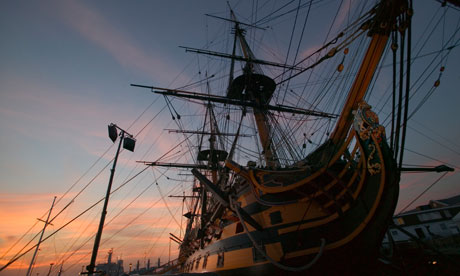
HMS Victory is no stranger to art. Nelson's ship has inspired artists (not to mention putters-of-ships-in-bottles) before. As Yinka Shonibare's engaging Trafalgar Square artwork goes on show to the public, perhaps it's time to look back on an earlier representation of this ship.
The battle of Trafalgar, 21 October 1805, took place in an age addicted to history paintings. The 18th century saw history as the highest theme for art – grand historical narratives were the summit of serious painting. The French Revolution, the rise of Napoleon and the eruption of war across Europe gave artists a living flow of new history. In 1822, George IV challenged JMW Turner to take on Britain's proudest moment, and to paint the great sea battles of Trafalgar.
In Turner's picture, HMS Victory is at the very heart of a terrifying and awe-inspiring scene. The massive wooden wall of this immense war ship will be instantly recognisable to anyone who has seen the surviving Victory in Portsmouth, where Turner had detailed sketches made to supplement his own drawings of Nelson's ship done in 1805. In the bottle on the fourth plinth, the Victory seems slight and flimsy: in Turner's painting, you feel its mass and its power. But it is vulnerable. Masts are toppling, sails ripped to shreds. Nelson led from the front, and died on his flagship's deck.
But Turner does not concentrate on Nelson's sacrifice – that had already commemorated by Benjamin West in his popular 1806 painting The Death of Nelson. Instead, Turner concentrates on the suffering of ordinary sailors and soldiers who cling to wreckage in the foreground. The sea has almost vanished under a tide of human bodies: a proud flag bears witness to their readiness to die for their country. Above, smoke mingles with the clouds, and broken ships tower and totter. It is a moment of sublime spectacle and bloody horror.
British artists of the Napoleonic wars were influenced by Leonardo da Vinci's essay on how to paint a battle, which was translated into English at the start of the 19th century by JF Rigaud. In this powerful passage in his notebooks, Leonardo says the painter of a battle should begin by showing the smoke of the guns, a rich, atmospheric visual theme. For artists painting sea battles in the Regency period, that was fascinating advice. Turner sets out to paint the smoke of war more hauntingly than his rival Philippe-Jacques de Loutherbourg, a stage painter who turned his hand to battle scenes. In fact, Turner's Trafalgar was commissioned as a pendant to de Loutherbourg's The Battle of the First of June, 1794.
Both paintings show the suffering of a sea battle amid the smoke. It is Turner's troubling vision of war that clings at your mind. If previous fourth plinth unveilings are anything to go by, coverage of Nelson's Ship in a Bottle this week will tend to assume that no artist ever before depicted HMS Victory with any ambivalence. But Turner's painting of its finest hour is by no means a simple patriotic picture.