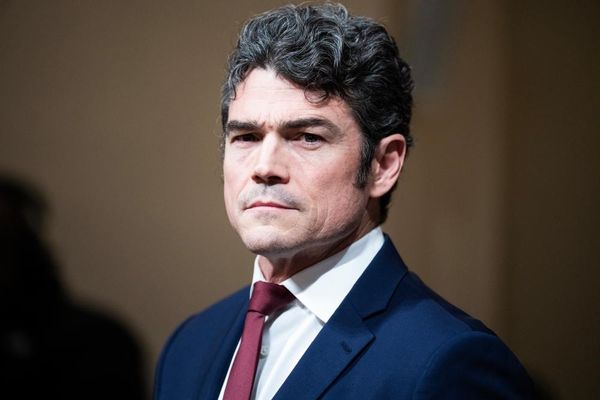
Malcolm Turnbull has avoided direct questions about whether he had ever supported Kevin Rudd’s ambition to be the secretary general of the United Nations, arguing his conversations with the former Labor prime minister were private.
Rudd has released correspondence to Turnbull which includes meticulously kept records of when he says the prime minister gave him private undertakings supporting his nomination as a candidate for the UN’s top job.
On Monday Turnbull said some of Rudd’s correspondence was “at odds with my recollection” and Rudd’s decision to release private correspondence after the fact spoke volumes about his character.
But Turnbull has contested the facts of only one specific meeting documented by Rudd.
The contested meeting occurred in December last year.
Rudd claimed Turnbull gave him a personal undertaking of support last December notwithstanding the fact that his candidacy would be put to the full cabinet for deliberation. Turnbull denied that outright on Monday, and confirmed a report in Guardian Australia on Sunday that his chief of staff was also at the meeting.
Asked on Monday whether he had given him support at other times, the prime minister said he would not “debate” Rudd about confidential conversations that touched on this subject over a long period of time.
Turnbull said Rudd knew at “all relevant times” that his nomination would be a matter for cabinet, not a decision by him or the foreign affairs minister.
He argued the process for the decision making was not as pertinent as the substantive judgment, which was that Rudd was not well suited to the role of UN secretary general. “Those are the facts of the matter,” Turnbull said on Monday.
On the correspondence released by Rudd, Turnbull suggested it was composed by the former Labor prime minister with the clear intention of releasing it after the fact.
“It says a lot about Mr Rudd that quite some time after the event he would seek to present an account of them in correspondence he would write to me with the clear intention of subsequently releasing it,” he said.
Rudd’s correspondence – released last week after Turnbull confirmed he would not be nominated – documented many discussions “in person, by text and by phone on the matter of my candidature for the position of UN SG over the last six months or more since you became prime minister”.
The former Labor prime minister said he and Turnbull discussed his ambition “on many occasions prior to you becoming PM as well”.
“You will recall that last September I contacted you asking for guidance on how I should address the matter of your previously stated support to me for my candidature when I met foreign minister Bishop at the UN general assembly in September,” Rudd wrote.
“You in fact sent me a message on your preferred Wickr system where you stated that you and the FM [foreign affairs minister] were ‘as one’ in your support for my candidature.”
Rudd said they met in November, then again in December, which is the contested meeting.
Turnbull subsequently told Rudd in May 2016 that he would not support his candidature and the cabinet wouldn’t either, a fact Rudd acknowledges.
Rudd records the May conversation in this way: “In your telephone call you said that neither you nor the cabinet would be supporting my nomination. When I asked the reasons for this, you said that neither you nor the cabinet has the view that I had the qualifications for the position.
“You will appreciate that you have never expressed that view to me in the multiple conversations we have had on this matter on the past.”
Subsequent to that conversation in May, the foreign affairs minister, Julie Bishop, was asked by the prime minister to prepare a cabinet submission on Rudd’s candidacy with formal consideration to happen after the election.
Bishop worked up the submission knowing the prime minister had some reservations about Rudd but she proceeded, with consultation, in the expectation that he would follow the bipartisan practice of elevating former prime ministers to international roles.