
The election represents a watershed in Turkish politics, writes Constanze Letsch Istanbul and Ian Traynor in an analysis of the success of the leftist Kurdish HDP.
The election result brought forth an embryonic new Turkey, but not the one the president wanted.
It produced what is tantamount to a cultural revolution in Turkish political life. Women will pour into the 550-seat parliament in Ankara in unprecedented numbers, 98 up from 79. Openly gay candidates won seats for the HDP. Most of all, the long-repressed Kurdish minority (one in 5 citizens) will be properly represented in the parliament for the first time with 80 seats.
“This is the first time that feminists in Turkey actively supported a political party,” said feminist activist Mehtap Dogan. “Up until now we have always done politics on our own, away from parliament. But this time we ran a campaign supporting the HDP because we believed in their sincerity when it comes to defending the rights of women, LGBTs and ethnic minorities.”
The HDP is the first party to introduce a quota of 50% female politicians, and all party offices and HDP-run municipalities are chaired by both a man and a woman.
The party’s successful attempt to break out of ethnic identity politics and broaden its appeal well beyond the Kurdish issue owes much to leader Selahattin Demirtas’ magnetism and his message of outreach.
But the mass protest movement born in a central Istanbul park two years ago and which mushroomed into national protests which Erdogan crushed mercilessly also fed in to the HDP’s support.
“During the Gezi [park] protests, many got an idea of what Kurds had to go through for years: the violence, the repression, the unjust arrests. It opened our eyes to the Kurdish suffering,” said Dogan. “At the same time, we saw how the pro-government press tried to turn our legitimate, peaceful protests into acts of terrorism.”
Just as Erdogan branded the protesters two years ago “riff-raff”, “terrorists” and “foreign agents”, in the election campaign he stoked division and malice by repeatedly smearing his HDP opponents as “terrorists, marginals, gays and atheists.”
He asked religiously conservative voters not to cast their ballots for “such people who have nothing to do with Islam.”
The tactic backfired as many religiously conservative Kurds shifted their votes from the AKP to a party that promised to represent everyone’s interests.
You will soon be able to read the rest of the piece on our Turkey page. The aftermath of the election now seems set to hinge on private meetings. And the outcome of those talks and deals could take sometime to emerge, so we are going to bring this blog to a close.
Updated
Apart from his written statement conceding the end of one party rule, Erdogan has gone to ground since polls closed.
His unusual silence has prompted Erdogan baiters to set up a Tick Counter.
The Guardian’s data editor Alberto Nardelli does the maths on the possible coalitions.
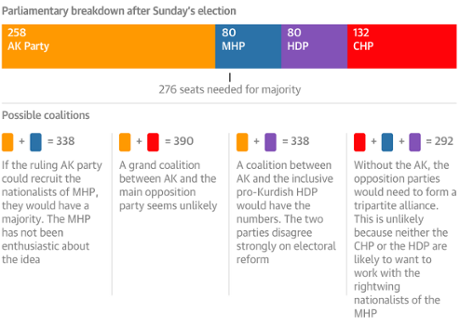
Initial reports in Turkey suggest the AK party would prefer a coalition government to a return to the polls. But any deal is difficult as the parties have less in common than not.
That said, in terms of potential deals – on paper at least – the AK party could work with the Nationalist Movement party (MHP). Although, due to the MHP’s hostility towards Kurdish issues, any deal would risk jeopardising Erdogan’s pursuit (and progress) of a peace deal with Kurdish rebels.
A second (also theoretical) possibility is an agreement with the pro-Kurdish Peoples’ Democratic party (HDP), who having passed the 10% threshold to enter parliament and by doing so denied the AK party a majority, are the election’s biggest winners. The AK party has been more sympathetic to Kurdish demands compared with other parties and previous governments. However, the HDP has been extremely critical of Erdoğan’s meddling in governmental affairs, authoritarian tendencies, and his most recent aspiration of increasing the presidential powers. But the MHP and the HDP have ruled out a coalition with the AK party.
Another option for the party would be to try to form a minority government and, assuming it can win a confidence vote, to then seek deals on an ad hoc basis. Such a government would most probably have limited shelf-life before elections are called again.
But if the opposition parties hold their ground and no type of agreement is reached within the necessary 45 days, then elections might be the only option. These would be called by the supreme election board in two months.
A grand coalition between the AK party and the the main opposition party the Kemalist Republican People’s party (CHP) is highly unlikely, as is the possibility of an agreement between all opposition parties (the CHP, MHP and HDP) due to the strife between the nationalist party and Turkey’s Kurdish population.
“On waking up this morning my overriding urge was to sing ‘Ding dong, the witch is dead!’ and dance like a liberated Munchkin,” writes Alev Scott author of Turkish Awakening and supporter of the Gezi Park protests.
In a comment piece for CiF America she says:
I could soon be regretting these words, but for now the puerile Wizard of Oz jingle is pure therapy. And I’m in good company – reading the triumphant headlines of anti-government papers this morning has been like taking part in a glorious orgy of righteous revenge, in which everyone has been granted sudden access to a stock of previously prohibited satire. It may prove hubristic, but today it is irresistible ...
While most people expect a coalition government of the AKP and the Nationalist Movement party or – worse – a hung parliament and new elections in a few months, Turkey’s best hope in moving forward lies in a grand opposition alliance that would seek to put aside its differences and leave Erdoğan and his minions firmly in the background.
Yes, there could be economic instability, and the coalition could struggle to survive a year. But after 13 years of the AKP, what a coalition of champions that could be. The opposition parties owe it to their voters, and above all to those who have died demanding change during the past two years.
Journalist Abdullah Bozhurt, from the opposition-backing Today’s Zaman, digs out the campaign clip of Prime Minister Davutoglu pledging to resign if the AKP failed to secure a majority.
A graph by the Wall Street Journal shows how far short the AKP has fallen short, first of a majority, and then of the three-fifths mark necessary for Erdogan to have changed the constitution.
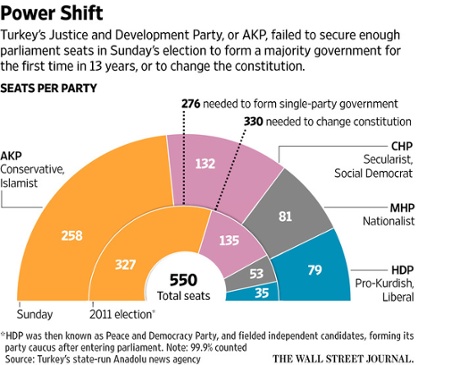
“This was a major defeat for Erdogan and it could usher in a period of heightened instability and confused policy,” Henri Barkey, former Turkey analyst at the U.S. State Department told the paper.
Putin’s decision to call Erdogan rather than the AKP party leader, Ahmet Davutoglu, has raised eyebrows among some Turkey watchers.
#Russia president #Putin places a call on pres @RT_Erdogan to congragulate AKP victory when PM @Ahmet_Davutoglu is the chairman of the party
— Abdullah Bozkurt (@abdbozkurt) June 8, 2015
Scandalously Russian President Putin called Erdoğan, not Davutoğlu, to offer congratulations for AK Party's electoral victory. #TurkeyVotes
— TurkeyWatch (@abyasun) June 8, 2015
Davutoglu has promised to resign if the AKP failed to win an outright majority. He is reported to be chairing AKP talks on what the group does next.
Some, perhaps including Putin, have already written him off. Professor Dani Rodrik at the Princeton’s Institute for Advanced Study, is one of them.
Davutoglu is a goner for sure. But Erdogan may come out on top still if the next coalition proves as successful as coalitions of the past.
— Dani Rodrik (@rodrikdani) June 7, 2015

Updated
Vladimir Putin has become one of the the first world leaders to congratulate Erdogan after his AKP party emerged as largest party in the elections.
A Kremlin statement said Putin “congratulated Erdogan on his victory” even if the result left the AKP a projected 18 seats short of a majority.
A translation of the statement said that in a telephone conversation, Erdogan and Putin agreed to continue “intensive personal contacts”.
Perhaps Putin also offered advice on how to successfully grab power after making the switch from prime minister to president.
Stocks in the suppliers of police water cannons and riot vehicles have seen some of the biggest falls after the election results, Hurriyet reports.
Shares in Katmerciler Ekipman, the company that manufactures the riot control vehicles popularly known as TOMAs, decreased 10% early June 8.
The fall was worse than the average decline in Borsa Istanbul stock prices, which saw a fall as low as 8.15% in its opening following the June 7 general elections.
The company, which is owned by a former AKP deputy, İsmail Katmerci, emerged as one of the biggest winners from the nationwide Gezi Park demonstrations in 2013.
Gezi-watchers will want to know that shares of Katmerciler, the Turkish maker of riot trucks, fell a record 19% today pic.twitter.com/TUcW8MP2HB
— Isobel Finkel (@is_fink) June 8, 2015
Reuters examines four possible scenarios from Turkey’s post-election horse trading:
- AKP/Nationalist Coalition. If it is to enter into a coalition, the AKP’s most likely junior partner is the right-wing Nationalist Movement Party (MHP), with which it shares a certain degree of conservative and nationalist ideology. MHP leader Devlet Bahceli, who has spoken out against Erdogan’s ambitions to create a presidential system in Turkey, is likely to try to extract significant concessions in such an arrangement, including curbs on Erdogan’s powers. He warned on Sunday, as the election results came in, that Erdogan should “remain within his constitutional limits” or consider resigning. He also said Turkey should hold a new election if the AKP is unable to agree a coalition with parliament’s two other opposition parties. An AKP-MHP coalition could deal a blow to a peace process with Kurdish militants. MHP supporters oppose negotiations with the Kurdistan Workers Party (PKK) militant group. AKP and MHP combined would nonetheless have more than 330 of parliament’s 550 seats, enough to take the country to a referendum on a new constitution.
- Broad opposition coalition.If prime minister and AKP leader Ahmet Davutoglu is unable to form a stable government, tradition in Turkey dictates that Erdogan could ask the next biggest party in parliament - the secularist Republican People’s Party (CHP) - to try to do so. However, there is no constitutional requirement for this, and it is far from certain that Erdogan, who has built a political career on opposition to the CHP, would go this route. The CHP won around 132 seats, according to initial results. It could team up in a coalition with the MHP and the pro-Kurdish People’s Democratic Party (HDP), which made it across the 10% threshold and entered parliament for the first time in Sunday’s vote. While it is unlikely that the MHP and HDP could set aside stark differences, Deputy Prime Minister Bulent Arinc challenged the three opposition parties to try to form a coalition, saying the AKP was ready to step into the void if they failed.
- AKP minority government. The AKP could seek to form a minority government, with the support of enough opposition deputies for it to win a confidence vote in parliament. The MHP is the most likely to support this move, but would again seek to extract concessions such as a guarantee of an early election. Analysts see little interest for the CHP or HDP in supporting such a move.
- Early elections.If no working coalition can be formed, or a minority government fails to win a confidence vote within 45 days, the constitution gives Erdogan the authority to call an early parliamentary election. That election would have to be held 90 days later.
Hurriyet has published a fullish version of Erdogan’s statement:
It quotes Turkey’s president saying:
“I believe that the current situation, which did not permit any party to form a government on its own, will be evaluated healthily and realistically by all parties that have taken part in the race.
“The esteem of our nation is above everything else. [The high turnout shows] our precious nation’s determination for democracy and for reflecting its will at the ballot box.”
“It is important for all political parties to show the necessary sensibility and responsibility to preserve stability and the environment of trust in the country, as well as the democratic gains.”
Updated
Here’s a summary of where things stand:
- President Recep Tayyip Erdoğan has accepted the end of one party rule in Turkey after his Justice and Development party (AKP) failed to secure a majority in Sunday’s election in a backlash against his increasingly authoritarian rule. “I believe the results, which do not give the opportunity to any party to form a single-party government, will be assessed healthily and realistically by every party,” he said as his party sought to form a coalition.
- Turkey’s large Kurdish minority has been granted its biggest voice ever in national politics. The leftist HDP, a coalition of Kurds and liberals, surpassed the steep 10% threshold for entering parliament to take more than 12% of the vote and around 80 seats in the 550-strong chamber.
- The result is being seen as a clear rejection of Erdogan’s plans to give the presidency extra powers. He needed to secure a three fifths majority to change the constitution.
- The European Union has pointedly welcomed the pluralistic outcome of the election as a “clear sign of strength of the Turkish democracy”. A joint statement by Federica Mogherini, high representative for Foreign Affairs and Johannes Hahn commissioner for European Enlargement, said: “The fact that all major political parties obtained representation in the new parliament is particularly important.”
- Opposition leaders have so far shown no willingness to enter a coalition with the AKP. Devlet Bahçeli, the leader of the Nationalist MHP party and the man being seen as the kingmaker in any future government, has called for fresh election if Erdogan’s AKP is unable to agree a coalition.
- Political uncertainty has spooked the markets in Turkey. The Lira has fallen to a record low against the dollar and the stock market fell by 8%.
The Guardian’s data editor Alberto Nardelli picks outs six things you need to know about the election. Here’s an edited version:
1) The provisional result
The AKP looks to have lost about 70 seats, and is 17 short of a majority. The main opposition party, the Kemalist Republican People’s party (CHP), has 132 seats and 25% of the vote, slightly down from the 2011 election when it won 26% of the vote and 135 seats.
In terms of the share of the vote, the Nationalist Movement party (MHP) is slightly up on 2011 (from 13% to 16.5%), but this time will see its candidates take 80 seats compared with 53 then.
2) AKP’s worst result in 13 years
In every election since 2002, Erdoğan’s AKP had always secured a majority in parliament, but for the first time in this election it failed to win an outright majority of seats:
3) The boom of the HDP and a slowing economy
The HDP was not only successful in uniting the pro-Kurdish vote but went strong on Erdoğan’s divisiveness and ambition to enhance presidential powers – and in doing so appealed to a broader electorate of liberals, leftists and women. It worked and the party claimed strong results beyond its enclaves in the east of the country, including in Istanbul, in the north-west.
4) A record number of women elected to parliament
The number of women in the Turkish parliament has increased from 79 in 2011 to 96 in 2015 – a record high. The tweet below shows the proportion of women in each party, for instance for the HDP 39.24% of its MPs are women.
5) The vote abroad
A breakdown of the vote among Turkish people living abroad and the countries where each party is strongest (most probably a reflection of the timing and composition of migrant communities in the various countries):
AKP 49.91% (Australia, France and Algeria), HDP 20.42% (United Kingdom, Italy and Canada), CHP 17.02% (Russia, United States and China), MHP 9.24% (Albania)
6) The markets aren’t happy
The markets aren’t too happy with uncertainty. Turkey’s stock exchange plunged 8% when it opened on Monday morning, and the Turkish lira was getting slammed.
Senior figures in the ruling AKP continue to reach out to opposition parties in the hope of forming a coalition.
The Anadolu agency has more:
Deputy Prime Minister [Bulent] Arinc said his party was the winner of June 7 general election, claiming that the “success” of the pro-Kurdish Peoples’ Democratic Party (HDP) was the result of efforts by other opposition groups to “overthrow” the AK Party.
Arinc invited the main opposition Republican People’s Party (CHP), Nationalist Movement Party (MHP) and the HDP to try and form a governing coalition “if they can”.
Minister Numan Kurtulmus said a coalition seemed the best option now and that early elections were very unlikely.
AK Party leader and Turkish Prime Minister Ahmet Davutoglu, as well as the party’s central executive board, are meeting with the cabinet in Ankara.
“We will discuss the election results comprehensively, and evaluate the voters’ message in the most correct way,” Deputy Prime Minister Yalcin Akdogan said.
Akdogan thanked all citizens for “making AK Party the winner again.”
So far none of the opposition parties appear willing to take the bait.
Updated
Reuters has a little more from Erdogan’s statement:
Erdogan said on Monday no party had won a mandate to govern alone in a parliamentary election and urged all political parties to work towards preserving an environment of confidence and stability in the country.
“Our nation’s opinion is above everything else,” Erdogan said in a statement released by his office, his first public comments on Sunday’s vote.
“I believe the results, which do not give the opportunity to any party to form a single-party government, will be assessed healthily and realistically by every party.”
The Economist’s Amberin Zaman, detects an unusually “conciliatory” note in Erdogan’s statement:
Erdogan breaks his silence sounds a conciliatory note:"The will of the people is above all else." #TurkeyElections
— Amberin Zaman (@amberinzaman) June 8, 2015
Erdogan calls for stability
Erdogan has broken his silence after the result by urging all parties to be “careful to preserve the environment of confidence and stability”.
In a statement he said he believed all parties would make a “healthy and realistic” evaluation of the results.
Erdogan also accepted that the result did not give any party a mandate for single party government. He said the high turnout was an indication of “Turkey’s determination on Democracy”.
#BREAKING Pres.Erdoğan:It's vital all political parties will act responsibly to maintain democratic gains & stability pic.twitter.com/KG8Jwq3uxA
— CNN Türk ENG (@CNNTURK_ENG) June 8, 2015
Markets spooked
Markets don’t like uncertainty.
Turkey’s main stock index fell by 8% and and the lira has sunk to a new low against the dollar. Bloomberg graphically shows the impact on the Lira.
Dramatic fall for the lira after #TurkeyElections - down to an all-time low against the dollar http://t.co/PN4iIceF9N pic.twitter.com/FeoYUrHQvy
— Bloomberg Business (@business) June 8, 2015
The Wall Street Journal’s Joe Parkinson predicts a “bumpy few weeks” ahead.
Lira plunges 5%, stocks down 8% as markets digest prospect of heightened political instability in Turkey.Expect a bumpy few weeks for market
— Joe Parkinson (@JoeWSJ) June 8, 2015
The WSJ canvased nervous opinion among analysts. Including Erdinç Benli, co-head of the global emerging markets team at GAM, who said:
In the mid and short term the uncertainty is incredibly elevated. The currency is likely to remain under severe pressure as are stocks and bonds. But in the longer term, I think that it could be positive. Many had feared that President Erdogan was moving towards a presidential style government. That risk is now put aside for the time being.
Based on the very latest polls, the outcome is not a huge surprise, but the market is still selling off hugely. Turkey was already trading at a discount and now it’s doing so even more. From a valuation perspective, Turkey therefore looks very attractive. In terms of equities, some high quality businesses that are selling off look particularly attractive.
But the uncertainty is still a huge issue so for the time being investors will be taking a wait and see approach until there is some clarity on whether a coalition can be formed.
And David Stubbs, global market strategist at J.P. Morgan Asset Management, who said:
“In emerging markets, investors particularly like certainty and strong leadership and that is something that we are now really lacking in Turkey. Turkey is one of the fragile five and is in a difficult situation economically and so uncertainty like this is really the last thing it needs. The key question now is what the central bank will do in the light of this huge depreciation in the lira. There is certainly an argument for it to hike interest rates. In terms valuations, many assets indeed look very attractive now, especially as valuations have taken a beating. There will be a lot of investors picking through various companies trying to look for cheap opportunities.”
Opposition party leaders appear to be in no mood to discuss forming a coalition with the AKP.
The pro-Kurdish HDP party, which won 80 seats have repeated its unwillingness to do a deal with Erodogan’s party. Its leader Selahattin Demirtas, said:
“We have promised our people that we would not form an internal or external coalition with the AKP. We are clear on that.”
More significantly the nationalist MHP is also in an uncooperative move.
MHP leader Devlet Bahceli said:
“Nobody has the right to sentence Turkey to an AKP minority government. Whenever there can be early elections, let them take place.”
The Republican People’s Party [CHP], which came second with 25% of the vote, says it is ready to form a coalition if the other parties honour their pre-election promises of not forming a government with the AKP.
Deputy PM: AKP will try to form coalition
Turkish deputy prime minister, Numan Kurtulmus, has played down talk of fresh elections. CNN Turk quoted him saying that the AKP will try to form a coalition.
#BREAKING Turkish Deputy PM says early election distant possibility, Ak Party will attempt to form coalition #TurkeyElections
— CNN Türk ENG (@CNNTURK_ENG) June 8, 2015
“I believe our prime minister will be able to form the government within the allotted time,” Kurtulmus told reporters in Ankara, according to Today’s Zaman.
The Nationalist MHP party, seen as the mostly likely partners, have called for early elections if no coalition can be formed within the necessary 45 days.
Updated
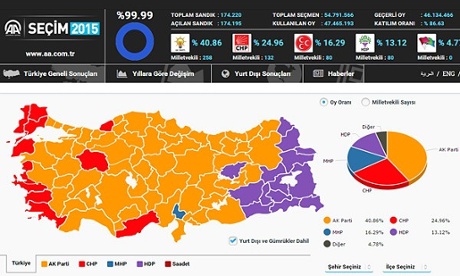
With almost all the votes counted, the Anadolu Agency, has a breakdown of the results. It shows the pro-Kurdish HDP party in fourth place in the share of the vote but with an equal number of seats as the third placed Nationalist MHP.
- AKP 40.86% of the vote and 258 deputies
- CHP 24.96% of the vote and 132 deputies
- MHP 16.29% of the vote and 80 deputies
- HDP 13.12% of the vote and 80 deputies
Updated
MHP calls for early elections if coalition talks fail

Devlet Bahçeli, the leader of the Nationalist MHP party and the man being seen as the kingmaker in any future government, has called for fresh election if Erdogan’s AKP is unable to agree a coalition.
Today’s Zaman quoted him saying
“The first possibility for a coalition should be between the AK Party and [pro-Kurdish Peoples’ Democratic Party] HDP. The second model can consist of AKP, [main opposition Republican People’s Party] CHP and HDP.
“If all these scenarios fail, then early elections must be held.”
European Union welcomes pluralist outcome
The European Union has pointedly welcomed the uncertain outcome of the election as a “clear sign of strength of the Turkish democracy”.
A joint statement by Federica Mogherini, high representative for Foreign Affairs and Johannes Hahn commissioner for European Enlargement, suggested great relief in Brussels that Turks have blocked Erdogan’s power-grabbing ambitious.
It said:
Turkey’s general election on 7 June took place with a record 86% turn out, a clear sign of strength of the Turkish democracy. The fact that all major political parties obtained representation in the new parliament is particularly important.
We look forward to hearing the OSCE/ODIHR’s preliminary findings and conclusions.
We now look forward to the swift formation of a new parliament and government, and to working together closely. The coming period offers opportunities for further strengthening the EU-Turkey relationship and to advance in broadening EU-Turkey cooperation in all fields, for the benefit of all our citizens.
In other words if Turkey wants to join the EU it will have to respect the result of the poll and ditch the super presidency idea.

Updated
The International Crisis Group analysts, Nigar Göksel and Hugh Pope, identify five takeaways from the election for Politico:
- After 12 years in power, the tide has turned against Erdoğan
- Democracy works, even for Kurds
- The result may well help efforts to end Turkey’s PKK insurgency
- Politics are going to be uncertain in Turkey for a while
- Turkey is not going back to the bad old days of the 1970s or 1990s
On that last point it ends with an optimistic note:
Things may not be so bad as Turkey finds a new normal. Turkish society is now more mature, compromising and accepting than in previous eras that were ended by military coups or plagued by ideological intolerance. Pluralism is now appreciated as necessary, a fundamental change of which the AKP, in its early years, was an integral part.
Ironically, it was also Erdoğan’s increasing intolerance of dissent, epitomized in the crushing of the Gezi protests in Istanbul in May-June 2013, that created a sense of solidarity between many normally fractious factions of Turkish society — nationalists, Islamists, Kurds, secularists, and liberals — that set the stage for much of the activism that persuaded Turks to vote against him on Sunday.
With 99% of the ballots counted Hurriyet has a helpful pie chart on the share of the vote.
As 99% votes counted in #TurkeyElections, nationalist #MHP rules out any coalition http://t.co/yaf6Kc1CFZ pic.twitter.com/G6wAwasAbJ
— Hurriyet Daily News (@HDNER) June 7, 2015
Hurriyet commentator Serkan Demirtas sees a deal between the AKP and the Nationalist MHP as the most likely scenario, but this could fall short of a formal coalition:
Therefore, a very critical period of 45 days will await us in which the ruling party has to conduct tough negotiations with a potential partner. Among the three oppositional parties, the AKP’s likely partner seems to be the Nationalist Movement Party (MHP). Both the Republican People’s Party (CHP) and the pro-Kurdish Peoples’ Democratic Party (HDP) have already declared that they won’t enter any partnership with the AKP in the government.
In this regard, [Prime Minister] Davutoğlu could launch a negotiation process with MHP leader Devlet Bahçeli, but a coalition protocol will not be easy given the latter’s strong opposition to Erdoğan’s interventions in governmental affairs. For example, it would be a huge concession on Bahçeli’s part if he agrees to go to the grandiose presidential palace to attend a cabinet meeting under Erdoğan’s leadership.
One option is that the MHP could support a minority government to be formed by the AKP on strict conditions and with the prospect of taking the country to early polls.
The Wall Street Journal’s Joe Parkinson describes’s the MHP’s leader Devlet Bahçeli as the “kingmaker”.
Kurds were biggest winners last night,but right now it looks like their nemesis Devlet Bahceli is coalition kingmaker pic.twitter.com/m1Dp3VvlWx
— Joe Parkinson (@JoeWSJ) June 8, 2015

Bloomberg has a helpful guide to what could happen next over the coming weeks. It examines five possible scenarios.
- Another election
- AKP minority government (the most likely)
- AKP coalition with the Nationalist Action party
- AKP coalition with the pro-Kurdish Peoples’ Democratic party (HDP)
- Other coalitions
Although the Erdoğan’s AKP emerged as the largest party the election result is being seen as a clear rejection of his plans to change the constitution to the create an executive presidency.
Yusuf Kanli, Hurriyet columnist, wrote:
The election was not a referendum on a super-presidency. But the Turkish people shouted strongly enough for everyone to hear: We do not want a presidential system. We do not want dictatorship. We want reconciliation. we want tolerance.
Writer and commentator Mustafa Akyol agreed:
There is only one code word for the setback of AKP and Erdogan: Arrogance. Not everybody loves it.
— Mustafa Akyol (@AkyolinEnglish) June 8, 2015
The FT looks ahead to possible clashes ahead between the president and parliament:
The election signified a national rebuff to Mr Erdogan’s ambitions, a new era of political and perhaps economic uncertainty and, according to many commentators, a return to checks and balances in a political system that had increasingly been characterised as authoritarian.
“The majority of the Turkish electorate evidently chose the uncertainty inherent to parliamentary coalition politics over President Erdogan’s vision of a strong presidential system,” said Francis Ricciardone, a former US ambassador to Turkey now at the Atlantic Council, a think-tank.
The result was in line with many pre-election polls. But so dramatically has it changed Turkey’s political landscape that it came all the same as a shock.
Mr Erdogan’s plans for a formal presidential system now seem the stuff of history — but his powers as president remain formidable and clashes between president and parliament are far from unlikely.
Many commentators also forecast a period of infighting within the AKP. Amid economic slowdown, corruption scandals and controversy about Mr Erdogan, the ruling party has seen its vote slump nine points from almost 50 per cent at the last general election. It is due to hold a congress this autumn, a gathering that could select a replacement for Prime Minister Ahmet Davutoglu, the handpicked successor with whom Mr Erdogan has been increasingly at odds.
One possible contender is Abdullah Gul, Mr Erdogan’s predecessor as president, who has made no secret of his ambition to lead the party and has set out differences with Mr Erdogan across the range of policy, most notably on the presidential system. “This may be the moment when we see what kind of mettle Gul has,” said Soli Ozel at Kadir Has university in Istanbul.
Summary

Turkey has woken up to an uncertain political future as the country’s main parties grapple with how to form a majority government. Here is what we know so far since Sunday’s elections:
- With the incumbent Justice and Development Party (AK Party) losing their majority, the country faces possible weeks of difficult coalition negotiations between reluctant opposition parties
- Should the sides fail to form a coalition, new elections are a real possibility and by law could be called any time 45 days from now
- Although seen as the most likely candidate for a coalition with the AK Party, the far-right Nationalist Movement Party (MHP) has ruled out that prospect, as did the pro-Kurdish People’s Democratic Party (HDP)
- AK Party deputy and head of the parliamentary constitution commission Burhan Kuzu called snap elections “inevitable” and blamed election deadlock on the “weakness of the parliamentary system”
- Unofficial results from the elections in Turkey show a total of 96 female parliamentarians securing seats in the Turkish Grand National Assembly – a record high and up from 79 in 2011
99.99% of the 47m votes cast have now been counted. According to current projections, of the 550-seats in the Turkish parliament:
- Justice and Development Party (AKP) will take 258 seats (winning 41% of votes)
- Republican People’s Party (CHP) 132 seats (25% of votes)
- Nationalist Movement Party (MHP) 80 seats (16.5% of votes)
- Peoples’ Democratic party (HDP) 80 seats (13% of votes)
Monica Tan signing off from this blog with my colleague Matthew Weaver taking over.
Updated
As 9am Monday hits Turkey and a new day begins, The Guardian’s reporter in Istanbul, Constanze Letsch, has said pro-government newspapers, including conservative Turkish newspaper Yeni Safak, are calling for early elections.
AK Party deputy and head of the parliamentary constitution commission Burhan Kuzu also called snap elections “inevitable”. He told BBC Türkçe:
No government will emerge from this scenario. Not even a coalition ... early elections look inevitable.
He added that the election results reflected the “weakness of the parliamentary system”.
The parliamentary system is a curse for the whole world. In Turkey only majority governments ever worked, coalitions always destroyed it.
Kuzu said the only solution would be an executive presidency.
We took a look at how overseas Turkish diasporas voted, but how did each province within the country vote? Turkey’s English-language Hürriyet Daily News has a map featuring the election results by province.
10 minutes that shook AKP #TurkeyElections http://t.co/KlsF5yno9J pic.twitter.com/MIayBsXU7e
— Hurriyet Daily News (@HDNER) June 7, 2015
No surprise, the pro-Kurdish Peoples’ Democratic party (HDP) was most popular on the eastern side of the country, where the majority of Turkey’s Kurdish population resides.
The centre of the country was dominated by the incumbent Justice and Development Party (AK Party), including in Istanbul, the largest city in Turkey, and the capital Ankara.
The western part of the country largely voted for the social-democratic Republican People’s Party (CHP). Voting for the far-right Nationalist Movement Party (MHP) was particularly strong in the southern city of Osmaniye.
Updated
This fascinating breakdown shows how Turkish people living abroad voted in the Sunday election. These statistics were compiled by the state-run Anadolu Agency.
Here you can look up how Turkish citizens in countries outside of #Turkey voted http://t.co/nCWbRAh4yO #Turkey pic.twitter.com/fMB6CHnWMJ
— Mathieu von Rohr (@mathieuvonrohr) June 7, 2015
Here’s the final tally and some of the countries in which these overseas diasporas are located that proved popular with each party:
- AK Party 49.91% (Australia, France and Algeria)
- HDP 20.42% (United Kingdom, Italy and Canada)
- CHP 17.02% (Russia, United States and China)
- MHP 9.24% (Albania)
- Other 3.41%
Compared to votes within Turkey, the AK Party (41%) was more popular overseas, as was the HDP (13%). Less popular was the CHP (25%) and MHP (16%).
Updated
Unofficial results from the elections in Turkey show a total of 96 female parliamentarians securing seats in the Turkish Grand National Assembly – a record high and up from 79 in 2011.
According to state-run Anadolu Agency, this was largely driven by the successful debut of progressive party HDP or Peoples’ Democratic Party. Much has been made of HDP’s pro-women platform, which was reflected in its 31 female MPs winning seats. Another 48 male MPs took out seats for the party.
HDP’s successful female MPs include Dilek Öcalan, niece of Kurdistan Workers’ Party (PKK) leader Abdullah Öcalan.
Dilek Öcalan Meclis'e girdi http://t.co/lNcAf5Rmn6 pic.twitter.com/Z4xkK4CtV3
— Sabah Gazetesi (@Sabah) June 7, 2015
The Justice and Development Party (AK Party) are sending 41 women into parliament (out of 258), five less than the 2011 election, becoming the only party to see a drop in their total number of female MPs.
The Republican People’s Party (CHP) increased their number of female delegates by one, bringing its total to 20 (out of 132).
The Nationalist Movement Party (MHP) also added one woman to their list, bringing the total to four (out of 81).

With pro-Kurdish party HDP or Peoples’ Democratic party, set to make a successful debut into parliament, there were celebrations on the streets of Kurdish city Diyarbakir.
Our reporter Constanze Letsch in Istanbul, along with wires, gathered responses from those celebrating well into the night:
‘This result shows that this country has had enough. Enough of Erdoğan and his anger,’ said Seyran Demir, a 47-year-old housewife who was among the thousands who gathered in the streets around the HDP’s provincial headquarters. ‘I am so full of joy that I can’t speak properly.’
‘I am so happy,’ said Bülent Aras, 40. ‘This means that there will be peace, the war is over. This party represents everyone. We will finally all be equal in Turkey. This will put an end to the corruption.’
‘The reason the HDP has won this many votes is because it has not excluded any members of this country, unlike our current rulers,’ said 25-year-old Siar Senci. ‘It has embraced all languages, all ethnicities and members of all faiths and promised them freedom.’
‘We have waited for this day for years. During those dark times, I wondered if I could see Turks and Kurds living in solidarity in my own lifetime. Thank God it happened,’ said 63-year-old Ersin Ates. ‘Now we don’t want another single bullet to be shot. Our fight will continue in the parliament.’
On Friday, two bombs exploded at an election rally in Diyarbakir, killing three and wounding hundreds of others.


The question now gripping Turkey is how a majority government will be formed. We could be facing weeks of difficult coalition negotiations between reluctant opposition parties.
Should the sides fail to form a coalition, new elections are a real possibility and by law could be called any time 45 days from now, reports AFP.
Although seen as the most likely candidate for a coalition with the Justice and Development Party (AKP), the far-right Nationalist Movement Party (MHP) has ruled out that prospect.
According to the state-run Anadolu Agency, party leader Devlet Bahceli said they are “ready to be a main opposition party in a possible AK Party-CHP-HDP coalition” during a delivery from MHP headquarters in Ankara early Monday.
“Nobody has a right to drag Turkey into [AK Party] minority and some circles’ scenarios,” said Bahceli. “Snap election will happen whenever it will happen.”
Selahattin Demirtas, leader of the pro-Kurdish People’s Democratic Party (HDP), quickly ruled out a coalition with the AKP after the election results and instead said the HDP would make a “strong and honest opposition”.
Updated

AFP has more on Selahattin Demirtas, the 42-year-old leader of Turkey’s new progressive party.
Demirtas is the second-born in a family of seven children and came to understand the full meaning of having a Kurdish identity during a formative experience in his teens:
He became aware of his Kurdish identity at the age of 15 after he attended a funeral of a prominent politician who is believed to have been murdered by security forces in Diyarbakir, Turkey’s main Kurdish-majority city.
“This was when I learnt what it meant to be a Kurd,” he told Turkish media in an interview last year.
Eight people died at the funeral when unidentified gunmen opened fire on mourners.
After completing his studies at the prestigious Ankara University, Demirtas worked as a human-rights lawyer in Diyarbakir before going into politics in 2007.
He has “sought to project a wholesome family image” throughout the campaign, frequently appearing in public with his wife Basak, a teacher, and their two daughters.
In May, he and his family appeared in an election-themed television show on a private Turkish channel in which Demirtas prepared a leisurely Turkish breakfast from scratch at his home in Diyarbakir.
“Breakfast is the only time we truly enjoy each other’s company. After that everyone goes to either school or work,” he said.
Updated

Is this the face of changing politics in Turkey?
Leader of the country’s pro-Kurdish party Selahattin Demirtas –known as “Selocan” (my darling Selo) by his supporters – has transformed the HDP into a mainstream liberal party.
The 42-year-old’s statesmanship has been on show throughout the campaign. According to the AFP:
Demirtas has been the target of fierce campaign attacks by Erdogan, who belittled him a “pretty boy” who is merely a front for the outlawed separatist Kurdistan Workers Party (PKK).
Erdogan also called Demirtas an “infidel” after he pledged to abolish the government directorate of religious affairs and likened him to a “pop star” because he plays the saz, a Turkish folk lute.
But Demirtas responded to those barbs with trademark serenity, challenging Erdogan by saying: “We, as the HDP, will transform the lion in your heart to a kitten.”
Demirtas, who is Kurdish and was born in the Kurdish-majority southeastern city of Elazig, broadened the appeal of his party to include secular Turks, women and members of the LGBTIQ community.

According to official projections, of the 550-seats in the Turkish parliament:
- Justice and Development Party (AKP) will have 258 seats
- Republican People’s Party (CHP) will have 132 seats
- Nationalist Movement Party (MHP) will have 81 seats
- Peoples’ Democratic party (HDP) will have 79 seats
Speaking from the balcony of AKP headquarters in Ankara – the traditional place for the party’s victory speeches – prime minister and party leader Ahmet Davutoğlu sought to put a brave face on the results.
According to AFP reports, he said:
The winner of the election is again the AKP, there’s no doubt ... Our people’s decision is final. It’s above everything and we will act in line with it.
The results wreck president Recep Tayyip Erdoğan’s dream of switching Turkey from a parliamentary to presidential system that he made a fundamental issue in the campaign.
Such a change would have required a two-thirds majority in the parliament.
Updated

Exciting times for Turkey’s new progressive party the Peoples’ Democratic Party, or HDP.
Their charismatic leader Selahattin Demirtas has been dubbed the “Kurdish Obama” for his silky rhetorical skills and was repeatedly attacked by Turkish president Recep Tayyip Erdoğan throughout the campaign.
At a news conference in Istanbul, Demirtas said the HDP would make a “strong and honest opposition”, AFP is reporting.
We, as the oppressed people of Turkey who want justice, peace and freedom, have achieved a tremendous victory today.
Now the HDP is a real party of Turkey. HDP is Turkey and Turkey is HDP.
Throughout the campaign, HDP sought to present itself as a genuinely Turkish party and expand its voters beyond the main Kurdish support base to include women, as well as lesbian, gay, bisexual and transgender people.
Updated
With 99.9% of votes counted here are the latest election results:
- 41% Justice and Development Party (AKP)
- 25% Republican People’s Party (CHP)
- 16.5% Nationalist Movement Party (MHP)
- 13% Peoples’ Democratic party (HDP)
Voting turnout stood at 86%.
Ruling party AKP may have the biggest share of the vote, but the results represent a significant drop on the nearly 50% it recorded in the previous 2011 polls.
Recep Tayyip Erdoğan has been president of Turkey since last August, following a triple term as prime minister. As head of state he is required to keep an equal distance from all parties, making his heavy involvement in the campaign in favour of the AKP controversial.
Our reporter Constanze Letsch in Istanbul said the election remained “a referendum on whether to endow his office with extraordinary powers that would significantly change Turkish democracy and prolong his reign as the country’s most powerful politician”.
With the election results pointing at a significant portion of the country disapproving of such a proposal, the party will have to make some tough decisions.
In May, Turkish prime minister Ahmet Davutoğlu offered to stand down if he could not deliver a ruling majority for his party. But in his immediate reaction to the results Davutoğlu gave no hint of any resignation, simply saying:
God willing, the people’s decision is the most righteous one.
Updated
Supporters of the pro-Kurdish Peoples’ Democratic party (HDP) fill the streets after passing Turkey’s 10% voting threshold.
Thousands of Kurds celebrated in the city of Diyarbakir on Sunday, setting off fireworks upon hearing the news that the party was likely to be represented in the Turkish parliament for the first time.

Our reporter Constanze Letsch is in Istanbul and described the atmosphere outside the AKP’s headquarters in Ankara as “muted”.
Several hundred supporters chanted for Erdoğan, the party’s founder, but there was little sign of the huge crowds that gathered after past election victories.
By contrast, thousands of jubilant Kurds flooded the streets of the south-eastern city of Diyarbakir as the results came in.
Erdoğan had repeatedly lashed out at the HDP and its charismatic leader, Selahattin Demirtaş, before the election. Demirtaş promptly ruled out a coalition with the AKP.
“This result shows that this country has had enough. Enough of Erdoğan and his anger,” said Seyran Demir, a 47-year-old housewife who was among the thousands who gathered in the streets around the HDP’s provincial headquarters. “I am so full of joy that I can’t speak properly.”
In Istanbul, enthused crowds chanted “we are the HDP, we will be in parliament” outside the press conference Demirtaş held in Istanbul on Sunday night.
More photos of the Turkish election and Sunday evening celebrations.
Updated
Welcome to the Guardian’s live blog of the Turkey election 2015. It is almost 3am on Monday in Turkey and nearly all the votes have been counted.
Turkey’s president, Recep Tayyip Erdoğan, appears to have suffered his biggest setback in 13 years of amassing power. The governing Justice and Development party, or AKP, has been denied a parliamentary majority for the first time since 2002.
The breakout star of the election has been the HDP or Peoples’ Democratic party, largely representing the Kurds but also running on a platform defending the rights of ethnic minorities, women and lesbian, gay, bisexual and transgender people. They look set to take more than 12% of the vote.
Here’s what we know so far:
- With 98% of all votes counted, the AKP secured 41% of the vote, followed by the main opposition Republican People’s party (CHP) at 25%, the Nationalist Movement party (MHP) on 16.5% and the HDP fourth on a surprise 12.5%.
- The AKP will be forced to negotiate a coalition, probably with extreme nationalists, or call a fresh election if no parliamentary majority can be secured within six weeks.
- Erdoğan had hoped for a crushing victory for the Justice and Development party he founded, allowing it to change the constitution and give him broad executive powers.
- The HDP said initial results from Sunday’s election showed it would take 80 of 550 seats and surpass the steep 10% threshold for entering the Turkish parliament.
- On Friday bombs tore through a HDP rally in Diyarbakir, killing two and wounding at least 200.
More updates as they come.
Updated